
July 2008
abstract
Responsabilité & Environnement
Emerging infections
Issue editor:
Benoît LESAFFRE
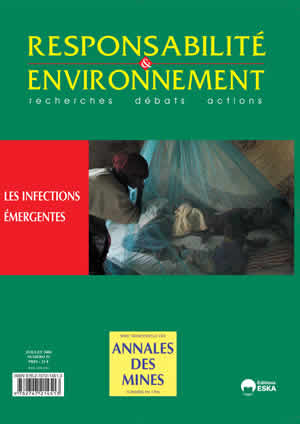
Issue 51
Editorial
By François Valérian
Inventory and issues
Emerging diseases: Illusion or reality?
By Yves Coquin and Jacques Chemardin
Direction générale de la santé
The frequent implication of new (or transformed) pathogens, the unexpected occurrence of something unpredictable, the existence of an animal host or vector (an independent variable with its own “logic”), the seriousness of the disease, its economic and social impact, human reactions (technological or behavioral) — these often overlapping factors account for the outbreak of a new illness or the resurgence of a familiar one.
The causes underlying the emergence of disease agents
By le professeur Didier Raoult
Université Aix-Marseille
Three phenomena come into play in the outbreak of new illnesses: knowledge of the causes, the “globalization” of disease agents and of their vectors (mosquitos, ticks, etc.), and the variability of microbes.
The risks of food infections
By Catherine Bouvier-Blaizot
Inspectrice générale de la santé publique vétérinaire Conseil Général de l'Agriculture, de l'Alimentation et des Espaces Ruraux (CGAAER)
The fight against disease agents has not yet reached an end; new ones will always crop up. Their incidence will be limited thanks to: a stability in health and social policies, a continuity in decision-making, the transparency and facility of relations between local and centralized authorities, scientific and technical know-how and the determination to increase it, the improvement of working conditions, and cooperation inside national as well as international networks.
The media’s power and a major health emergency
By Benoît LESAFFRE
Ingénieur général des eaux et forêts
and François VALÉRIAN
Rédacteur en chef des Annales des Mines
According to this former cabinet member, a major health emergency is inevitable, and our Internet society with its rumors and media is much less prepared than during a more authoritarian era. A crisis will entail a frenetic quest for information, and we will have to be courageous enough to accept information that contradicts ideologies, doctrines and standard procedures.
Will the changing climate affect infectious diseases?
By François Rodhain
Professeur honoraire à l'Institut Pasteur
Improving the population’s health has always been a priority used to justify development programs. Nowadays, development, by altering the climate, seriously threatens health. It is necessary to reduce the effects of the underway climate change and find the means for adapting as best possible thanks to a specifically human quality: cultural adaptability. The question of infectious diseases must be placed in its general — bioclimatic, socioeconomic and political — setting.
Knowledge, surveillance and alerts
The history and relevancy of the Pasteur Institute’s international network
By Maxime Schwartz
Institut Pasteur
There is no equivalent in the world to the creation, maintenance and extension of the Pasteur Institute’s network. Why? In the beginning, Louis Pasteur’s prestige sufficed to explain why the first establishments were set up. Since their motivation was to render service to the host country, the establishments in this network have continued operations regardless of political circumstances.
Simulating outbreaks of emerging diseases: Chikungunya fever and influenza
By Pierre-Yves Boëlle
Ingénieur civil des Mines de Paris, INSERM U707
For the first time in history, the possibility exists of controlling epidemics at the source if the necessary means are used, as proven by the SARS outbreak (Severe Acute Respiratory Syndrome). However this possibility should not be interpreted as a warrant of success. It turned out to be rather easy to control SARS by isolating patients — an action that would not be possible during a flu pandemia. Interventions have to be based on epidemiological studies grounded on ever improved observations.
Ecosystems, entomology and the fight against disease vectors
By Didier Fontenille
Directeur de recherche, entomologiste médical Institut de Recherche pour le Développement, UR 016, Caractérisation et contrôle des populations de vecteurs - Monpellier
As experience has proven, controlling illnesses borne by vectors is seldom achieved through a single approach, whether by fighting against the vectors, their hosts or pathogenic agents. Only an integrated approach is realistic. New knowledge and technology provide us with exceptional opportunities for making a great leap forward in coping with targeted vectors in a way that respects the environment and is accepted by the population.
Actions in the field and recent lessons
Chikungunya fever: Looking back on a surprising epidemic and its management
By Evelyne Falip, Marie Bâville, Bernard Faliu and Yves Coquin
Direction générale de la santé
No one can remain indifferent to the fact that, despite the efforts and means used, more than a third of the population on the islands of Reunion and Mayotte contracted Chikungunya fever in less than two years. It was probably impossible to fend off the epidemic, since several key factors related to this disease, its pathogenic agent and vector came to be understood only afterwards. As a retrospective analysis shows, health authorities were able— even though the means devoted to fight against the vector decreased over time — to organize to cope with the epidemic and draw the lessons from it.
The Chikungunya fever epidemic in the Indian Ocean, 2005-2006: The first lessons
By Antoine Flahault
Directeur de l'Ecole des Hautes Etudes en Santé Publique Rennes et Paris
In February 2006, the French prime minister decided to set up a multidisciplinary unit of scientists, headed by the author of this article, from various disciplines (clinicians, virologists, immunologists, statisticians, epidemiologists, sociologists, entomologists, veterinaries) for coordinating research on Chikungunya fever in Reunion and Mayotte. This task force’s assignment was later broadened to cover dengue in the French Antilles and Guiana. An initial assessment is presented herein with the first lessons to be learned from the Chikungunya epidemic that struck nearly 40% of the population on the two islands and killed 248 people: one death per thousand cases.
Emerging animal diseases in the tropics: The unexpected impact of avian influenza
By Emmanuel Camus
Directeur régional du Cirad pour le Languedoc-Roussillon
and Renaud Lancelot
Coordinateur du projet EDEN, Cirad
National and international veterinary services have learned from the health crisis and economic problems caused by bird flu and its risk of reaching pandemic proportions. They have carried the day by imposing the idea of a global approach to animal health.
The modified International Health Regulations
By Guénaël Rodier
Directeur du Programme de Coordination du Règlement Sanitaire International, Organisation mondiale de la Santé
The future of International Health Regulations and, consequently, of international health safety now depends on the ability of countries to pursue, with WHO’s technical support, the mobilization that made the overhaul of the IHR possible.
Plan for continuing activities (PCA) in case of an influenza outbreak
By Laurence Breton-Kueny
PhD, Directrice des Ressources Humaines AFNOR Groupe
and Docteur Sandrine Segovia-Kueny
Ministère de l'écologie, de l'énergie, du développement durable et de l'aménagement du territoire
All organizations must be prepared to carry on with their activities and protect wage-earners during an influenza epidemic. The organization’s or firm’s sense of social responsibility, its ethics and the continuity of its economic activities are at stake. Information is now available in printed material and through work groups, such as the French PCA club.