July 2011
abstract
Responsabilité & Environnement
L'eau potable
Issue editor:
Rémi GUILLET
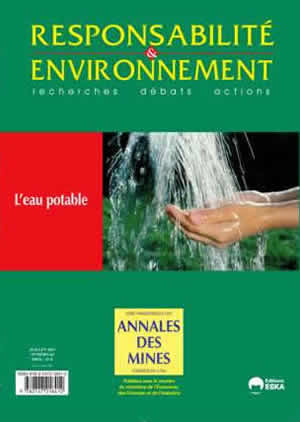
Issue 63
Editorial
By Pierre COUVEINHES
Rédacteur en chef des Annales des Mines
Part 1 — The distribution of drinking water at the start of the 21st century
The necessary rationalization of the authorities that organize the water supply in France
By Sylvain ROTILLON
Chef de projet Services publics de l’eau et de l’assainissement ONEMA
What characterizes the organization of the water supply in France is a historical legacy of splintered services and utilities. This organization has turned out to be inadequate for exercising the important assignments of producing, transporting and distributing water at the scale of communes. The pooling of services among communes, which started in the 19th century, has not provided a solution for simplifying a quite complicated organization. The “territorial reform” under way might represent a new stage in rationalizing the organization of water utilities. But will it meet up to expectations?
Organizing the distribution of drinking water: A few remarks about European benchmarks
By Mathias GALERNE
This overview of a study conducted in the spring of 2010 under the auspices of the Office National de l’Eau and des Milieux Aquatiques (ONEMA) analyzes the regulation of public water utilities and of water purification procedures in four European lands (England-Wales, Portugal, Netherlands and Denmark). Their results and common points are described.
Distributing drinking water: The situation in developing countries
By Ghislain de MARSILY
Professeur émérite à l’Université Paris VI et à l’Ecole des Mines de Paris, Membre des Académies des Sciences et des Technologies
and Jacques BERTRAND
Président d’AquaOrbi – Président du Comité Stratégique de la Chaire « Suez Environnement Eau pour tous » de ParisTech
Will everyone someday be able to draw drinking water from a faucet — in Africa and, more widely, in all developing countries? For those who already enjoy this privilege, when will water flow without interruption from their faucets? When will it be safe to drink? When will cities be equipped with adequate purification stations? It is a proven fact that drinking water alone — without purification and without education in hygiene — does little to improve the population’s state of health. Answering these questions boils down to answering a single one: how to fight against the “durable” underdevelopment of the water supply given that this topic has figured on the agenda for more than thirty years? Furthermore, there is a massive urbanization trend in these countries, and most of the newcomers in cities will, as we know, be living in shanty towns.
Part 2 — The quality of the distributed water supply
Drinking water in France: Preventing and managing health risks
By Béatrice JÉDOR, Bérengère LEDUNOIS, Aurélie THOUET
Les trois auteurs de cet article sont ingénieurs du génie sanitaire en fonction au Bureau de la Qualité des eaux, Sous-direction de la Prévention des risques liés à l’environnement et à l’alimentation, Direction générale de l a Santé, Ministère du Travail, de l’Emploi et de la Santé
Bringing the health risks related to the production and distribution of drinking water under control requires constant vigilance. The provisions for preventing and managing these risks in France’s Public Health Code stipulate strict, stringent procedures based on principles for analyzing and controlling risks from the source to the faucet in the consumer’s home. An explanation…
The quality of drinking water in France: Results with a focus on a few parameters
By Laëtitia GUILLOTIN
Chef du bureau de la Qualité des eaux, Sous-direction de la prévention des risques liés à l’environnement et à l’alimentation, Direction générale de la Santé, Ministère du Travail, de l’Emploi et de la Santé
Béatrice JÉDOR
Ingénieur du génie sanitaire, Bureau de la Qualité des eaux, Sous-direction de la prévention des risques liés à l’environnement et à l’alimentation, Direction générale de la Santé, Ministère du Travail, de l’Emploi et de la Santé
and Charles SAOUT
Adjoint à la sous-directrice de la prévention des risques liés à l’environnement et à l’alimentation, Direction générale de la Santé, Ministère du Travail, de l’Emploi et de la Santé
Sanitary controls (piloted by regional health agencies) include a program for analyzing water from the source to household spigots. For this purpose, more than ten million parameters are analyzed every year in France. The results are discussed along with data about the quality of the water supply as measured through the presence of nitrates, pesticides and lead and by microbiological and radiological parameters.
ANSES, an operator in safe water for human consumption in France
By Pascale PANETIER
Chef d’unité - Anses - Direction de l’évaluation - Unité d’évaluation des risques liés à l’eau
Morgane BACHELOT, Thomas CARTIER, Juliette HOSPITALIER-RIVILLON, Eléonore NEY
Coordonnateurs scientifiques en évaluation des risques liés à l’eau Anses - Direction de l’évaluation - Unité d’évaluation des risques liés à l’eau
Anne NOVELLI
Adjoint au chef d’unité - Anses - Direction de l’évaluation Unité d’évaluation des risques liés à l’eau
and Gwenn VO VAN-REGNAULT
Coordonnateur scientifiquese n évaluation des risques liés à l’eau Anses - Direction de l’évaluation - Unité d’évaluation des risques liés à l’eau
The Agence Nationale de Sécurité Sanitaire de l’Alimentation, de l’Environnement et du Travail (ANSES) has come out of the merger on 1 July 2010 of AFSSA (Agence Française de Sécuritaire Sanitaire des Aliments) and AFSSET (Agence Française de Sécurité de l’Environnement et du Travail). By assuming the assignments of these two agencies, ANSES provides a multidisciplinary approach to health issues in food, environment and work safety. It offers a global view of the risks to which people are exposed through their lifestyles and consumption patterns and owing to the characteristics of their environment, including the workplace.
Can we rank the criteria used for the quality of drinking water?
By Philippe HARTEMANN
Professeur de Santé Publique – Université de Nancy, Département Environnement et Santé Publique Faculté de Médecine - INSERM U954 Nutrition Génétique et Exposition aux Risques environnementaux
The progress already accomplished shifts the limits of our methods of analysis. For instance, more and more unwanted molecules or microorganisms are detected in water, even after purification for drinking. The assessment of these risks and the application of the principle of prevention have always lain at the center of the work done by the authorities in charge of drafting regulations at the World Health Organization and at the national and EU levels. Scientific data have always been used in debates about the criteria for designing ever more accurate standards for drinking water. They also enter into discussions about possible exemptions and about the problems of applying compulsory criteria and technical specifications about water quality. Although the compulsory criteria related to quality are not ranked (since all of them are to be met), the parameters are ranked de facto since some of them do not entail a danger or risk sufficient for making them obligatory. Water safety plans contain procedures for assessing the dangers and risks so as to quantify the protection of water resources and the whole supply line.
Drinking water: How drinkable? The shift toward risk management
By Dominique GÂTEL
Président de la Commission Eau Potable de l’ASTEE (Association Scientifique et Technique de l’Eau et de l’Assainissement) Directeur technique délégué à l’eau potable chez Veolia Eau
The question of whether water is fit for drinking arises less in terms of whether unwanted substances are present (or absent) than in relation to the maximal values not to be exceeded. Improving the quality of drinking water depends very much on improving our analytical techniques. The wide variety, complexity and origins of contaminants (pesticides, medication, etc.) and the many ways they pass into the environment, not to mention their weak concentrations, make it difficult to design reliable data bases about their impact on the environment and, as a consequence, about the effectiveness of the treatments to be designed. The issues related to the quality of drinking water are both environmental and sanitary. By protecting human health, we also protect biodiversity. Although the reduction of risks is related to the purification of waste water, it depends, first and foremost, on efforts to reduce the quantity of contaminants at the origin, before they enter the purification system. Despite the progress already made, much remains to be done.
Part 3 — Drinking water, a tool for sustainable development
Conservation of the supply of drinking water: An objective and lever for protecting the quality of water
By Odile GAUTHIER
Ingénieur général des Mines, directrice de l’eau et de la biodiversité à la direction générale de l’aménagement, du logement et de la nature – Ministère de l’Ecologie, du Développement durable, des Transports et du Logement (DGALN- MEDDTL)
and Claire GRISEZ
Sous-directrice de la protection et de la gestion des ressources en eau et minérales à la direction de l’eau et de la biodiversité– Ministère de l’Ecologie, du Développement durable, des Transports et du Logement (MEDDTL)
Initial concern for the conservation of drinking water has led to a determination to conserve water in general, since the water for human consumption must be available in the necessary quantity and quality. This has entailed a shift from a public health approach to one based on the environment. A relation was established in 1975 at the European level between the quality of water resources and the actions for conserving them. From this perspective, France’s actions for conservation have mainly aimed at stimulating a change in farming practices and have targeted high-stake areas, such as catchment basins.
Protecting underground water: Examples of actions related to agriculture conducted by Eau de Paris
By Manon ZAKEOSSIAN
Eau de Paris – Direction des Eaux Souterraines
Since the sources of the Paris water supply are located in rural areas, their quality is mainly affected by contaminants from agriculture (nitrates and pesticides), which are more or less present depending on the aquifers. On the basis of an assessment of its actions since the early 1990s, Eau de Paris, the Paris water utility, has developed pilot programs in agriculture for three strategic catchment basins: Voulzie, Vigne and the Vanne valley. The general objective is to limit the chemical input from farming by proposing a model for sustainable agriculture. Each of these programs is adapted to the local area. They provide advice and a financial stimulus to farmers. An assessment of farmers’ participation in these programs in these three areas is encouraging.
The sustainable management of water resources: Using a “payment for environmental services” to protect catchment basins
By Sarah HERNANDEZ
ONEMA, DAST, Vincennes
and Marc BENOÎT
INRA, SAD, UR Aster, 88500 Mirecourt
Proof of the interdependence between business and the environmental benefits of maintaining water resources in a good state has led to a shift from an individualized management of water (The user acts in pursuit of his own goals and interests) to a collective management with the aim of reaping global benefits from the maintenance (or supply) of one or more “environmental services”. The use of market mechanisms, such as the “payment pour environmental services” (PSE), is intended to encourage a decision-making that is not just based on the economic value of these services (or the cost of losing them) but should also lead to forms of governance adapted to the environmental issues in each geographical area concerned. The PSE is a financial instrument for stimulating changes of behavior among those at the origin of environmental degradation. In France, a first experiment with the PSE (conducted by the mineral water company Vittel) has brought to light the needs and risks related to implementing this mechanism.
Using rainwater in buildings: The stakes in a practice to be developed
By Bernard de GOUVELLO
CSTB (Centre Scientifique et Technique du Bâtiment) / LEESU (Laboratoire Eau Environnement et Systèmes Urbains, Ecole des Ponts ParisTech)
Using rainwater for household purposes is developing in France. Regulations adopted in 2008 favor this trend, even though their interpretation by various stakeholders raises difficulties.
A lower consumption of drinking water and sustainable development
By Bernard BARRAQUÉ
Centre International de Recherche sur l’Environnement et le Développement (CIRED), Nogent-sur-Marne
Laure ISNARD
Centre International de Recherche sur l’Environnement et le Développement (CIRED), Nogent-sur-Marne
Marielle MONTGINOUL
Centre International de Recherche sur l’Environnement et le Développement (CIRED), Nogent-sur-Marne
Jean-Daniel RINAUDO
Cemagref, Montpellier
and Julien SOURIAU
BRGM, Montpellier
Since the 1990s, the volume of drinking water distributed in France has decreased. This trend, as well as the saving of water, is beneficial to the environment and presumably to consumers too, but it might not be such a good idea after all. In order to cover their costs (most of which are fixed), water utilities might be tempted to increase the price per cubic meter billed. Given this threat, we wonder whether it might not be time to completely reform public water utilities, in particular their financial operations, and to bring under question the network model of services by reorganizing these services at a level above the local one.
Tap water: Quality and consumer confidence
By Marillys MACÉ
Directrice du Centre d’Information sur l’Eau (C.I.Eau).
According to the public opinion surveys conducted by C.I. Eau since 1995, the French are strongly attached to tap water: 86% of the persons polled trust the water supply. However consumers are lost with the information that, delivered by the mass media or through advertisements, conveys the idea that tap water is not as good as bottled water… especially when they learn that the latter comes from the same source as the water drawn from the faucet in their locality.
Drinking tap water: When reducing wastes goes in hand with sustainable development
By Wiebke WINKLER
Chargée de mission en charge de la Prévention des déchets au Centre national d’information indépendante sur les déchets (CNIID)
The Grenelle of the Environment, which assembled officials and organizations for a wide-ranging discussion of environmental issues in France, set the objective of reducing wastes by 25 kg/year per inhabitant by 2014. Drinking tap water instead of bottled water would, by itself, enable an inhabitant to meet up to 40% of this objective! Other arguments also weigh in favor of this everyday gesture. Drinking water from the faucet is a winning strategy for a genuine sustainable development.