April 2012
abstract
Responsabilité & Environnement
L'ACV (analyse du cycle de vie)
Issue editor:
Myriam MERAD et Rémi GUILLET
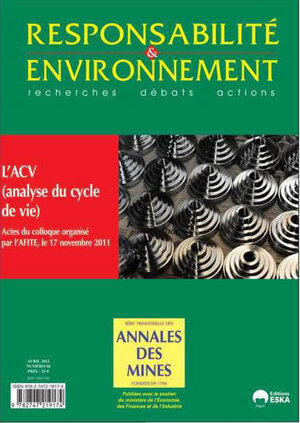
Issue 66
Editorial
By Pierre COUVEINHES
A - LCA’s place in sustainable development policies
Analyzing the life cycle: Public authorities’ viewpoint
By Dominique DRON
Commissaire générale au Développement durable, ministère de l’Ecologie, du Développement durable, des Transports et du Logement
A life-cycle assessment provides, above all, an overall view, based on multiple criteria, of the whole life cycle of products, whether goods or services. It relies on quantifying environmental impacts in functional units as a measure of the service or results obtained. The purpose is to make relevant comparisons among products, processes or services. LCA has gradually become a valuable tool whereby both private and public parties can undertake an environmental assessment for orienting and backing up the decisions they make.
Life-cycle assessment, a tool or drawback for a firm’s competitiveness?
By Sophie COSTEDOAT
Direction générale de la Compétitivité, de l’Industrie et des Services (DGCIS), ministère de l’Économie, des Finances et de l’Industrie
Taking account of the environment has become a full-fledged dimension in strategic corporate decisions. This calls for improving our understanding of how industrial activities affect the environment and human health. LCA is a tool that enables firms to better assess potential environmental impacts over the whole life cycle of their products or services, from cradle to grave. It should help manufacturers develop a green economy, what some pundits have called the third industrial revolution.
B - LCA: History, uses and prospects
Eco-efficiency, life-cycle analysis and eco-design: Interrelations, challenges and prospects
By Philippe SCHIESSER
Directeur et fondateur d’Ecoeff - Professeur associé à l’université de Cergy-Pontoise, - Président de l’Association des professionnels de l’éco-design et de l’éco-conception (Apedec)
Eco-efficiency (doing more with less), life-cycle analysis (assessing the environmental impact of products and services) and ecodesign (reckoning with the environment when designing goods and services) refer to goals and fields of intervention for managing the life-cycle of goods and services. This provides a framework both for experiments with labeling so as to make people more aware of this environmental impact and for the wide diffusion of LCA in the corporate world, where some firms have adopted it as a slogan for their sales campaigns. Although environmental assessments now represent an achievement rather than a drawback, they are still more widely used in public policy-making (Several European and French legal texts refer to them) than in industry or when designing the objects around us.
Analyzing the life cycle of a product or service: Applications and practices
By Philippe OSSET
Président de Solinnen S.A.S.
In November 2011, AFITE organized a symposium with the goal of helping environmental engineers appropriate and implement LCA. There is a growing need for this appropriation! Applications of LCA have been presented in L’analyse du cycle de vie d’un produit ou d’un service: Applications et mise en pratique . Other uses are emerging thanks to eco-labels in both France and the EU. The objective herein is to present an inventory of LCA practices and provide an introduction to “starters”, such as the AFITE engineers now discovering this approach. The key points made during the symposium are discussed and enlarged upon.
Environmental labels: Information for both consumers and manufacturers
By Christine CROS
Chef du Service Eco-conception Consommation durable – Agence de l’environnement et de la maîtrise de l’énergie (Ademe)
Products of current consumption will soon have to convey information about the impact that producing them has on the environment. Manufacturers will thus be able differentiate their products as a function of the decisions they made when designing them; and consumers will be able to exercise responsibility when choosing and purchasing products. How to develop the methodology for guaranteeing that the information on these labels can be compared?
Applying LCA to complex biotechnical systems: At the frontier of science?
By Véronique BELLON-MAUREL and Cécile BESSOU and Guillaume JUNQUA and Laurent LARDON and Eléonore LOISEAU and Catherine MACOMBE and Eva RISCH and Philippe ROUX
Irstea - UMR ITAP, Montpellier Supagro Cirad – Persyst EMA, LGEI Inra – LBE Irstea - UMR ITAP, Montpellier Supagro Irstea - UMR ITAP, Montpellier Supagro Irstea - UMR ITAP, Montpellier Supagro Irstea - UMR ITAP, Montpellier Supagro
During the past decade, LCA has become the methodological framework for quantitatively assessing the environmental impact of products or of a system of production. Even though LCA is already widely used in the economy (eco-design, corporate social responsibility, green labels), its tools are still a vast field of study for scientists. This frontier of science is described as well as the approach adopted by ELSA, a French pole of research.
The issues and perils of ecolabels
By le Docteur Jérôme PAYET
Directeur de Cycleco et Enseignant-chercheur à l’Ecole polytechnique de Lausanne (EPFL)
A key measure proposed by the Grenelle of the Environment, which assembled French officials and organizations for a wide-ranging discussion of environmental issues, was ecolabeling, which is now deeply changing communications about products for mass consumption. Its aim is to provide consumers with quantitative information about how products impact the environment over their whole life cycle. This information must enable consumers to use “environmental performance” as a criterion for making decisions about whether or not to purchase a product. In the firms with higher standards for this performance, ecolabels are no longer seen as a regulatory nuisance but as a competitive advantage in the long run.
C - Testimony from stakeholders: The uses and limits of LCA
Analyzing the life cycle of processes for recycyling used tires: Feedback from experience and added value
By Catherine CLAUZADE and Charlotte HUGREL and Magali PALLUAU and Philippe OSSET
Directeur du Développement d’Aliapur Experts en ACV, co-fondatrice de Bleu Safran Experts en ACV, co-fondatrice de Bleu Safran Expert en ACV, Président co-fondateur de Solinnen
Under the principle of the manufacturer’s “enlarged responsibility”, the parties that place products on the market have full or partial, financial and/or operational liability for managing their products at the end of the life cycle. The major organization in France that implements this obligation for tire manufacturers is Aliapur. Since it was set up, it has endeavored to support an industrial economy that creates environmental, economic and societal “value” — an economy shaped around the many potentials of recycling used and no longer usable tires. This takes on special importance given the increasing scarcity of raw materials.
Analyzing the life cycle of processes for recycyling used tires: Feedback from experience and added value
By Catherine CLAUZADE and Charlotte HUGREL and Magali PALLUAU and Philippe OSSET
Directeur du Développement d’Aliapur Experts en ACV, co-fondatrice de Bleu Safran Experts en ACV, co-fondatrice de Bleu Safran Expert en ACV, Président co-fondateur de Solinnen
Under the principle of the manufacturer’s “enlarged responsibility”, the parties that place products on the market have full or partial, financial and/or operational liability for managing their products at the end of the life cycle. The major organization in France that implements this obligation for tire manufacturers is Aliapur. Since it was set up, it has endeavored to support an industrial economy that creates environmental, economic and societal “value” — an economy shaped around the many potentials of recycling used and no longer usable tires. This takes on special importance given the increasing scarcity of raw materials.
Appendix: LCA and recycling worn-out products — Attribution of the environmental impacts of up- and downstream life cycles
By Philippe OSSET and Catherine CLAUZADE and Charlotte HUGREL and Magali PALLUAU
Expert en ACV, Président co-fondateur de Solinnen Experts en ACV, co-fondatrices de Bleu Safran
By applying the method set down in ISO standards 14040 and 14044, the environmental benefits can be quantified of reusing used tires, in particular for manufacturing new products, such as floor and ground coverings for use in sports. The methodological alternatives are presented for attributing the so-called benefits among a product’s many life cycles; and attention is paid to their implications for industry. These alternatives involve switching from an inventory analysis to calculations (which now seem better suited) that extend to the system’s boundaries.
An original approach to integrating ecodesign in the supply chain: CORINE, a European research projec
By Pierre GARÇON
Président d’EcoMundo, jeune entreprise de conseil en éco-conception et en développement de logiciels, partenaire du projet CORINE
European aeronautics is under mounting pressure from environmental regulations. The regulations Reach and RoHS on chemicals and DEEE on electrical and electronic equipment impose new obligations. CORINE’s objective with respect to the helicopter industry is to improve the latter’s environmental performance by orienting the choice of materials and processes from the initial phase of design onwards. CORINE also seeks to better integrate ecodesign throughout the industry’s supply chain by developing software in collaboration with buyers and suppliers. In this sense, small businesses are the core of this project.
Innovative solutions for reducing environmental footprints: Total’s Ecosolutions program
By Yves GERMAIN
Manager Gestion responsable des produits, Total Petrochemicals Research Feluy (Belgique)
Launched in 2009, Total’s Ecosolutions program calls for developing innovative products and services that consume less and/or have a lower impact on the environment. To bear this ecolabel, products or services with an equivalent result must present an environmental performance that is significantly higher than market standards. LCA lies at the center of Total’s evaluation of requests for this ecolabel.
The “Score LCA” research project: Objectives and organization
By Denis Le Boulch
Chercheur Expert, EDF R&D, Département Eco-Efficacité et Procédés Industriels et al.
Life-cycle assessment in firms
By Pierre-Marie GUINEHEUC
Efficient Innovation
This article presents feedback from the experience acquired during a program for stimulating and following up on the practices of small- and mid-sized businesses in the Midi-Pyrenées Region of France with regard to LCA and value analysis. This program, called “Sustainable development and eco-socio-conception, ‘Innovating differently’” was conducted under Christine Schoendorf from AGATE (Tarn Department). The firms involved wanted to implement LCA and eco-design so as to assess their environmental vulnerability and the opportunities opened to them.
Analyzing a product’s life cycle and protecting the environment: LCA’s pertinence and limits — an association’s viewpoint
By Pénélope VINCENT-SWEET
France Nature Environnement (FNE)
The battle for improving the awareness of how human activities impact the environment has been waged for a long time now. Tools have been designed for measuring this impact and making it intelligible: carbon footprints, “ecological rucksacks”… and LCA. The LCA studies published to date tend to present findings partial to the parties that commissioned them. LCA has improved, becoming more complicated, complex and expensive. It risks, therefore, becoming a tool that allows big firms to increase even more their advantage over small companies. Can we hope, sooner or later, for a neutral but efficient tool that will help with decision-making? First of all, questions having to do with governance and democracy must be settled, and then the LCA tools must be sharpened and put to relevant uses. Above all, LCA’s critical spirit must be preserved.
Analyzing a product’s life cycle and protecting the environment: LCA’s pertinence and limits — an association’s viewpoint
By Pénélope VINCENT-SWEET
France Nature Environnement (FNE)
The battle for improving the awareness of how human activities impact the environment has been waged for a long time now. Tools have been designed for measuring this impact and making it intelligible: carbon footprints, “ecological rucksacks”… and LCA. The LCA studies published to date tend to present findings partial to the parties that commissioned them. LCA has improved, becoming more complicated, complex and expensive. It risks, therefore, becoming a tool that allows big firms to increase even more their advantage over small companies. Can we hope, sooner or later, for a neutral but efficient tool that will help with decision-making? First of all, questions having to do with governance and democracy must be settled, and then the LCA tools must be sharpened and put to relevant uses. Above all, LCA’s critical spirit must be preserved.
Twenty years of life-cycle assessment: A user’s experience and thoughts
By Rémi GUILLET
Ingénieur général des Mines, Conseil général de l’Economie, de l’Industrie, de l’Energie et des Technologies (CGEIET) Inspecteur général de l’Environnement (CGEDD)
Engineers have always needed a single statistic that presents the immaterial contents of a unit of material, insofar as it has a pertinent parameter. LCA holds this promise. To its advantage when applied to waste management, LCA shows that the actual place of the phase corresponding to the end of a product’s life is often a small proportion of its global environmental cost. Manufacturing is usually the most important phase. Several examples are cited to show how necessary it is — if we want to avoid going astray or even making errors (too often left undetected) — to subject LCA’s findings to an evaluation by competent experts in the fields corresponding to a product’s life cycle from cradle to grave.