January 2014
abstract
Responsabilité & Environnement
Consommation et environnement : l'information des consommateurs sur l'impact environnemental des produits
Issue editor:
Nathalie HOMOBONO
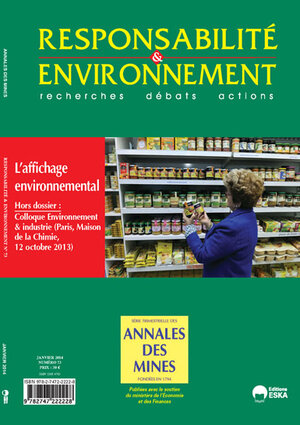
Issue 73
Editorial
By Pierre COUVEINHES
Rédacteur en Chef des Annales des Mines
A.The context
Changes in consumer expectations about environmentally friendly products
By Yvon MERLIÈRE
Directeur général du CRÉDOC (Centre de Recherche pour l’Étude et l’Observation des Conditions de vie)
The French are sensitive to environmental problems. The degree to which consumers rely on criteria related to sustainable development when making choices is, we notice, rising, whence the high proportion of persons buying “organic” products. Nonetheless, the French have trouble identifying ecofriendly or fair-trade products. Although significant progress can be observed in the consumption of water, much less headway has been made in transportation, heating and tourism. Virtuous behavior patterns are also emerging with respect to the “second life” of objects (second-hand or recycled goods, rentals, etc.). The current recession has attenuated consumer sensitivity to sustainable development. Pressure on the purchasing power of consumers has forced them to focus on the quality/price relationship, which might, or might not, coincide with ecofriendly consumption. French consumers are not yet ready to pay more for products with environmentally sound credentials.
Ecolabeling: When marketing washes green…
By Alain BAZOT
Président de l’UFC-Que Choisir
Ecolabeling provides information about the environmental impact of products over their full life-cycles. Its aim is to move beyond a single criterion toward an approach based on multiple criteria. For ecolabeling to function efficiently as a means of consumer information, a preliminary to generalizing it is to improve the accuracy of all “green” words used on labels. This entails tighter regulations and independent regulators.
The ecolabeling of current consumption goods: Conditions for success
By Blandine BARREAU
Chargée de mission au Commissariat général à la Stratégie et à la Prospective (CGSP)
and François VIELLIARD
Chargé de mission au Commissariat général à la Stratégie et à la Prospective (CGSP)
The French are quite aware of the importance of protecting the environment. The adoption of “green” consumption patterns is but nascent, mainly due to the lack of reliable, easy-to-understand information. Through the experimentation conducted by public authorities following the Grenelle meeting on the environment, the Commissariat Général à la Stratégie et à la Prospective (CGSP) has worked out several proposals for ecolabels on current consumption goods. Based on a study of French consumer behavior and on experiences in other lands, these proposals draw attention to the conditions that will make a marketing approach to ecolabeling successful.
B – Joint initiatives and experimentation
Conseil National de la Consommation (CNC): Joint initiatives from business and consumer organizations
By Loïc ARMAND
Ancien Président de la commission Consommation du MEDEF (Mouvement des Entreprises de France), président de l’Union des annonceurs (UDA) et président de L’Oréal France
and Franck AVIGNON
Juriste à la direction Droit de l’entreprise du MEDEF (Mouvement des Entreprises de France)
The National Consumer Council (CNC) serves as a sort of French parliament on issues related to consumption, since it brings together representatives of consumer and business organizations. Quite naturally therefore, it delivered an opinion on 9 July 2013 about experimentation in ecolabeling.
Experiments in ecolabeling in France: The context and results
By Jean-Paul ALBERTINI
Commissaire général au Développement durable (CGDD), ministère de l’Écologie, du Développement durable et de l’Énergie
Ecolabeling is a procedure for informing consumers about major aspects of the environmental impact of products placed on the market. Before generalizing it, experiments were conducted in France for a year starting on 1 July 2011. The context of these experiments is described, and the major results are presented.
Informing consumers about the environmental impact of products: The case of agribusiness
By Nathalie BÉRIOT
Directrice des Affaires scientifiques et réglementaires chez Nestlé
and Laura FARRANT
En charge des problématiques environnementales à l’ANIA (Association nationale des Industries alimentaires)
Consumers are showing ever more interest in the environmental impact of the goods they use. Given these rising expectations, the food industry has been active since 2009 in plans for drawing up a methodology to assess this impact in the case of food. The experimentation conducted between July 2011 and July 2012, in which firms from this sector participated, was a learning process for both companies and consumers. The goal is to eventually provide consumers with information that is relevant, standardized, reliable, understandable and controllable. Given the diversity and complexity of food products, several major issues have arisen, mainly related to the methods used for calculations and the availability of data.
Ecolabeling electrical and electronic goods
By Gérard SALOMMEZ
En sa qualité, lors de la rédaction de cet article, de Vice-président de la Fédération des industries électriques, électroniques et de communication (FIEEC), en charge de la branche « Biens de consommation durables »
For nearly twenty years now, the environmental characteristics of products have been a driving force in innovation for the makers of electrical and electronic goods. These manufacturers have developed procedures for ecodesign mainly based on analyzing a product’s lifecycle. The first EU directives, issued in 1992, focused on labels about the consumption of energy by appliances. Since then, ecolabeling has been oriented toward providing intelligible information about the environmental impact on the water supply, in terms of noise, etc. In branches of the economy where ecolabeling has been enforced for several years now, the market has been oriented toward better performing products with, as a consequence, a gradual improvement in the machines and appliances now in use. Manufacturers of electronic and electrical equipment have been very attentive to the experimentation with ecolabeling in France. Criticism of the methodology used raises questions about the reliability and intelligibility of the information intended for consumers. For the purpose of free and fair trading practices among all stakeholders, the FIEEC wants this discussion to be pursued at the EU level.
C – Methodology and prospects
A technical basis for ecolabeling products of mass consumption
By Virginie SCHWARZ
Ingénieur en chef des Mines, directrice générale déléguée de l’ADEME (Agence de l’environnement et de la maîtrise de l’énergie)
and Lydie OUGIER
Chef du Service Éco-conception et Consommation durable de l’ADEME (Agence de l’environnement et de la maîtrise de l’énergie)
Consumption is a major issue in public policy-making with regard to the environment. Several measures (in particular the August 2009 and July 2010 acts of parliament) have been adopted for more transparency in the information provided about the environmental characteristics of products. Under the law, this information has to be based on multiple criteria and related to the product’s life-cycle. Given this framework, ADEME has, at the government’s request and in association with all stakeholders, drawn up methods and a first battery of tools for a simplified, reliable calculation of the environmental footprints left by various consumer goods.
The EU’s actions in favor of “greener” products and the adoption of adequate communication about them
By Marie-Paule BENASSI
Chef d’unité à la direction générale de la Santé et des Consommateurs (DG SANCO) de la Commission européenne
What actions has the European Commission undertaken to help con sumers obtain reliable information for orienting their preferences toward products that are more environmentally sound while preventing unfair business practices based on groundless claims?
Miscellany
The Environment & Industry colloquium (Paris, Maison de la Chimie, 12 October 2013)
Ingénieur des mines
Miscellany The Environment & Industry colloquium (Paris, Maison de la Chimie, 12 October 2013) Under the auspices of Entreprises pour l’Environnement (EpE), INERIS and La Fabrique de l’Industrie, a colloquium, “Environment & industry”, was organized on 15 October 2013 at the Maison de la Chimie in Paris. The stated objective was to discuss the means for coping with environmental issues. Between the “green economy” and innovations, questions are ever more keenly arising about the role of firms in environmental policy.