
January 2015
abstract
Responsabilité & Environnement
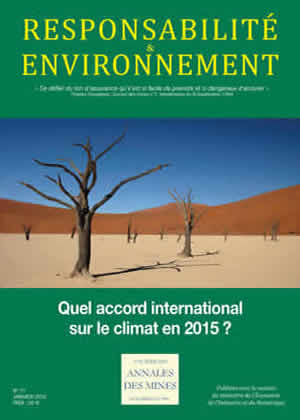
Quel accord international sur le climat en 2015 ?
Issue editor:
Richard LAVERGNE
Issue 77
1 - General context
The Paris Climate Conference: What kind of international agreement in 2015?
By Sylvie LEMMET
Directrice des Affaires européennes et internationales, ministère de l’Écologie, du Développement durable et de l’Énergie.
Paul WATKINSON
Chef de l’équipe de négociations internationales sur le climat, ministère de l’Écologie, du Développement durable et de l’Énergie.
and Damien NAVIZET
Chef du Bureau Changement climatique et Maîtrise de l’Énergie, ministère de l’Écologie, du Développement durable et de l’Énergie
At stake during the 21st Climate Conference (COP21) to be held in Paris in 2015 is the adoption of a worldwide agreement that can be applied to all countries. This agreement, which will take effect by 2020, will focus not only on reducing greenhouse gases and adapting to climate change but also on funding and concrete actions for sustainable, resilient economic development. Throughout the coming year, France, which hosts and chairs the COP21, must see to it that a transparent, inclusive process allows all parties to express their viewpoints and be heard. An agreement is not the only result expected of this conference. For the sake of fairness and in order to limit global warming to 2°C, pledges and commitments, including financial ones, from countries in favor of protecting the climate are expected too. International recognition will also have to be provided to climate-related initiatives that have already been launched.
What agreement in Paris in 2015?
By Michel COLOMBIER
Directeur Scientifique de l’Institut du Développement Durable et des Relations Internationales (IDDRI).
and Teresa RIBERA
Directrice de l’Institut du Développement Durable et des Relations Internationales (IDDRI) et ancienne secrétaire d’État du gouvernement espagnol
In Warsaw, countries agreed to a process whereby each will unilaterally design and communicate its contribution toward reducing greenhouse gas emissions in the atmosphere. This process is to be ratified in late 2015 in Paris. Will the Paris agreement mark a turning point in climate policy? Will it measure up to the ambitions proclaimed by the international community at the Durban meeting?
The tragedy of global warming: From the fifth IPCC report to the 2015 Paris Climate Conference
By Dominique AUVERLOT
Chef du département Développement durable, France Stratégie, Services du Premier ministre
Reports by the Intergovernmental Panel on Climate Change (IPCC) always signal a new step in the fight against climate change. The first report, in 1990, led to the adoption of the UN Framework Convention on Climate Change during the 1992 Earth Summit in Rio de Janeiro. The second one, released in 1996, prepared the way for the 1997 Kyoto Protocol. The third, in 2000, emphasized “adaptation”, an idea taken up during subsequent negotiations. The fourth report in 2007 made a step toward setting at 2°C the maximum increase in temperature and opened the way to the non-binding Copenhagen Accord and then to Cancun. What consequences will the fifth IPCC report of October 2014 have? Will it help finalize the Paris agreement? Or will it be considered to be one report too many — repeating what has oft been stated over the last twenty years? Before replying, the major points raised in this report are discussed; and questions, asked about some of the conclusions. Lessons are drawn for the worldwide agreement on the table in Paris.
Changes in global energy: will they be led by policies or driven by events?
By Fatih BIROL
Chief Economist, International Energy Agency
As disseminated in the International Energy Agency’s World Energy Outlook 2014, the global energy system increasingly looks to be in danger of falling short of the high hopes placed upon it. Energy security concerns are on the rise in oil and gas markets as turmoil in the Middle East may jeopardise upstream oil investment needed today and the conflict between Russia and Ukraine has reignited concern about gas supply in Europe. Energy efficiency remains an indispensible tool to bring about a more sustainable energy mix, but energy prices and government policies must provide the right signals to continue to encourage its uptake. Meanwhile, global greenhouse-gas emissions keep rising, setting up a critical round of international climate negotiations in Paris in 2015. Ultimately, it will take deliberate and sustained policy action by governments to overcome the inertia of current trends and to spur the development of a more secure, more affordable and cleaner energy system.
Which approach should Europe adopt to reach an international agreement?
By Laurent MICHEL
Directeur général de l’Énergie et du Climat, MEDDE.
and Maxime DURANDE
Chef du bureau des Marchés carbone de la direction générale de l’Énergie et du Climat - Ministère de l’Écologie, du Développement durable et de l’Énergie (MEDDE)
The goal of international negotiations on the climate should be an agreement that, applying to everyone, both addresses the issues of attenuation and adaptation, and focuses on the means for implementing a worldwide transition toward low-carbon economies. The European Union’s position during negotiations has been laid down in the conclusions adopted by all member states of the Council of Europe. During bargaining sessions, meetings will be organized to coordinate EU member states’ actions so that Europe speaks with a single voice. In this respect, the EU approach does not differ from France’s. In effect, coordination between ministerial departments in France is ensured by the Secrétariat Général des Affaires Européennes (SGAE), the secretary-general being the councilor on Europe to the President of the Republic.
Legal questions about negotiating a new international climate agreement
By Sandrine MALJEAN-DUBOIS
Directrice de recherche au CNRS, Directrice du CERIC (UMR 7318 CNRS-Aix-Marseille Université)
and Matthieu WEMAËRE
Avocat aux barreaux de Paris et de Bruxelles, chercheur associé CERIC (UMR 7318 CNRS-Aix-Marseille Université)
Although the last IPCC report emphasized the need for urgent action, international cooperation on the climate has stalled. The second phase (2013-2020) of the Kyoto Protocol has been merely symbolic. The Cancun agreement, which made the Copenhagen one operational, laid the basis for a more flexible system for the period up to 2020. Negotiations on the period after 2020, which started in Durban in 2011, should end with a new agreement in Paris in late 2015. This future agreement should apply to all, as stipulated in the Durban Platform. However the increasing symmetry of obligations between North and South has been achieved by significantly lowering the goals set by each country with regard to its economic situation and national priorities. What kind of agreement will come out of Paris? What legal form will it take?
An economic analysis of climate negotiations: Deciphering a set of incentives for participating, acting and making commitments
By Jean-Paul ALBERTINI
Ex-Commissaire général au Développement durable (CGDD), ministère de l’Écologie, du Développement durable et de l’Énergie
and Baptiste PERRISSIN FABERT
Commissariat général au Développement durable (CGDD), ministère de l’Écologie, du Développement durable et de l’Énergie
Given the complexity of situations, negotiations face the daunting task of motivating “sovereign” nation-states to cooperate in the fight against climate change. As game theory shows, the interest of rational countries is always to shift the weight of efforts for curbing greenhouse gas emissions onto others so as to profit from climate policies without having to bear the costs. Although it does not account for the full complexity — historical, institutional and ethical — of a country’s diplomatic motives for cooperating, the theory does shed light on the conditions for the emergence of solutions based on cooperation. An agreement ultimately comes out of a compromise between economic efficiency, a participation as broad as possible among signatories, and the goals adopted for preserving the climate. Given the shift in paradigms during negotiations at Cancun and the more decentralized approach that has prevailed since then, how credible is a worldwide goal like the 2°C limit set for global warming? These factors force us to reconsider the commitments that countries can reasonably make.
The implications of cognitive and ethical positions for national climate strategies
By Olivier GODARD
Directeur de recherche au CNRS, Laboratoire d’économétrie - UMR 7176 du CNRS-École polytechnique
Regardless of the sort of international negotiations on the climate, the results will reflect each country’s consent, and hinge on how each country articulates its choices with worldwide climate-related issues and with other countries’ actions. The combination of the cognitive and ethical dimensions determines how much a country feels responsible and how much of a commitment it will make for controlling greenhouse gas emissions by 2050. Assuming that policies will be based on an assessment of the damage wrought by climate change, a table of the positions that countries might adopt (and of their consequences) is transposed into a set of values to be assigned to discount coefficients and to the avoidance of emitting a ton of CO2. The “factor 4” objective in 2050 turns out to be justified only for countries that adopt a “universalistic” position or a strong version of “cosmopolitical altruism” — choices that lead to a discount rate of no more than 3,25% and to a reference value for the quantity of CO2 avoided of more than 52 euros per ton in 2010.
2 - Major players’ strategies
Transparent national strategies for long-term decarbonization in compliance with the 2°C goal: The Deep Decarbonization Pathways Project
By Michel COLOMBIER
Institut du Développement Durable et des Relations Internationales (IDDRI).
and Henri WAISMAN
Institut du Développement Durable et des Relations Internationales (IDDRI)
Fifteen countries among the biggest emitters of greenhouse gases are involved in the Deep Decarbonization Pathways Project (DDPP), which is based on “country teams” of climate experts. This international project seeks to draw the pathways for a transition toward national decarbonization in compliance with the goal of limiting global warming to 2°C maximum by 2050. These pathways should serve to: a) foresee the economic, technical and behavioral “ruptures” to be addressed in order to facilitate the transition; b) identify specifically national factors in pathways toward decarbonization; and c) analyze the effects over time of this transition and the sequencing of the measures that might cause them. A preliminary report was released in September 2014, and the final report is scheduled for mid-2015. In support of an international agreement during the Paris Climate Conference, it will focus on the implications of deep decarbonization and the conditions for achieving it.
Industry: Decarbonization of the economy and international competition
By Patrick CRIQUI
Directeur de recherche au CNRS, responsable de l’équipe d’Économie du Développement durable et de l’Énergie du laboratoire PACTE (CNRS-UGA, Grenoble).
and Claire TUTENUIT
Délégué général d’Entreprises pour l’Environnement (EPE)
Like governments, corporations have understood the need for reducing the emission of greenhouse gas. They have solutions that depend on public policies for deployment on a large scale. Under agreements adopted internationally, companies might benefit from the energy transition or, on the contrary, risk becoming less competitive. Their growing involvement in preparing international agreements is evidence of how important these issues are to them and of how much they expect.
International climate negotiations: The transfer of technology
By Matthieu GLACHANT
Professeur d’économie à MINES ParisTech, PSL - Research University, et directeur du CERNA - Centre d’économie industrielle
In matters of technology, climate negotiations mainly focus on the issue of transferring the low-carbon technology developed in the technically advanced North toward other countries. Negotiations on this point have been at a standstill for a long time now. The only concrete result was the decision in 2010 to set up coordination between the Technology Executive Committee (TEC) and the Climate Technology Center and Network (CTCN). Using previously unpublished statistics, a recent study (2013) ordered by French authorities (Commissariat Général à la Stratégie et à la Prospective) suggests that, despite the absence of international coordination, the emerging countries that actually need this technology are already well connected in the international circulation of technology. The priority is, therefore, to concentrate on the less advanced countries, where the situation is less urgent since their greenhouse gas emissions are still rather limited.
Acting efficiently on climate change
By Olivier APPERT, Jean-Eudes MONCOMBLE
Président du Conseil Français de l’Énergie
Climate change is a major issue. A survey of the utility companies that account for 80% of the world’s electric power was released during the 20th climate conference in Lima as part of the World Energy Council’ Global Electricity Initiative. It has concluded that all these utilities see climate change as being real and declare that policies for adapting to it are as important as policies for limiting it. Nonetheless, 97% of these utilities think that consumers will refuse to pay more for decarbonized electricity! This is the core problem in the fight against climate change: all agree that the issue is urgent, some agree about what should be done, but none wants to pay.
Local authorities, key players for the success of the 21st Climate Conference
By Ronan DANTEC
Sénateur de Loire-Atlantique, Vice-président de la commission du Développement durable, des Infrastructures, de l’Équipement et de l’Aménagement du territoire, Groupe Écologiste du Sénat
Since the 1990s, local authorities have gradually managed to become players that cannot be overlooked in the fight against climate change. This can mainly be set down to their greater “ability to do” which is, in turn, related to a decentralization trend in several regions of the world. It also has to do with their growing political influence through international networks, which have arisen in a situation where multilateralism has been repeatedly blocked.
Labor-union initiatives on the climate and a fair transition
By Marylise LÉON
Secrétaire Nationale CFDT Développement durable
For several years now, the CFDT has worked out an approach to sustainable development that is not a pale copy of the grievances expressed by associations or NGOs, but a plan for a new model for developing a fair, environmentally-friendly economy. This French labor union has supported this coherent, global approach in the International Trade Union Confederation (ITUC) and the European Trade Union Confederation (ETUC). In France, it has strongly backed a bill of parliament on the “energy transition”. To this end, it mobilized its members and means; but more importantly, it has worked through unusual partnerships with associations, businesses, local authorities, parliament and experts. This campaign, a response to the challenges facing France and Europe, strives to make the Paris Conference a success.
Cities, indispensable for the fight against climate change
By Michèle PAPPALARDO
Conseillère maître à la Cour des comptes, fédératrice du « Mieux vivre en ville » auprès du secrétaire d’État au Commerce extérieur, co-animatrice de Vivapolis.
and Loïc BATEL
Rapporteur à la Cour des comptes, ancien membre de l’Agence française de développement sur les questions de financement du changement climatique
Big cities around the world have never been as noticeable as during the meeting on the climate organized by Ban Ki-moon in New York on 23 September 2014. Since they will be the dwelling-place of two-thirds of humanity by 2030, they are a key factor in the campaign against climate change, even though the latter is but one aspect of how a “sustainable city” should cope with development. As the Paris Climate Conference of December 2015 draws near, it is worthwhile pointing out the importance of cities given the intense urbanization under way worldwide. Owing to its know-how in this field, France has brought public and private parties together in an effort to provide an offer in terms of city-planning under the name Vivapolis.
An economic approach to “losses and damages”
By Thomas ROULLEAU
Direction générale du Trésor, ministère des Finances et des Comptes publics et ministère de l’Économie, de l’Industrie et du Numérique (les propos tenus dans cet article n’engagent que leur auteur)
Given ever more greenhouse gas emissions, developing countries have recently placed the issue of “losses and damages” on the bargaining table. The losses and damages ensuing from climate catastrophes depend on factors that are both planetary (extreme meteorological phenomena wherein climate change is a factor) and domestic (the exposure and vulnerability of populations). The Warsaw International Mechanism for Loss and Damage Associated with Climate Change Impacts was set up in 2013. Several developing countries are demanding that it become autonomous with its own funding. This demand does not seem justified scientifically or economically in the current context. Although economic losses owing to climate-related catastrophes have increased in recent decades, they are, as scientific studies have shown, due to increases in wealth and in the population’s exposure and not to climate change as such. Furthermore, the aforementioned funding mechanism risks impeding efficient domestic actions for reducing a country’s vulnerability and its population’s exposure to climate-related risks.
3 - The key role for economic and financial instruments
To implicate the private sector in funding: The Kyoto mechanisms and SUMO policies
By Benoît LEGUET
Directeur, CDC Climat Recherche.
and Romain MOREL
Chef de projet, CDC Climat Recherch
Internationally set objectives in the fight against climate change cannot be reached without funding from the private sector. Public money, a scarce resource, must be used as best possible, in particular when it has a leverage effect on private funding. In this respect, feedback from the Kyoto Protocol’s clean development mechanism is of interest. On the eve of the 2015 Paris Climate Conference, we must ramp up the mobilization of private resources. Smart unconventional monetary (SUMO) policies could help us toward this goal. Several countries have adopted such policies to cope with macroeconomic circumstances or systemic risks. Is the destabilization of the climate not a risk of this sort?
Financing the low-carbon transition in a fragile world economy
By Jean-Charles HOURCADE
Centre International de Recherche sur l’Environnement et le Développement (CIRED)
An unfavorable economic situation will hinder the launching of the “low-carbon transition” in compliance with an increase of approximately 2°C — the official goal set by the international community for global warming. Reversing the perspective, this transition is seen, herein, as the grounds for a “sustainable” growth based on a monetary policy that ties the emission of liquidities to investments in low-carbon facilities. “Climate remediation [sic] assets” with a social value set by an agreement in the framework of the Convention on the Climate are discussed.