
April 2015
abstract
Responsabilité & Environnement
L'industrie française et la politique énergétique ?
Issue editor:
Jean-Pierre CLAMADIEU et Christophe SCHRAMM
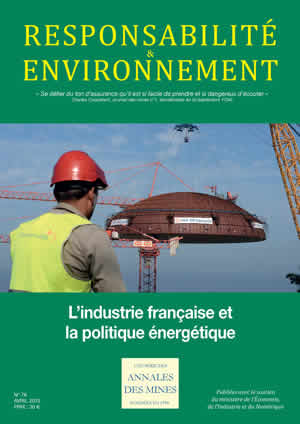
Issue 78
1 - At stake in energy policy: Changing the climate, being competitive and securing the supply
Why must there be an energy transition?
By Virginie SCHWARZ
Directrice de l’Énergie, direction générale de l’Énergie et du Climat, ministère de l’Écologie, du Développement durable et de l’Énergie
and Richard LAVERGNE
Conseiller du Directeur général de l’Énergie et du Climat et conseiller « Énergie-Climat » du Commissaire général au Développement durable, ministère de l’Écologie, du Développement durable et de l’Énergie
The energy transition is a response to the environmental and climate issues now facing our planet. It is also a source of growth and jobs, both very important during the current economic slowdown. Far from being a preoccupation of France alone, this transition toward green growth brings together a vast international movement bearing a new awareness by scientists, citizens and their representatives. Accordingly, changes in the “energy model” are to be made through joint efforts and the reinforced role to be played by citizens and local authorities for the sake of the environment and well-being and with the ambition of addressing the new century’s main environmental issues.
Difficulties with the energy policy triptych
By Claude MANDIL
Ancien directeur général de l’Agence internationale de l’énergie
The worth of an energy policy is usually measured along three axes: security of the energy supply, protection of the environment and economic growth. How to assess, beyond any doubt, how a given decision measures up along each of these axes? Certain so-called facts taken for granted turn out to be, in fact, false. For example, the degree of energy independence does not provide a good measure of energy security. Yet another example, renewable energy sources do not, in general, contribute to this security, nor to economic growth, nor, for that matter, to protection of the environment. Moreover, energy efficiency is often a worthy goal but not always…. The grounds for the energy policy triptych (“20-20-20”) set by the European Union, as well as the relevance of the decisions made for reaching these objectives, are examined. The often incredible conclusions drawn herein call for urgently adopting thoroughgoing, corrective measures.
A glimpse into european political debate: is energetic transition really mandatory for everybody ? État des lieux du débat politique européen : une transition pour tous ?
By Jorge VASCONCELOS
Diderot was one of the main actors in the transition to modern age and his Lettre sur les aveugles provides amusing insights into the construction process of a new mindset by exploring different views about how we “see” (or “frame”) reality. In every transitional process there are things we see immediately and things we don’t see because of our blind loyalty to custom. Therefore, a critical approach is essential to better understand (and to better manage) any transitional process - including the present transition towards the European “Energy Union”.
2 - Challenges for French industry
The incredible challenge of producing energy in a deeply changing world
By Gérard MESTRALLET
GDF Suez
Major trends in the energy sector — emerging countries thirsty for energy, unconventional fossil fuels (a development roiling geopolitics around the globe) or the deep alterations occurring in the EU’s energy policy — are forcing professionals to design a new planetary model. This sector is anticipating trends, innovating and thus proving its ability to change. These trends arise locally in response to customer needs, whether of businesses or private persons. Plans for the future will be oriented by the uses to which energy will be put. There will be room for decentralized, renewable forms of energy and related services; and priority will go to reducing the insecurity of the energy supply. The big challenge we now face is to cope with changes in the sources of energy and in related techniques and, too, with geopolitical trends.
During the coming two decades, what changes should a global group in petroleum and gas prepare for?
By Patrick POUYANNÉ
Directeur général du groupe Total
Supplying to as many customers as possible a clean, secure and competitive (in terms of price) energy is the goal of an industry involved in the global business of petroleum and gas. This assignment entails preparations. From now to 2040, worldwide demand for energy will increase by about 35%. Although the share of renewables will increase too, the energy mix will remain heavily dependent on fossil fuels. As a consequence, major investments are called for, especially in R&D and innovation, to be able to tap ever more complicated sources. In parallel, the campaign against climate change will eventually: favor natural gas and photovoltaic solar energy, improve energy efficiency, facilitate the access to energy and entail participation in international climate programs. As these changes take place, a new profile of this international petroleum and gas group will emerge, stroke by stroke, out of the effort to better satisfy humanity’s energy needs.
Are conventional turbines winners or losers in the energy transition?
By Christophe DE MAISTRE
Président directeur général de Siemens France
and Jean-Philippe HENRY
Directeur des activités Energy Solutions de Siemens France
As an analysis of the energy transition in major European countries shows, the thermal production of electricity will still be significant, especially in Great Britain and Germany. These two lands are coping with the development of intermittent sources of renewable energy; and the means of deploying natural gas in Britain and coal in Germany depend on national energy policies. Given the considerable share of nuclear and hydraulic power in its electricity mix, France is a case apart. Thoroughly renovated thanks to the deployment of new combined cycle gas turbines, which are making up for the shutdown of plants using coal or fuel oil, French thermal installations should continue being a vector for making adjustments that complete chains of production for generating electricity.
Can energy-intensive products still be made in France?
By Hervé BOURRIER
Directeur général d’ArcelorMittal France (depuis 2009), président de l’Union des Industries du Recyclage (UIR) et vice-président d’Entreprise pour l’Environnement (EPE)
In a context of global competition, France must see to it that the cost of energy is competitive and that a forward-looking energy policy is conducted for industry and for the sake of jobs. Energy-intensive industries significantly contribute to French manufacturing, representing more than 150 plants, around 10% of the country’s consumption of electricity and natural gas, and approximately 50.000 jobs directly and 120.000 indirectly. In an increasingly complex economy with ever more regulations, these industries have adapted over the years; and some of them have even had to redraw their business plans. In industries where energy accounts for from 10% to 25% of production costs, there is a dual imperative: access to competitive sources (in terms of full costs €/MWh) and the adoption of measures in favor of efficiency (MWh energy/ton of finished products). There are tools for improving competitiveness in these industries. All stakeholders should be mobilized to resuscitate a strong industry thanks to the rapid adoption of concrete, effective measures.
A new energy model and new governance: A chance for small and midsize companies?
By Bruno VENANZI
Administrateur délégué, Lampiris SA
and Bruno VANDERSCHUEREN
Lampiris SA
Given the awareness of the scarcity of basic resources and of the impact of the climate change, a new energy model has been adopted since 200, one that is more “sober”, more decentralized and more respectful of the planet. The opening of the French energy market in 2007 has not facilitated its emergence, mainly because governance in this sector is national but the sector itself is multinational. The new model in the pipeline might benefit from the presence on this market of small and medium-sized companies that have proven their mettle in terms of adaptation and innovation.
What if some basic industries cannot forgo fossil fuels?
By Philippe ROSIER
Solvay
Starting in 1821 in the United States when whale oil (used for street lighting) was replaced with products derived from fossil fuels, the industrial development of hydrocarbons has been a major issue throughout the last two centuries. It is now the target of many a criticism despite the promises it initially held for the environment (the decline in fishing for whales). It is accused of causing pollution and global warming; and concerns are vented about depleting reserves — on which we have become too dependent. These criticisms invariably lead to a single conclusion: we must break free from a fossil-fuel economy. But is this actually so? Which industries can imagine no longer consuming fossil fuels, and under what conditions? Which industrial sectors will receive the last gallons of hydrocarbon?
3 - Innovation at the service of the energy transition
Nuclear power and the energy transition: Which innovations for adaptation?
By Philippe VARIN
Président du Conseil d’administration d’AREVA
In a few years, the energy transition has risen to the top of the French political agenda. Despite disagreements about the means, the goal has been nearly unanimously approved: the fossil-fuel economy is to be reviewed in the light of the fight against climate change. This issue, sometimes under different names, now stands at the top of agendas in both developed and emerging countries; and it will lie at the center of talks during the COP 21 to be held in Paris in December 2015. France, where one of the pillars of energy policy has been nuclear power since the 1970s, seems to set an example for several reasons. Objectively, nuclear power plants are a sure, competitive and sustainable source of energy that can, therefore, be a driving force — along with renewables — in the transition. As Ségolène Royal, minister of Ecology, Sustainable Development and Energy, recently stated, “Thanks to nuclear power and its security, we can accelerate the energy transition and prepare for it serenely.” The issues of competitiveness, safety and acceptability are forcing the nuclear industry to maintain its capacity for innovation.
Developing wind power in a shifting regulatory context
By Jean-Marc LECHÊNE
Chief Operating Officer, Vestas Wind Systems A/S
By deliberately adopting a policy in favor of developing wind power through significant (but not excessive) subsidies, the EU is now equipped with a renewable energy that is competitive and provides a response to climate change. The continent’s wind industry employs 250.000 persons and, in 2013, supplied nearly 7% of the electricity generated in Europe. To pursue this development, major issues must be addressed: fix the share of wind power in the energy mix; optimize energy market operations; stabilize and optimize the regulatory framework; and consolidate the wind power industry.
Biomass, geothermal, solar, heat, the recuperation of fatal energy: Opportunities for French industry
By Bruno LECHEVIN
Président de l’ADEME
According to the climate and energy predictions made in ADEME’s Vision 2030-2050, the objective of placing our society on a trajectory for reaching factor 4 by 2050 would entail cutting energy consumption by 50% and massively resorting to renewable sources of energy. Among the latter, wind power and photovoltaics are so often mentioned that we tend to forget the very large share of other renewables — in particular, the biomass — which supply firms with a carbon-free, competitive form of energy.
Electrochemically storing energy: Principles, applications and prospects
By Patrice SIMON
Université Paul Sabatier, Laboratoire CIRIMAT UMR CNRS 5085, Toulouse - France, Réseau sur le Stockage Électrochimique de l’Énergie (RS2E), FR CNRS n°3459
Storing energy electrochemically in batteries is now a major socioeconomic issue. Progress is expected in mobile or static applications: on the one hand, portable electronics and automobiles; and on the other hand, the storage of renewables, which are, by nature, intermittent. The various chemicals used in the batteries now available are described as well as the materials and systems being developed in corporate and academic research laboratories. France has genuine qualifications in this field, since it has oriented R&D through the Network on the Electrochemical Storage of Energy (RS2E) so as to boost its position in this very competitive field.
The digital revolution in energy
By Jean THERME
CEA
The growth of renewable sources of energy on the planet (in particular, solar power) is deeply altering the economics of energy. The decentralization of decision-making, the placing of users at the center of systems, the management of energy consumption in buildings, new forms of mobility… all these are expectations that digital technology can satisfy. Do digital technology and energy naturally converge… or will there be a revolution? For sure, a revolution, but one that has to take place, first of all, in our heads!
No energy transition without a smart network
By Ian FUNNELL
Président d’ABB France
Influencing the demand for energy and modifying the means of production while introducing new uses are part of a quite complicated equation. Smart electricity grids are very important for solving this equation and indispensable for the energy transition. Since they deeply alter jobs in this sector, they are forcing industrialists to draw up a genuine strategy. ABB is convinced that a successful energy transition involves using three levers: the evolution of consumer behavior patterns; the regulatory and legal framework; and the deployment of technical solutions. As for the last, ABB can, owing to its strong experiences and skills, advise decision-makers about the changes necessary in existing networks so as to open the way for this transition toward a sustainable world.
To improve buildings, dare communicative innovation
By Carole LE GALL
Directrice générale du Centre Scientifique et Technique du Bâtiment (CSTB)
The energy and environmental transition is a daunting task for all stakeholders in the building trade, and first of all for those who are going to live in the housing being built — all of us, citizens, consumers, inhabitants. What can construction firms propose in response to our expectations?
A house makeover paid for by your energy bill
By Jasper van den MUNCKHOF, Ron van ERCK
Director Energiesprong
In the Netherlands, 27 social housing associations (HLM’s) and a group of builders are refurbishing 111,000 houses to Net Zero Energy levels. Net Zero Energy means that the house annually produces the same amount of energy that is used for heating, hot water, lights and electric appliances. Remarkably, the refurbishments take only one week; the builder provides a 40-year guarantee on the energy performance and the refurbishments are done without government subsidies. The best part is: the people living in these houses are very happy with their refurbished new homes. In 2015, these solutions are also brought to the private market. The deal is the same: A Net Zero Energy makeover, with no additional cost for the homeowner. It sounds too good to be true. How was this achieved and could this be done in France?