
October 2015
abstract
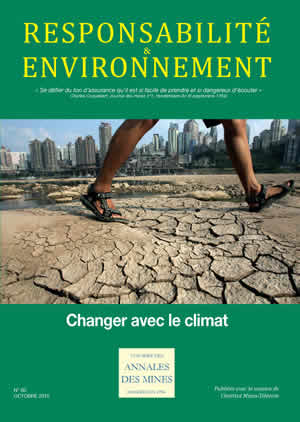
Responsabilité & Environnement
Changer avec le climat
Issue editor:
Pierre COUVEINHES
Issue 80
Editorial
By Pierre COUVEINHES
Rédacteur en Chef des Annales des Mines
Economic and historical considerations about the climate-related issues up for negotiation
By François VALÉRIAN
Conseil général de l’Économie, professeur associé de finance au Conservatoire national des arts et métiers
After a brief look over the main points in the consensus on climate change, the economic tools available for attenuating this change are reviewed along with their limits and the theoretical problems they raise. The question of funding a program of attenuation is tackled from the angle of the available assessments and the (few) proposals made about the means. Above all, it is placed in the geopolitical context of negotiations. Geopolitics helps us both assess the uniqueness of the EU’s position about public policies for fighting against climate change and better define Europe’s room to maneuver during the Paris Conference in December 2015 (COP21).
A prospective analysis of technological solutions for coping with the climate challenge
By Olivier APPERT
Président du Conseil français de l’Énergie
Energy and environmental issues are closely linked. Technology is a lever for finding solutions. Bear in mind, however, that time in matters of energy and technology is long. For this reason, the transition toward a sustainable energy system will take decades. Several techniques can be imagined, but there is no panacea for all problems.
Global warming, droughts and migrations
By Thierry GAUDIN
Ingénieur général des Mines honoraire, président de Prospective 2100
Futurologists’ warnings have not led to changes capable of forestalling the catastrophe described by the Club of Rome in the 1970s. For the human species, the worst consequence of global warming - its effects already visible - is the increase in spates of drought. For want of adequate measures to be taken soon, hundreds of millions of persons will migrate. Four proposals are made to keep the prolongation of current trends from turning into a humanitarian and environmental catastrophe. The first is a transnational fiscal system for funding programs of planetary interest. The second is to establish “basin agencies” as France has done in the areas at the highest risk of drought. The third is to set up agencies for building the infrastructure necessary for settling migrants. The fourth, more global, is to construct a new monetary system, based on complementary currencies and a systemic, biological model.
The land sector: A solution to the problems stemming from global warming? A brilliant future for agriculture
By Guillaume BENOIT
Ingénieur général des Ponts, des Eaux et des Forêts, membre du Conseil général de l'Alimentation, de l'Agriculture et des Espaces ruraux (CGAAER)
Although the public and many decision-makers have are not yet aware of this, the “land sector” - agriculture, forests and the soil - is essential to solving the climate crisis thanks, in particular, to the advances possible in stocking and replacing carbon compounds. Even though the soil in many places has deteriorated, solutions exist at a time when climate change is menacing agriculture and food security, and the risk of large-scale migrations and instability is already perceptible. These solutions help us imagine possibilities for sustainable development, especially in Africa. Generalizing them presupposes, however, an awareness of the strategic importance of rural resources. It is also necessary: to make food security a key objective at COP 21; to better manage and develop the resources of water, the soil and the forest; to calculate the progress possible in the land sector; and to finance and achieve sustainable economic development. To be successful, climate negotiations must pay attention to all these issues.
A young engineer’s thoughts after the CGE-AFCPN conference on 30 June 2015, “Changing with the climate”
By Pierre JÉRÉMIE
Ingénieur des Mines
In this year of 2015, when France will be hosting in December the 21st Climate Conference (COP21), I had the privilege of attending, on 30 June, the conference on “Changing with the climate” organized by the Association Française de Prévention des Catastrophes Naturelles (AFPCN) and the Conseil général de l’Économie (CGE). The major issues related to a changing climate were debated from economic, technical and societal approaches. This review of the conference, laced with a few digressions, focuses on three examples of economic sectors that could contribute toward a better management of the carbon cycle through actions ranging from Promethean transnational projects to solutions with a rural or local dimension. Despite the uncertainty about the scope of climate change and the amount of investments to be made, one point stands out: the best solutions are those that allow for an adaptation to climate change and an appreciable reduction of greenhouse gases.