April 2016
abstract
Responsabilité & Environnement
Les métaux stratégiques, un enjeu mondial ?
Issue editor:
Alain LIGER
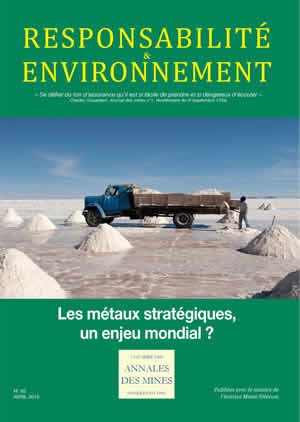
Issue 82
The general framework and state strategies
Economic development and the growing uses of metals
By Patrice CHRISTMANN
Direction de la Stratégie et de la Recherche, BRGM
Since the origin of human societies two and a half million years ago, mineral resources have been continually tapped as innovations have made it possible or necessary to do so. The real “metal age” started after World War II owing to the combined effects of an abundant supply of cheap energy and the discoveries in chemistry and physics that led to using ever larger quantities of nearly all metals. Nowadays, metals and other minerals are indispensable to several sectors in the economy. They are central to the energy sector: 10% of the world’s energy supply is spent on producing them, and they are indispensable for developing renewable energy sources. The major challenge in this 21st century is to redesign our lifestyles and models of growth, in which the consumption of metals plays a part, so that the impact does not exceed the ecosystem’s resilience. Life on Earth depends on this.
A determinant: China’s industrial strategy
By Joël RUET
Chercheur CNRS au Centre d’économie de Paris-Nord (CEPN) et chercheur associé i3-CRG
Far from being just a market for Western firms or a vast operation of dumping for ripe technologies that are losing wind financially, “technological China” - the advanced part of the Chinese industry’s ecosystem - has a “constructed” comparative advantage in terms of technology and technogovernance. In order to assess this ecosystem’s current and future resilience, we need to understand how it has been patiently built in line with a coherent vision “from mines to technological prescripts”.
The EU’s raw materials strategy
By Gwenole COZIGOU
Directeur Transformation industrielle et Chaînes de valeur avancées à la Commission européenne
Most European industries, the core of the EU’s economic rank in the world, depend on imports. Access to raw materials used to be relatively easy but is now uncertain. Coping with this situation calls for a long-term strategy, whence the EU’s “Raw materials initiative”. The latter has entailed a series of programs spanning innovation (the European Innovation Partnership on Raw Materials), research and development (The EU’s R&D project, Horizon 2020, has raw materials as a theme) and education/innovation/entrepreneurship (the launching of a Knowledge and Innovation Community on raw materials). Significant budgetary support must be set aside for this: more than one billion euros from 2014 till 2020.
The French Strategic Metals Committee (COMES), a place devoted to dialog with industry
By Alain LIGER
Ingénieur général des Mines honoraire, ancien secrétaire général du COMES
In 2010, an analysis of the economic risk of the reliance of industry upon outside mineral sources led the French Government to set up a mineral strategy ; the Committee for strategic metals - COMES - was subsequently created at the beginning of 2011. Within the COMES, a strategic dialogue takes place between the representatives of the many industry branches that are concerned by minerals and the various Ministries in charge; technical experts from Government agencies also participate in the debates. Members of the COMES work-groups discuss issues concerning industry needs and exposure, e.g. primary or secondary resources, circular economy targets or strategic metals substitution. The COMES debates inspired new Government actions such as creating a digital tool to help small and medium enterprises diagnose the strategic metals risks they are exposed to, and setting a French language Internet portal describing mineral issues and data.
Strategic actions for ensuring Japan’s supply of nonferrous metals
By Jean-Claude GUILLANEAU
Directeur des Géoressources, BRGM
Although the recent price levels of extractive raw materials hardly motivate industrialized countries to assign priority to this branch of the economy, actions have been carried out in recent years. An EU report has identified three pillars: 1) secure for member states industries an access to raw materials on international markets at conditions identical to their competitors’; 2) define, within the EU, the framework conditions for a sustainable supply of raw materials from European sources; and c) boost global efficiency in using and recycling resources so as to reduce the consumption of basic raw materials and, as a consequence, the Union’s dependence on imports. This report has led in France to the creation of the Strategic Metals Committee (Comité pour les Métaux Stratégiques, COMES) and the idea of “responsible mining”. Other lands, such as South Korea or Japan, are trying to make their supply of metals secure. In 2004, JOGMEC was set up in Japan with the assignment to ensure the supply of hydrocarbons and metals to the archipelago. Among its many strategic actions: the formation of stockpiles; advances in science (bioleaching in Latin America or remote detection in Botswana); the monitoring of mining operations around the world and of metal prices; an examination of equity investments and of contracts for waste removal in mining operations; and the pursuit of strategies in close association with Japanese mining companies (such as Mitsubishi, Mitsui or Sumitomo).
A priority: The circular economy
The scarcity of metals and strategic dependency
By François VALÉRIAN
Conseil général de l’économie, professeur associé de fi nance au CNAM
In 2015, the French General Economic Council published a book on the circular economy and competition for resources (L’économie circulaire ou la compétition pour les ressources) to demonstrate the need for a convergence between the environmental concern about the scarcity of resources and the need to improve France’s and Europe’s competitive edge in comparison with other regions of the world. The methods of analysis developed therein are applied to the problem of the scarcity of metals, which symbolizes a form of strategic dependency created by technological progress.
The physical limits of recycling in supplying metals
By Jean-François LABBÉ
BRGM
The circular economy tries to optimize efficiency in using and recycling nonrenewable mineral resources. However this concept is often mistakenly interpreted as a closed, self-sufficient economy, where recycled materials would be used and natural resources as such would no longer be needed. On the planetary scale, recycling alone cannot satisfy demand given the increasing consumption of nearly all metals - since the start of the industrial era. Besides, the rate of growth in mining necessary to satisfy demand will have to equal at least the rate of growth in consumption - even were recycling to reach the ideal of 100%.
Recycling smart cards: A glimpse at the state of the art
By Christian THOMAS
Fondateur de TND (société développant des technologies d’extraction métallurgiques innovantes)
Smart cards contain from 10 to 500 grams of gold per ton (g/t) and from 7 to 100 g/t of palladium, not to mention silver, copper, tin, tantalum and other metals, some of which figure on the list of strategic materials. A point of comparison: open pit gold mines are worked at concentrations less than 1 g/t. In 2013, 51,1 million tons of electric and electronic equipment were sold on the planet; and wastes estimated at 10,8 million tons will have to be collected. Thanks to regulations, Europe, Japan, South Korea and China are the most efficient recyclers. The United States should be able to catch up since adoption by 25 states of regulations for recycling electric and electronic wastes. In 2013, the manufacturing of new integrated circuit cards amounted to two million tons; and the wastes from these smart cars have been estimated at half a million tons per year, with an annual growth rate of 5%. What do these chip cards contain? How to improve our handling of them once they are thrown out?
Strategic metal recycling: adaptive metallurgical processing infrastructure and technology are essential for a Circular Economy
By Markus A. REUTER, Antoinette VAN SCHAIK
Director Helmholtz Institute Freiberg for Resource Technology
Recycling forms the heart of the Circular Economy (CE) system. Ultimately all products will have to be recycled at their End-of-Life (EoL). Maximizing the recovery of materials and also especially strategic elements from EoL products requires a deep understanding of the fundamental limits and the dynamics of the evolving system, thus an adaptive processing and metallurgical infrastructure is critical to recover all metals and materials. Paramount is the quantification of the “mineralogy”, the complex and interlinked composition of products, to trace and quantify specifically all the losses of materials, metals, alloys, etc. due to thermodynamic and other non-linear interactions. We named this product centric recycling. The recycling potential and performance must be quantified and demonstrated for products, collection systems, waste separation and recovery technologies, and material supply. System Integrated Metal Processing (SIMP) using big-data, multi-sensors, simulation models, metallurgy, etc. links all stakeholders through Circular Economy Engineering, an important enabler to maximize Resource Efficiency.
Strategic metals: The French urban mine
By Alain GELDRON
Expert national matières premières à l’ADEME
If recycling dates back to ancient origins, urban mining and its place in strategic metals supply is a relatively recent practice. France has significant potential in terms of deposit, sometimes difficult to assess, and stakeholders to develop efficient solutions. However the collection of materials and many used goods is for various waste as electrical and electronic equipment and batteries and accumulators, insufficiently effective. Technological innovation is present in France on this sector as evidenced by the projects submitted and those adopted in the various calls for proposals.
French industry and its response to risks
Mines and minerals, a key sector for French industry tomorrow
By Catherine TISSOT-COLLE
Co-présidente d’A3M (Alliance des Minerais, Minéraux et Métaux)
Mining and metals holds a strategic position in the chain of value in every major French industry. This sector is facing a dire situation owing to a combination of factors: rising costs at a time when world prices have fallen, and will remain low; unfair “rules of the game” given the commercial breakthrough of low-cost countries and the growing regulatory pressure, which necessitates substantial, in particular human, means. Far from giving up, this sector is trying to remain competitive so as to seize opportunities for serving companies downstream in the production process.
The French mining industry’s revival and strategic raw materials
By Rémi GALIN
Chef du bureau de la gestion et de la législation des ressources minérales non énergétiques, ministère de l’Environnement, de l’Énergie et de la Mer
The interest shown by investors is evidence of the French mining industry’s (recently perceptible) revival. Although mining is no El Dorado in France, it has a real potential for providing the national economy with several strategic raw materials: fluorine, tungsten, antimony and germanium. Under the leadership of the Strategic Metals Committee (COMES), data for assessing this potential have been reinterpreted with the support of BRGM. Reforming the mining code and defining a new, more responsible business model should stimulate the emergence of very profitable mining operations in certain locations. France’s offshore mining resources, which have a potential for producing strategic metals, are worthy of consideration in a context where worldwide resources on shore will, in the long term, be in short supply. Successfully developing offshore sites (and onshore, for that matter) depends both on mustering investments from firms to secure their supply lines in the years to come and on making mining operations and techniques environmentally friendly.
The stakes for Delachaux Group in the chromium supply
By Philippe LIEBAERT
Responsable Recherche et Développement de DCX Chrome
The chromium found in nature is far from marginal: worldwide reserves of chromite are estimated at more than seven billion tons. Not as much can be said about certain finished products such as ultra pure (more than 99,4%) chromium metal, an indispensable constituent in superalloys. Functional under critical conditions (in terms of temperature and corrosion), these alloys have many uses especially in aviation (both civilian and military), energy (gas turbines), nuclear power and petrochemistry. There are few players in this field: two in Europe, the others being Russian or Chinese. Environmental regulations have changed drastically in Europe, and demand (concentrated in the United States, Europe and Japan) for this strategic metal risks being out of balance with supply, which will continue contracting in Europe where prices will be higher than those of competitors who are not subject to such tight regulations.
The European stakes in the titanium supply
By Patrick DELABORDE
Directeur du Développement commercial d’UKAD, Aubert et Duval - groupe ERAMET
World consumption of titanium is growing fast - in Europe too, where it has been stimulated by civil aviation. Titanium alloys are used to make critical parts, and there is no substitute for it. Owing to the restructuring of its industry, Europe now depends on American and Russian firms. Given the turbulent, fragile geopolitical context, the emergence of a French titanium industry is a solution.
Lithium, a key stake for industry, the economy and the environment in the 21st century
By Hughes-Marie AULANIER
Chargé de mission Stratégie et Développement, groupe ERAMET
Litihium, a soft, silvery white, alkaline metal, has several properties allowing for a wide range of applications. This lightest metal on earth has the highest specific heat and a good electrochemical potential. Its energy density - twice as high as the nearest alternative - makes it ideal for the on-board storage of energy. In 2025, the market for lithium-ion batteries will probably account for more than half of worldwide demand for lithium, as compared with a third at present; and the world market will, according to analysts and market experts, at least double in size. This metal will mainly be extracted in the “Lithium triangle”, a vast area stretching over parts of Chile, Bolivia and Argentina.
From Orange’s strategy to methods of evaluation in information and communications technology
By Philippe TUZZOLINO
Directeur Environnement du groupe Orange
Orange is deploying ambitious solutions and action plans that, based on processes related to a circular economy, focus on the environmental and energy transition, climate change, and resource and waste management. Several specialists in Orange Group have been mobilized to reduce our consumption of energy and emissions of greenhouse gases and to optimize the end of life of our appliances and machines through recycling and research on ecoresponsible solutions for our customers. As part of its corporate responsibility program, Orange has voluntarily made commitments about accountability and the tracking of scarce resources and critical materials. Though not involved in manufacturing, Orange does draw up specifications for certain products from suppliers. Orange is committed to anticipating risks on the supply side and to maintaining its reputation by applying methods of corporate social responsibility.
Life-course analysis in the service of Orange’s responsible policy on the consumption of strategic metals
By Mikko Samuli VAIJA
Analyste Cycle de vie, Orange Labs
As part of its environmental policy, Orange has, since 2007, been assessing the environmental impact of its products: both those it sells (for example, cell phones or tablets made by third-party firms) and those it has developed (such as Livebox or television decoders). The major tool for doing this is the life-course analysis in compliance with ISO standards 14040-14044.
Managing strategic raw materials at Renault
By Philippe SCHULZ
Expert leader Environnement, énergie et matières premières, Renault
Metals are vital to the automotive industry. Not only has the quantity of metals increased over 100 years of history with a fleet of almost 800 million vehicles worldwide, but so too have the number and variety of metal used. In a typical car of the 70’s, a maximum of 20 to 25 different metals would have been used. Now it is about 60. Even rare ones. Used at trace levels, but an absolute must for their physical or chemical properties in all parts of modern vehicles. As an example, Rare Earths elements - a family of 17 chemical elements with 8 being typically used for automotive applications- might be present in about 2000 different parts of the Renault vehicles, even if the average amount by car is lower than 200g per vehicle for the whole Rare Earths family. Renault developed therefore an internal methodology to assess the criticality of the different metals and get a clear and objective view on the risky materials and the reasons behind. Risks might be external (to Renault), like availability, production concentration, country production governance, or internal ones, like the quantity used or the substitution capability. This article gives a comprehensive view on the Renault approach to secure raw material supply through criticality analysis, substitution and recycling roadmap and innovative partnerships in R&D.