
October 2016
abstract
Responsabilité & Environnement
What cities tomorrow? Technological, digital and environmental issues
Issue editor:
Jean-Louis MARCHAND
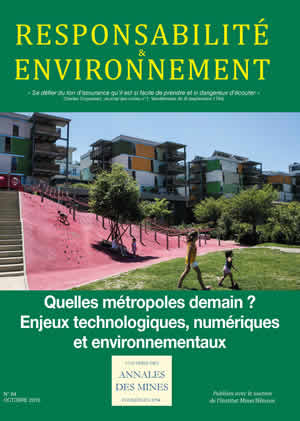
Issue 84
1 – A new vision of cities, new expectations
The smart city in 2040, an urban utopia in two fictive narratives
By Julien DAMON
Professeur associé à Sciences Po, auteur, notamment, de Questions sociales et questions urbaines (PUF, 2010) et Les 100 mots de la ville (PUF, 2015). Site : www.eclairs.fr
Cities, metropolitan areas and megacities have, historically, provided fertile grounds for visions of utopia and dystopia. Cities make us have a dream, or a nightmare, depending… The current trend is anything “smart” (intelligent, elegant, clever), especially in urban affairs. Grand projects are in the works while serious preoccupations are in the pipeline. In any case, the words “smart” and “utopia” are combined in talk about urban planning. Urbanism might rely on models, tables and statistical projections, or it might invoke a figment of the imagination, a faculty long active in this discipline.
Creating the Greater Paris Metropolitan Area: The need for a new urban model
By Jean-Louis MISSIKA
Conseiller de Paris, adjoint à la Maire de Paris, chargé de l’Urbanisme, de l’Architecture, des Projets du Grand Paris, du Développement économique et de l’Attractivité
The formation of a “Grand Paris” – a Greater Paris Metropolitan Area – necessitates a new urban model based on changing economic paradigms. The economics of innovation, the first means of leverage for forming this new territorial subdivision, provides a response to several environmental and social issues thanks to an agile, thought-out approach. The “logic of open innovation” touted by the City of Paris combines several solutions. The city has based its actions on: a deliberate policy of open data so as to make this source available for the creation of new services; the mobilization of the ecosystem of innovation in favor of the energy transition and the circular economy; and the co-construction, thanks to digital technology, of urban services with citizens. This profound change of urban models cannot stop at the city’s administrative limits; it must be constructed, program by program, with neighboring areas with which the city will form a metropolitan area.
Improving security in cities
By David HARARI
Co-président du Haut Conseil franco-israélien de la Science et de la Technologie
and Claude TRINK
Ingénieur général des Mines
The steadily rising population in urban areas reinforces the need to find effective solutions in response to citizens’ basic need for security. Digital technology and new schemas of organization, governance and mobility provide solutions for improving the quality of urban life, in particular with regard to security, mobility and the improvement of facilities for the disabled or elderly. Using big data, which cities naturally accumulate, will open the way to new urban services and products. But these solutions, stemming from urban innovations, cannot be deployed until they have proven their effectiveness. For this reason, technical demonstrations are important along with international exchanges on experiments and practices.
A smart, human city
By Nathalie BOULANGER
Directrice d’Orange Startup Ecosystem
and Hélène JEANNIN
Laboratoire « Sociologie des usages », Orange
Deploying new technology in the context of growing urbanization opens possibilities for a different way of living in cities. Grounded on a set of arguments and beliefs, the “smart city” – understood as an intentional actor with the capacity for making choices that have a heavy impact on its own future – is taking shape around concrete, material achievements. The strategies and means to be used by smart cities are examined. To deal with the much more ordinary question of everyday life in the city, the idea of the smart city will be compared with the view of other actors. When we focus on cities, a duality arises: the city as designed, the city as lived in – whence possible variations.
Big metropolitan areas come to grips with climate change
By Laurence MONNOYER-SMITH
Commissaire générale au Développement durable
and Anne CHARREYRON-PERCHET
Chargée de mission stratégique Ville durable au Commissariat général au Développement durable
Big metropolitan areas now play an active part in the fight against climate change. Their role was recognized during the 21st Climate Conference (COP21). As experience shows, cities must, to address the issue of climate change, bring into synergy all dimensions of urban life: the quality of air, means of mobility, efficiency of energy, etc. Local authorities as well as concerned parties must become involved, but this entails a long-term view.
2 – New tools
New building techniques
By François BERTIÈRE
Président de Bouygues Immobilier
Long aware of the issues related to adapting cities to climate change, Bouygues Immobilier adopted, several years ago, an ambitious strategy based on innovation and sustainable development. This strategy is presented through a few concrete examples for illustrating this firm’s deep conviction that the construction industry must reinvent how it designs and builds cities. To do so, it must seize the opportunities provided by digital technology and adopt an open form of team work, which places human beings at the center of its preoccupations.
Water, mobility and energy: For a coordinated steering of networks
By Jean-Christophe LOUVET
Président de la Commission développement durable de la Fédération nationale des travaux publics (FNTP)
The world is changing faster with urbanization as both a consequence and catalyst. In 2050, approximately 80% of the world’s population will probably be living in cities. Metropolitan areas must, therefore, respond to the expectations and fundamental needs of the citizenry and allow for new uses, whether or not related to digital technology, to emerge. The infrastructure lies at the center of solutions for a sustainable development that will stimulate growth.
The ecodesign of the built environment and the infrastructure
By Bruno PEUPORTIER
Directeur de recherche au Centre Efficacité énergétique des Systèmes – MINES ParisTech
Tools for assessing the environmental impact of constructed zones and infrastructure projects exist that take into account: the production of construction materials; construction sites; processes ranging from the consumption (heating, water) of buildings up till their demolition; and waste disposal, including eventual recycling. These tools can, as a complement to socioeconomic analyses, help decision-makers advance toward a more sustainable urban planning and development.
Big data and open data at the service of local authorities
By Pascal SOKOLOFF
Fédération nationale des collectivités concédantes et régies (FNCCR)
The FNCCR (Federation Nationale des Collectivités Concedantes et Regies) helps its members – local authorities – activate their qualifications in matters related to public networks: energy, water, waste disposal, digital technology. Since the digital transition will have a considerable impact on processes in these networks, the FNCCR has drafted a report on digital technology to share its views about this irreversible mutation. In this report, which bears the title “Making the digital revolution a success: Networks, services and data for the benefit of citizens, public services and the economy”, the issues and prospects of using data in the management of public affairs are discussed in detail.
Uses of, and progress in, urban model-building
By Gérard HÉGRON
Institut français des sciences et technologies des transports, de l'aménagement et des réseaux (IFSTTAR)
A city amounts to much more than the sum of its parts. It is an open system, open to uncertainty. To apprehend this complexity, urban model-building must adopt a systemic approach that reckons with various interacting components. The major trends and uses are successively explored of the models applied during stages of urban development (planning, designing, constructing, managing). This overview brings to light problems related, for example, to the multiscalar approach, the collection and quality of data, the validity of models, graphic representations of results and the ergonomics of simulation software. Models are tools for making a diagnosis and assessing, both before and afterwards, urban programs or public policies so as to assist project directors and contractors in designing and decision-making.
When the value of real estate slips downstream in urban development: Thoughts about new economic models for urban areas
By Isabelle BARAUD-SERFATY
Fondatrice d’Ibicity
and Nicolas RIO
Consultant chez Acadie
Models reveal broader changes in the economics of urban areas. Value is no longer created during the phase of construction. The processes of making investments and operating what has been built are ever more interlocked. Given this slippage of value downstream in the overall process of urban development, local authorities must redesign their actions, which are now too compartmentalized and splintered.
How the predictive analytics of human behavior can help create cities where it will be more pleasant to live
By Raphaël CHERRIER
Fondateur de Qucit
Owing to their density, which stimulates interactions and makes it necessary to pool resources, cities are outstanding examples of places with a concentration of complexity. This gives rise to problems about how to organize various forms of mobility and install public areas that are pleasant and open to all categories of users. The bicycle-sharing system in the Paris area serves as an example for illustrating a network’s dense effects and the resulting congestion, which has an impact on the system’s actual operation. The predictive analytics of behavior patterns can help us both manage congestion and assess comfort in public services in order to improve it.
A dream of urban scenes: An industrial demonstration of a sustainable city in Plaine Commune (Seine-Saint-Denis)
By José-Michaël CHENU
Directeur Marketing stratégique et développement urbain du groupe Vinci, représentant de Vinci à la présidence de l’Association « Rêve de scènes urbaines »
“A dream of urban scenes” (Rêve de Scènes Urbaines) is a demonstration with an original approach to cooperation between public authorities and private parties for experimenting and coming up with innovative solutions to urban problems. It is taking place in a continually changing area, Plaine Commune in Seine-Saint-Denis Department, itself in the heart of the greater Paris area. This demonstration is based on an open ecosystem where all players share the objective of reinforcing sustainable development in order to improve the quality of life for inhabitants and enhance this locality’s prestige. This demonstration won, in March 2016, the public bid for projects on the theme “Industrial demonstrations for a sustainable city”. Public authorities will, for five years, back this approach for facilitating innovation, especially its methodological and regulatory aspects in relation to urban planning environment.
3 – A few examples from around the world
The Greater Paris Metropolitan Area? It’s the Île-de-France Region!
By Valérie PÉCRESSE
Présidente du Conseil régional d’Île-de-France
We have reached a turning point signaled by the rising power of metropolitan areas. The Île-de-France Region, which includes Paris, has a key role to play. It is the greater Paris metropolitan area. This region, of the right geographical size and with historical legitimacy, will be the pillar of a new vision for a “Grand Paris” that will turn this area into one of the most prosperous and attractive in the world. The potential of Île-de-France is incredible owing to its centuries of heritage, at the origin of its diverse activities and its capacity for innovation. What has been lacking is ambitious programs and a new vision to tout the region’s attractiveness in a world that is changing fast owing to the environmental and digital revolutions. This new vision should encompass digital technology and the circular economy; its ambition should be to invent a model of development of its own, specific to our region, while also benefitting all of France.
Accompanying cities on the way toward sustainable development: Achievements and prospects of the World Bank’s Global Lab on Metropolitan Strategic Planning
By Florence CASTEL
Ingénieur général des Ponts, des Eaux et des Forêts, directrice générale du pôle de compétitivité ADVANCITY
More than half of the world’s population is now living in urban areas. According to predictions, seven out of ten persons will be doing so by 2050. Owing to this situation, metropolitan areas, such as the greater Paris area, can contribute significantly to the growth of the GNP (in some cases, up to 70%). This trend has, however, concomitant effects that must be addressed, such as: abandoned rural areas; uneven development of the national territory; the formation of urban ghettos; or the evolution of urban populations. Given that this trend creates wealth, investing in cities has become a priority for many governments. It is hard to pursue this priority while implementing a strategy for sustainable — economic, social and environmental — development. Set up by the World Bank in 2013, the Global Lab on Metropolitan Strategic Planning provides the first elements for answering — not from a normative stance but in the ongoing quest by a community of practice — the recurrent question: how to evaluate cities?
Morgenstadt, the city of tomorrow: Partnerships of innovation for sustainable urban development
By Volker TIPPMANN, Alanus VON RADECKI
Institut Fraunhofer
Given the current phenomena of urbanization, climate change and digital technology, European cities, especially in Germany, have to cope with changes of a planetary scale. Complex tendencies and trends, ever more fluctuating, are a major source of insecurity. The conditions under which politics and municipalities must now make decisions have changed fully, the aptitudes required now reaching far beyond mere urban management. All sectors are swept up in processes of urban innovation, ranging from technology to regulation, from finance to sociology. All concerned parties must come together; and partnerships of innovation, be formed to foresee the future – to design, test and develop tomorrow’s solutions. These partnerships should have a place alongside the municipal authorities and firms that are undertaking actions in favor of urban innovation.
Les challenges of urban development in China
By Christian LÉVY
Inspecteur général au Conseil général de l’environnement et du développement durable (CGEDD)
To pursue the goal of turning the country into the world’s workshop, Chinese authorities have been conducive to urban development and rural flight. This goal has been reached but with negative effects on urban development and social stability, the latter based on an equilibrium between human beings and nature, the historical source of legitimacy for central authorities in China. Recognizing the country’s serious urban problems, authorities now want to mitigate technological and societal shocks by promoting sustainable urban development. Plans are being pursued for a society where the domestic consumption of city-dwellers will make up for falling world markets and where technological innovation inside the country will sustain a self-centered economic development that will not, however, keep the country from opening doors ever wider to foreign markets. Major errors were made at the start of this change of policy, and these daunting challenges have not yet been taken up. The objectives set are ambitious, and social demand is strong.