January 2017
abstract
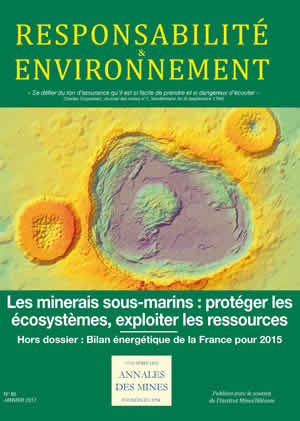
Responsabilité & Environnement
Les minerais sous-marins : protéger les écosystèmes, exploiter les ressources
Issue editor:
François JACQ
Issue 85
1 - Marine mineral resources and their economic context
Mining on the land, mineral resources on the seabed… and our hunger for raw materials
By François BERSANI
Ingénieur général des Mines
Unlike hydrocarbons, deep-sea mineral resources have not yet been worked much, apart from certain minerals near coastal areas. Nor have al these resources been identified, but there is now no doubt about their economic interest. As technological progress is being made, these resources could help supply the world with raw materials in a near future under condition that precautions be taken to protect the environment… and, too, depending on trends in market prices.
Hydrothermal mineralization: Scientific issues related to prospecting and exploration
By Yves FOUQUET
Ifremer
The economic promises of oceanic sources of sulfides are attracting industrialists. Estimates of the size and potential of deposits are not very accurate however. Our knowledge about mineralization mainly comes from scientific explorations. Active sites have thus been localized, but the inactive ones are of interest to industry. Technologic progress has been the prerequisite for exploring the seabed and assessing resources. Issues arise involving basic research, industrial interests and the strategies to be worked out for conservation of the environment. Several scientific studies must be conducted to understand the processes involving these metals, their mineralization and dispersion, and to set the conditions for sustainably mining them.
Technology developments in the exploration and evaluation of deep-sea mineral resources
By Sven PETERSEN, Mark HANNINGTON, Anne KRÄTSCHELL
GEOMAR, Helmholtz Centre for Ocean Research Kiel (Germany)
Manganese nodules, Co-rich crusts, and Seafloor massive Sulfides (SMS) are commonly seen as possible future resources that could potentially add to the global raw materials supply. At present, a proper global assessment of these resources is not possible due to a severe lack of information regarding their size, global distribution, and composition. The sizes of the most prospective areas that need to be explored for a global resource assessment are vast. Future deep-sea minerals exploration has to provide higher-resolution data and at the same time needs to cover large areas of the seafloor in a fast and cost-efficient manner. While nodules and crusts are 2-dimensional occurrences and an assessment of their distribution at the seafloor itself seems sufficient, seafloor massive sulfides are 3-dimensional sites and a proper resource assessment will always require drilling. Here the development of methods to image the subseafloor and to recognize economically interesting sites prior to drilling is of importance.
The economic stakes: What is the potential of marine mineral resources?
By Christophe-Alexandre PAILLARD
Chef du département « Intelligence économique et protection de l’information » du service de défense, de sécurité et d’intelligence économique du ministère de l’Environnement, de l’Énergie et de la Mer
Given technological developments that consume ever more metals, the demand for mineral resources is growing. This forces us to raise questions about the potential of undersea mining, which is currently restricted to a few sites near the coasts and the emblematic Solwara 1 program conducted by Nautilus Minerals in Papua New Guinea. The general conditions for undersea mining are still fuzzy. Three questions have not yet been clearly answered. What sort of mining technology is called for? How to assess financial costs? And what impact will undersea mining have on the environment? Given these questions, it would be very hazardous to make any prediction about undersea mining, despite its considerable potential. Aware of its interests, the French Interministerial Committee on the Sea (CIMer) approved in October 2015 a national strategy for prospecting for undersea deposits and mining the ocean floor.
The challenges of deep-sea mining: Global and European regulatory frameworks
By Gwenole COZIGOU
Directeur Transformation industrielle et chaînes de valeur avancées à la Commission européenne
Deep-sea mineral resources have been receiving attention as potential sources of copper, zinc, gold, lead, cobalt, rare earths and manganese. The attention now paid to the possibility of working undersea mineral resources has been aroused by the demand for these metals and the risk of shortages. Thanks to several decades of R&D on deep-sea mineral resources, we can now imagine mining deposits that used to be out of reach. Even though most of the requisite technology is now available, it is important, before moving on to the phase of commercially mining undersea fields, to acquire much more knowledge about this operation’s environmental impact and to adopt measures for reducing risks. It is also important and necessary to set up a suitable regulatory framework before starting to extract minerals. Despite many recent advances in knowledge and technology, the mining of deep-sea mineral deposits is still difficult from both technological and environmental viewpoints.
2 - A daunting task: Protecting ecosystems
The environmental impact of mining the seabed: State of knowledge
By Pierre-Marie SARRADIN
Ifremer
Jozée SARRAZIN
Ifremer
and François H. LALLIER
Professeur, CNRS
The potential mining of deep-sea mineral resources necessitates asking, before actual mining operations start, questions about the impact on ecosystems, the goal being to better prevent or limit this impact or even propose procedures for mitigating it and restoring an equilibrium. Assessing the potential impact is still hard to do given our lack of knowledge, on the one hand, about the mining techniques that industrialists will be using, and, on the other hand, about fundamental scientific aspects. Research is needed on the evaluation of biodiversity, the dynamics and functions of deep-sea ecosystems, and the coupling between waters in the deep sea and the rest of the ocean.
Mineral resources, environmental risks and strategies for managing biodiversity: Zones with nodules in the northeastern Pacific
By Lénaïck MENOT
Chercheur en écologie benthique au laboratoire « Environnement profond » de l’Ifremer
The discovery a half-century ago of polymetallic nodules set off the first rush toward deep-sea minerals. Over these past fifty years, advances have been made in exploration, international law and the environmental sciences but not all at the same pace. Exploration of the nodular zone in the northeastern Pacific – its total surface area being equal to Europe’s, and the fields with workable sites covering an area as big as France – was soon farmed out under contracts. Exploiting these resources will undoubtably have lasting consequences, not yet well known, on a diverse and vulnerable fauna. The international authority set up in 1994 to manage undersea resources and the environmental impact of deep-sea mining decided, in 2012, on a plan. The scientific recommendations underlying it were based on knowledge that was, at the time, fragmentary. Furthermore, this decision concerns an area where exclusive exploration rights had already been granted.
“Why not the abysses?” IFREMER’s research program for improving knowledge on deep-sea biodiversity
By Sophie ARNAUD-HAOND
Écologue à l’Ifremer
and Florence PRADILLON
Chercheur au Laboratoire « Environnement profond » de l’Ifremer
Launched in 2016, IFREMER’s program “Why not the abysses?” (ABYSS) has the objective of drawing up a new inventory of deep-sea biodiversity worldwide. New molecular techniques will be used for access to the so-called “environmental DNA”. DNA strands isolated in water or sediment samples can now be used to detect the species that are living in an environment or used to live there. Based on a systematic description of these samples from all oceans on our planet, this program will help establish a molecular inventory of the diversity of life in the seas, in particular in the depths and abyssal zones – 95% of which have not yet been explored. This in-depth review of this biodiversity sheds light on the factors that determine its distribution and persistence.
Addressing the Financial Consequences of the Unknown Environmental Impact of Deep-Sea Mining
By Sarah P. HOYT, Linwood H. PENDLETON, Olivier THÉBAUD, Cindy Lee VAN DOVER
Independent Consultant
The emerging deep-sea mining industry faces an opportunity for tremendous economic gain through the commercial harvest of a variety of high-grade minerals found at great ocean depths around the world. A certain negative consequence of mining, and thus a potential flashpoint for social conflict, lies in the damage to deep-sea ecosystems that will result from these activities. To advance the conversation on managing the economic consequences of currently unknown environmental impacts of deep-sea mining, we develop a typology of potential environmental impacts. We draw on the literature from similar industries to show how others have implemented financial tools – specifically, environmental bonds, environmental insurance, and mutual insurance – to deal with each type of impact. We argue that proper planning is needed to specify and identify the most appropriate mechanism, or combination thereof, that provides adequate financial protection against unknown environmental impacts related from deep-sea mining.
Impact assessments of mining the seabed: A necessary but still difficult step
By Jean-Damien BERGERON, Ronan LAUNAY, Jean-Marc SORNIN
CREOCEAN
The ethical responsibility for working mineral resources in untouched natural areas has received recognition. National regulations about exclusive economic zones as well as international regulations (International Seabed Authority) require detailed impact assessments for such operations. For a description of the initial state of potential mining sites, these assessments must be based on reliable data covering all aspects of the marine environment (fauna, flora, sediments, water columns). The current state of knowledge on the seabed is still far from adequate. Assessing the impact of mining also requires knowledge of the industrial processes to be used, most of which are confidential or incipient. Environmental assessments must, from the start, take into account such innovations. The very few environmental impact studies currently available are limited by blind spots in knowledge. They underscore the need to gather much more data and to make further innovations in prospecting and mining techniques.
3 - A regulatory framework and tools for sustainable mining
International legislation provides a framework regulating the access to marine mineral resources
By Élie JARMACHE
Chargé de mission au Secrétariat général de la Mer, membre de la commission juridique et technique de l’Autorité internationale des fonds marins (AIFM)
International mining law is mainly maritime. It concerns the seas, their depths and the zones where no state exercises jurisdiction but over which an international authority now has competence: the International Seabed Authority, whose major duty is to regulate deep-sea mining. The players in this field are nation-states, state firms, private companies and the Enterprise, the ISA’s own mining operator. This setup concerns all phases from exploration and prospecting to actual mining. Till now, three types of mineral resources have been subjected to international regulations: nodules, polymetallic sulfides and cobalt-rich crusts. The international and national regulatory systems on mining share common points but also reflect differences of viewpoints.
EXTRAPLAC: Questions about the French continental shelf
By Walter R. ROEST
Ifremer et membre de la Commission des limites du plateau continental
The UN’s Law of the Sea Convention, adopted in 1982 and ratified by France in 1996, attributes sovereign rights to nation-states over an exclusive economic zones extending from the coasts out to 200 nautical miles (approximately 370 km). Under article 76 of the Convention, a state may claim an extension of this zone to 350 nautical miles (or even farther under certain conditions) if the continental shelf stretches beyond the 200-limit. It is, of course, necessary to prove that this condition holds. For this purpose, France launched, in 2002, a national program, EXTRAPLAC, for assembling the scientific and technical evidence that demonstrates the validity of such an extension from the coasts of the country and its overseas departments and territories. This program will submit the evidence to, and even defend it before, the UN Commission on the Limits of the Continental Shelf. Through this program, France is addressing important questions about extending its continental shelf, among them: the access to natural resources, protection of the environment, scientific research and the country’s geopolitical strategy. Despite the legal and its diplomatic context, EXTRAPLAC is still, first and foremost, a scientific program.
The Secretary-General of the Sea: Active in deep-sea research policy
By Vincent BOUVIER
Secrétaire général de la Mer
The French Secretary-General of the Sea plays a leading role in matters related to the exploration and exploitation of the seabed. This role has three principal aspects: drafting a strategy, following up on programs and integrating them in an international environment.
What are French industry’s strong points for deep-sea mining?
By Francis VALLAT
Président fondateur du Cluster Maritime Français et président de l’association « SOS Méditerranée »
Deep-sea mineral wealth is an opportunity for humanity under condition that the environment be protected. France has considerable advantages in this domain: a dynamic maritime economy, a dense and diversified industry (big groups as well as small and midsized firms), an adapted research facilities, champions recognized among the best in the world for each stage in the mining process (from exploration to production), and a government that is apparently realizing that the country is lucky to see a major branch of industry emerging, comparable to the nuclear industry or aeronautics. However France also has handicaps: an anemic, slow-moving government and a confused, contradictory Europe that seems poorly equipped to gauge the means needed. Two of the most active countries (Germany and Japan) in this domain have contacted French professionals. The choice has been made for industry: we must advance with Germany, since we have already taken the first steps together.
A state-of-art mining of undersea minerals
By Julien DENÈGRE
Chargé du développement commercial au sein de Forsys Subsea
Apart from the mining of diamonds at a depth of 150 meters, no long-term commercial operation has yet successfully gathered solid minerals at depths of more than 200 meters. In January 2011, Nautilus Minerals obtained its first concession for mining polymetallic sulfides in zones near Paua New Guinea. Having developed a system for mining these deposits, this Canadian company will carry out the first tests in 2019. France has a consistent set of advantages in matters related to the seabed and undersea mining: resources, skills, and an expertise unique in the world. Its players have formed a work group in the French Maritime Cluster. The government has offered an award in a competition open worldwide on innovations for developing marine resources. It has provided funding to two of the most innovative projects selected and has federated several French industrialists around two consortiums (MELODI and FONASURF) for developing the tools and techniques of deep-sea exploration and mining.