
October 2019
abstract
Responsabilité & Environnement
La pollution de l'air
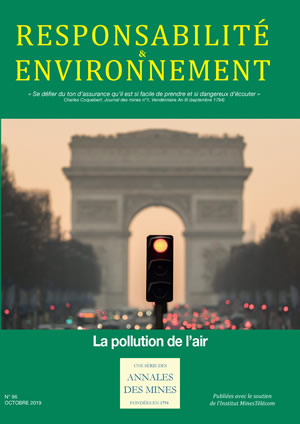
Issue 96
1 ‒ Air pollution: Problems
Air pollution, a general presentation
By Sophie VASLIN-REIMANN
LNE
The general context of air pollution is presented in relation to its sources. Its multiple origins are pointed out along with the national and international efforts made to reduce this form of pollution.
The effects of air pollution
By Eva LEOZ-GARZIANDIA
Laboratoire central de surveillance de la qualité de l’air (LCSQA)
By shedding light on the effects associated with pollution of the atmosphere, public policies can, thanks to public awareness, be adopted to protect the points of impact of pollution, namely human health and the environment or, more broadly, ecosystems as a whole. Several national and international studies help us estimate the number of exposed persons and better understand how this pollution acts on human health. The impact of atmospheric pollution on natural and farming ecosystems is being monitored in Europe, and knowledge about it is advancing. Besides the effects observed on various types of environments, air pollution also has major economic consequences. Since climate change and air pollution are tightly related, the actions for reducing emissions must be identified that will help to deal with both.
Reducing emissions in the air from industrial plants
By Jean-Luc PERRIN
direction générale de la Prévention des risques/MTES
The industrial plants likely to be a danger for the environment fall under French legislation on “classified installations”. Approximately 1600 inspectors enforce this legislation by investigating demands for permits and prescribing the regulations (to the department’s prefect) for overseeing operations locally. These technicians regularly inspect these plants and eventually propose modifying the rules prescribed. They are assisted in their everyday work by teams from the Ministry and DREAL’s regional headquarters. Furthermore, they may rely on public establishments and agencies for granular appraisals by experts. Thanks to this organization, emissions into the air from industrial installations have been curbed through the investments made by the industries concerned in compliance with the EU directive for regulating long-distance, crossborder air pollution. Initially centered around installations, this legislation has evolved toward regulating complex “objects” such as industrial platforms and dealing with risk reduction and emissions on this scale. The inspection chain from the Ministry down to inspectors allows for handling problems locally in line with national plans and strategies.
The impact of air pollution on human health
By Jorge BOCZKOWSKI, Sophie LANONE
INSERM et Université Paris Est Créteil
The exposure to high levels of air pollution ‒ a major health-related environmental risk ‒ affects not only the respiratory but also the cardiovascular and central nervous systems. It is noteworthy that these effects depend on air quality and, too, on the persons affected and their vulnerability (children, the agèd, patients with preconditions, etc.). The pollutants usually associated with these harmful effects on health are: gases (ozone, sulfur and nitrogen oxides…) and particulates. A major difficulty comes from the complexity of the atmosphere’s composition. Innovative experimental procedures are needed to better understand these effects; and efforts must be sustained for protecting the population from the noxious effects of air pollution.
Reinforcing the fight against air pollution
By Charlotte, LEPITRE
France Nature Environnement
Air pollution has been recognized as a social issue and a cause of risks to health and the environment, but several points must be reinforced to cope with this menace. First of all, monitoring so as to identify pollutants and the sources of emissions will provide a guide for research and, too, for communications and actions. There is also a strong need to reinforce information: providing the right information and the keys for interpreting it in relation to the targeted public are factors that raise awareness and spawn actions. When facing a threat, the major goal is to eliminate, or at least curb, it. Once the data have been collected and awareness has grown, the next step is to act to reduce the sources of emissions or, at least, exposure to them. By tightening surveillance, reinforcing information and solidifying the determination of stakeholders, there is no doubt but that a genuine policy for reducing air pollution will work.
2 ‒ Public policies
European policies
By Daniel CALLEJA CRESPO
Directeur général de l’environnement de la Commission européenne
Every year, ambient air pollution causes more than four million deaths in the world. In Europe, it accounts for four hundred thousand deaths per year, while exacerbating chronic illnesses such as asthma, cardiovascular problems and lung cancer. Its very high cost, approximately €24 billion per year in the European Union, is due to: health expenditures, days of work lost, and damage to crops and buildings. What is the EU doing to fight against this omnipresent calamity? What share of responsibility does France have? What is the European Commission (the guardian of European treaties) doing to protect EU citizens? The author, director-general of the Environment to the European Commission, recounts the history of this sensitive issue and discloses the factors underlying breaches of EU law, which now concern about twenty member states.
French policies for fighting against air pollution
By Loïc, BUFFARD
Ministère de la Transition écologique et solidaire DGEC
Atmospheric pollution, one of the leading environmental preoccupations of the French, is the second cause of mortality after tobacco, and the first cause of passive mortality. Public interventions are a sensitive issue, since the emissions of several pollutants must be reduced while taking into account complex chemical phenomena in the atmosphere. It is, above all necessary to reduce diffuse emissions, but such interventions are difficult and expensive. For the sake of efficiency, the priority is to lower the population’s exposure to chemicals by using all available levers from the international down to the local level. Given the keen resistance, the population must be mobilized; and its awareness of this issue, raised. Strong public actions are indispensable, but they will not vouchsafe the right of everyone to breathe healthy air unless the question of air pollution is fully integrated in policies of urban planning and territorial development.
Four years afterwards, an update on “Dieselgate”
By Cédric BOZONNAT
Ministère de la Transition écologique et solidaire/DGEC
In September 2015, the US Environmental Protection Agency accused Volkswagen of having equipped its diesel vehicles with software for circumventing emission controls. The investigations conducted in France (by the committee set up by Minister Ségolène Royal) and similar studies carried out in other countries have found that several vehicles of various brands had emissions far above the legally set limits. Automakers in Europe called back more than ten million motor vehicles. As a consequence of this scandal, known as “Dieselgate”, European lawmakers accelerated their efforts to control such emissions: in particular, by requiring a new set of tests under real driving conditions. Manufacturers are under an obligation of transparency with respect to their strategy for reducing emissions from their vehicles. Each member state has to set up effective market oversight by conducting tests on vehicles in service. In addition to tighter controls on emissions of air pollutants, Europe also intends to regulate CO2 emissions from motor vehicles. It has set an ambitious calendar for automakers: reduce emissions from new vehicles by 37.5% in 2030.
Indoor air pollution: From knowledge to action
By Nadia HERBELOT
ADEME
We spend 80% of our time indoors: in houses, transport, offices, schools, factories, etc. A major public health issue is to improve our knowledge about the quality of indoor air. France is drafting its fourth National Health Environment Plan (“My environment, my health”) under the auspices of the ministries of the Environmental Transition and of Health; and this topic has been made a priority and emblem. Nonetheless, knowledge about the quality of indoor air in specific environments, about its determinants and effects on people, is still piecemeal, even though awareness of this issue has grown during the past ten years. Research on these environments has to be pursued so that each party can identify drawbacks and levers, and effectively act to preserve and improve indoor air quality.
Air pollution in China
By Bertrand BESSAGNET
Futuris Environment Ltd ‒ INERIS
Over the past two decades, China has undergone an economic growth unprecedented in modern times and switched from being a developing country to being a driving force in many fields of technology for the rest of the world. This rapid development has come along with a rural exodus toward big urban centers, and brought strong pressure to bear on natural resources. It has very much affected air quality. Increasingly drastic measures have limited air pollution and remarkably improved the situation during the past five years. This issue could be addressed thanks to the quality of Chinese researchers in this field, the pragmatism of officials and support from a population who feels concerned. China now ranks as a leader in developing new energy sources and innovative techniques for conserving the environment. Stakeholders are aware of the efforts still to be made, in particular in farming, energy production and storage, and the reduction of both methane emissions and ozone concentrations (which have slightly increased). Efforts must focus on the sectors of energy, mobility (transportation), agriculture and the water supply. As elsewhere around the world, policies for controlling emissions of pollutants will have to be effectively coordinated with policies for fighting against global warming.
Public policies for fighting against air pollution: The findings of the French Court of Auditors
By Ève DARRAGON, Marie-Ange MATTEI, Julien MARCHAL
Cour des comptes
Released in 2016, the report on French public policies for fighting against air pollution has drawn attention to the impact of this pollution on public health and argued for an ambitious policy to address the issue. However governance in the field of air quality has fallen short. The policies pursued have had contradictory effects, and efforts have varied widely depending on the sector of activity. Successive national plans (never fully implemented) have tended to respond to injunctions from the European Commission more than to provide lasting guidelines for action. Furthermore, an ex post cost-benefit ratio has never been calculated. Since the measures adopted have not enabled France to reach, in many areas, the European thresholds set for the concentration of particulates and nitrogen oxides, the European Commission is undertaking legal action. The French Court of Auditors has pointed to the need for urgent actions in support of a clear, ambitious, long-term policy, even more so since an EU directive (NEC modified for 2030) has set new objectives for reducing emissions.
Air pollution: Our health is not always adequately protected
By Janusz WOJCIECHOWSKI, Colm FRIEL
Cour des comptes européenne
Under the European Union treaty, the European Court of Auditors is an external body for auditing EU finances. Although its reports are not political, its conclusions and recommendations convey messages for improving the efficiency and effectiveness of the management of public finances. Its recent social report on air quality in the EU, which was also presented during the Climate Summit (COP24) in Katowice, bears such a message. It has had a strong impact on public opinion and spawned articles in the media, both European and international. This hardly comes as a surprise since air pollution is at the origin of the EU’s biggest public health crisis. Illnesses related to air pollution account for more than 400,000 premature deaths per year in the Union, mainly in central and eastern Europe. However no adequate response has yet been found. The EU devotes a tiny percentage of its budget to actions for directly improving air quality, while granting much more sizeable means to programs that ultimately deteriorate air quality. The Court’s role is not to tell the EU how to spend nor how much to spend, but to verify whether EU funds have been allocated legally and spent as foreseen, and to check their results and value. For the Court, the key priorities are the sustainable use of natural resources and the adoption of measures in favor of the climate. The aforementioned report was presented prior to the debate on the EU’s pluriannual financial framework for 2021-2027. We can expect that the European Parliament and Council will take it under consideration when setting budget priorities. The acceptance by the European Commission of the Court’s remarks and recommendation should reinforce the audit’s social impact. A presentation of this audit’s major findings along with its recommendations…
Associations certified for monitoring the quality of the air: At the service of local authorities who want to improve air quality
By Guy BERGE
président de Atmo France
Given 68,000 deaths per year in France, air pollution is an escapable health, economic and political problem and, too, an ever more cogent societal expectation. The responsibility for improving air quality is shared with local authorities. As a lead partner and/or owing to their powers, these authorities help, along with state services, to carry out measures for improving air quality. They can rely on the associations certified for monitoring the quality of the air (AASQA). As a player in national arrangements for monitoring air quality, these associations have acquired a genuine expertise for monitoring, studying and predicting air quality and undertaking actions on it. Their skills are made available to help local officials take account of air quality in their decisions and communications about urbanism, the quality of life and the environment.
Local authorities, key players for improving air quality
By Nadia HERBELOT
ADEME
Despite the noticeable progress made during the past twenty years, the concentration of pollutants in the air is, in some zones (in particular, densely urbanized areas and mountain valleys), higher than the levels set by EU directives on air quality. All branches of the economy pollute the atmosphere. In 2017 for instance, 63% of nitrogen oxides nationwide were emitted by transportation; 97% of ammonia, by farming; and 36% of PM10 particulates, by the residential tertiary sector as compared with 28% by industry, 20% by agriculture and 14% by transportation. However these national statistics cover geographical disparities since, for example, transportation accounted for 34% of PM10 emissions in the Île-de-France Region. There is every reason for conducting actions to reduce air pollution in all branches of the economy and on various scales. Local authorities, given their duties and obligations (PCAET: climate, air and energy plans) as well as their powers (in urbanism, housing, transportation and energy), have levers for undertaking effective actions on air quality.
Air pollution: What NGOs want
By Olivier BLOND
Respire
In France, air pollution kills 48,000 people every year and is, therefore, at the origin of a major health crisis. However the government’s response, specifically from the Ministry of Health, is not on par with the issue. Evidence of this comes from a comparison with public policies about road safety or against smoking, and from the opinions formulated by administrative courts, the Council of State and even the European Union. NGOs are calling for the adoption of a major national plan against air pollution.
Measurable, reportable and verifiable standards for national inventories of air pollutants
By Jean-Pierre CHANG, Nadine ALLEMAND
Citepa
Inventories of emissions of pollutants are necessary to meet reporting requirements under international and European regulations, which are binding on France. These requirements involve drafting public policies for improving air quality and monitoring the measurements made for this purpose. These efforts can be effective only if measurable, reportable and verifiable (MRV) rules are implemented. A detailed description of MRV in making inventories of pollutants is presented….
3 ‒ Economic issues, technical prospects and research
The economic stakes and the costs air pollution
By Yves CROZET
Professeur émérite à Sciences-Po Lyon, Laboratoire Aménagement Économie Transports
Although air quality has improved continually in Paris, the urban agglomeration experienced in 2018 six episodes (lasting several days) of pollution above authorized thresholds. This apparent contradiction can be set down to the rising level of requirements, since we now know more about the emissions and concentrations of various types of pollutants and their effects on health. Physical data on morbidity and mortality related to air pollution are being turned into monetary data for calculating costs, thus providing a basis for following economists’ recommendations about internalizing external costs (which economic agents do not spontaneously take into account). This internalization occurs in several ways. The most current is via regulations (for example, low-emission zones). However the most effective is pricing which, owing to its effectiveness, spurs several forms of opposition.
Regulatory and tax tools for reducing the emission of pollutants from industry
By Paul BOUGON, Richard LAVERGNE
Conseil général de l’Économie (CGE)
Public authorities use so-called “environmental” regulations and taxes to make economic agents take account in their decisions of the impact of the pollution caused by their businesses and to reduce it. Taking an example in which these two tools were used to reduce the pollutants emitted by industrial plants, an analysis is made of each tool’s strengths and weaknesses.
A historical account of the reduction of sulfur dioxide emissions in French refineries
By Franck CHEVALLIER
UFIP (Union française des industries pétrolières)
For a long time now, the oil industry has been committed to improving air quality at its refineries and, too, in relation to the quality of its products. Refineries have undertaken major efforts, technically, organizationally and economically, to reduce emissions into the atmosphere, whether the emissions are made by the refineries or by the customers/users of their products. Sulfur dioxide (SO2) offers a good example of the progress achieved: emissions during the refining process in France have dropped more than 80% over a thirty-year period, during which the quantity of crude oil refined changed much less. Major investments have been made to adopt the best techniques available to both reduce emissions at the location of refineries and produce petroleum products of an ever improved quality with very little sulfur ‒ thus enabling automakers to develop technology for reducing even more emissions from combustion engines. The refining industry has also developed model-building software and is using it to conduct impact assessments and make predictions during spates of pollution (by relating predictions about the dispersion of smoke and emissions with weather forecasts). The positive effects on air quality are observable. Furthermore, the exceedance of the critical value set as a limit for the concentration of SO2 in the ambient air now seldom occurs on plant locations and in nearby agglomerations. Given the low levels of emissions and concentrations of SO2 now achieved in France, any measures for further reductions should be rigorously assessed, since they might push costs higher for an effectiveness and benefits that are ever smaller.
Are technological innovations really at the service of air quality and public health?
By Caroline VAN RENTERGHEM
WAIR
Innovations, each more revolutionary than the others, are continually proliferating to help this breather healthier air. Although these innovations can help us in the short term, only changes of behavior and of policies can settle the problem in the long run.
Monitoring: Its organization and metrology
By Tatiana MACE
LNE
Under the decision of 19 April 2017 on a national program for monitoring ambient air quality, the Central Laboratory of the Surveillance of the Quality of the Air (LCSQA) has to vouchsafe “the accuracy and quality of the data for assessing air quality”. To meet this requirement, this laboratory has procedures for checking the reliability and comparability of data over space (France and Europe) and time, and verifying whether they meet European requirements and satisfy the needs of monitoring services. These procedures entail the following actions: a) relating measurements of air quality to national benchmarks; b) involving the LCSQA and AASQA (associations certified for monitoring the quality of the air) in interlaboratory comparisons; c) having the LCSQA carry out technical audits of the AASQAs; and d) verifying the technical compliance of measurement devices with the requirements set by EU standards.
Measuring pollutants from space
By Carole DENIEL
CNES,
and Camille VIATTE
LATMOS/CNRS
Techniques for measuring from space the gases in the atmosphere have constantly improved, and can now be used to probe the lowest layers of the troposphere and monitor air quality. The main tools used from space are high-definition spectrometers, which measure spectral components (from infrared to ultraviolet) to assay the atmosphere’s composition. We can no longer do without observations from space, which are combined with measurements from the ground and with models of the atmosphere. Most scientific studies use them, not to mention the software programs for improving our knowledge of physical and chemical processes from the global down to the local scale. The world map of ammonia concentrations ‒ drawn by an IASI from space ‒ has pinpointed significant underestimates in inventories of emissions. Thanks to the European program Copernicus, new services will be offered to help manage environmental crises.
The current state of research on air quality and its prospects
By Gilles FORET, Isabelle COLL, Patrice COLL
Laboratoire Interuniversitaire des systèmes atmosphériques (LISA), UMR CNRS 7583, Université Paris-Est-Créteil, Université de Paris, Institut Pierre Simon Laplace (IPSL)
Air pollution is still a major environmental problem. Despite the consequent efforts made to limit it, pollutants are still in the atmosphere at concentrations that cause health problems, especially in Asia and Africa. Although our stock of knowledge about toxicology, epidemiology and the physical chemistry of the atmosphere has considerably improved over the past decades, major doors for science have still not been opened. For solutions to be more effective, we need to better link sources of pollution to their effects. This means improving estimates of the exposure of individuals and obtaining more knowledge about pathologies and the processes associated with them. This calls for multidisciplinary approaches involving several partners: institutions, socioeconomic agents, local authorities and, more directly, citizens.
Miscellany
The AGREGA program: An educational tool of market simulations on aggregates in Île-de-France Region
By Jacques SCHLEIFER
Bruno TESSIER
Isabelle THENEVIN
Centre de Géosciences, MINES ParisTech, PSL Université,
Carole DENEUVE
Christine MALLENS
UNICEM,
and Laurent GOETHALS
Andreil Game
The “Grand Paris project”, with its railways, tracks, housing and networks will greatly impact the already stretched market of aggregates of the Île-de-France area. In order to mitigate this risk, the stakeholders in this market have been mobilized around a partnership research program named AGREGA and founded by the French National Research Agency. This project has made it possible to develop a tool for visualizing the fluxes of aggregates. This software package is equipped with a mathematical solver to match the offer to the demand in different configurations. This part has been implemented by Mines Paris-Tech Geosciences Center. The tool relies on an up-to-date and realistic database provided by UNICEM, and a friendly interface designed by Andreil Game inspired from a serious game. In this article, the tool is fully described, the input data, the output files as well as the market resolution method. Finally, the presentation of some results for the current year and 2024 show the societal interest of this approach. This may allow considering a strategy of resource management to meet the qualitative and quantitative needs in raw materials, while limiting the tonnages transported and more generally the environmental footprint.
Simulating an electricity mix with the storage of current but without fossil fuels
By Ilarion PAVEL
Conseil général de l’Économie (CGE)
This mathematical model of an electricity mix allows for the storage of electricity but not for the production of current from fossil fuels. Under various hypotheses (that the production from nuclear energy remains at 72%, or falls to 50% or is fully halted), calculations are made of the capacity for storing electricity, the quantity of current that will have to come from solar and wind power, the installations to be built and the related costs.