
April 2020
abstract
Responsabilité & Environnement
Actualité de la catastrophe
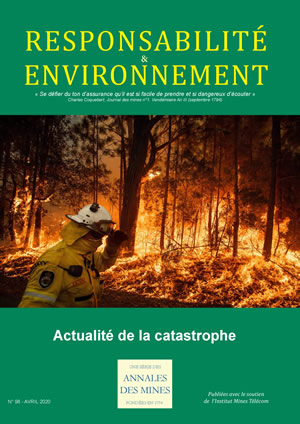
Issue 98
Catastrophe, a multifaceted concept
Learning from the past how to better handle catastrophes
By Emmanuel GARNIER
CNRS
By drawing on historical sources in the written archives and on images and architecture, extracting, conserving and conveying the memory of past catastrophes prove to be important activities that provide feedback for reinforcing the resilience of contemporary societies, as their vulnerability augments. As the grounds for reconstructing the long-run “trajectories of vulnerability”, history brings to light turning points related to the exposure to risks and lack of adaptation. This helps us dispute the tenet of “never seen before”, a force that increases risk exposure. A comparative approach is then proposed from floods in France (the Seine), British examples of reconstruction after a catastrophe, and a Japanese model for boosting our memory of risks.
Tectonics and religions
By Thierry GAUDIN
Président de l’association Prospective 2100
The analysis of ice cores, a technique invented by Claude Lorius, has helped us not only understand the evolution of the climate but also identify explosions of volcanoes (their dates, characteristics and effects). Apart from the explosion of Mount Vesuvius, which destroyed Herculaneum and Pompeii in 79 CE, a few lesser known but just as devastating examples are presented in which unexpected eruptions made the powers-that-be and even religions quake.
The paradoxes of prophesying misfortune: A critique of collapsology
By Jean-Pierre DUPUY
Stanford University
In the past few years, a “catastrophist” environmentalism, called collapsology, has made a remarkable impression on public opinion in France. Its supporters are fighting for the right cause, since no one can dismiss an eventual “collapse” of industrial civilization (or even the end of the world). However their message has serious conceptual deficiencies. If heeded, it will eventually spawn panics, which prophecies of coming catastrophes do not fail to trigger. Light is shed on a fallacy involving the time line separating us from a catastrophe announced but at an unknown date. The disciplines involved in collapsology are all branches of philosophy: metaphysics, logic, ethics and politics.
Futurology, catastrophes and “collapsology”
By Jacques THEYS
Ancien enseignant à l’EHESS, vice-président de la Société française de prospective
Public opinion has suddenly become aware of the extreme seriousness of the decline in biodiversity and of climate change. This situation provides an echo chamber for the hypothesis of a soon-to-come collapse of “socioecological” systems. Collapsology has several aspects: an emotional shock, an ideological view of the future, a new science and predictions about the future. Only the last two are discussed herein, since the intent is to restore futurology to its place in this debate and show how it differs from collapsology in terms of both its epistemology and hypotheses about the future. Although questions about the risks of (at least partial) collapses are grounded, there are no grounds for the shortcuts that collapsology takes to make dire predictions about the near future, nor for the attitude of “withdrawal” that it advocates. Less fatalistic and categoric, futurology, a practical art oriented toward action, prefers staking out a position between two extremes that it refuses: the denial of the catastrophist hypothesis and the certitude of its realization.
Catastrophes: News and newness
Catastrophic forest fires
By Éric RIGOLOT & Jean-Luc DUPUY & François PIMONT & Julien RUFFAULT
INRAE
Une recrudescence des incendies extrêmes est observée sur tous les continents. Trois principaux facteurs aggravants sont discutés. La croissance démographique et l’étalement urbain augmentent l’exposition des biens et des personnes, et multiplient les mises à feu accidentelles. Les changements d’usage des sols favorisent le développement de la biomasse combustible. Enfin, le changement climatique et les sécheresses associées accroissent la combustibilité des végétaux et, de fait, la propagation des feux. Les interactions entre le risque d’incendie et d’autres risques d’origines biotique et abiotique sont ensuite illustrées, notamment l’effet retour des incendies extrêmes sur le climat par la libération massive de gaz à effet de serre. Nous concluons sur des recommandations pour la France en matière de gestion massive du combustible, de planification territoriale et de responsabilisation des citoyens. L’efficacité de ces mesures sera jugée à l’aune des dommages socio-écologiques évités plutôt que des gains en termes de superficie brûlée.
The issues raised by reconstruction following Hurricane Irma
By Jérémy DESARTHE & Nicolas BAUDUCEAU & Antoine QUANTIN
Caisse centrale de réassurance (CCR)
When it struck the French Antilles in September 2017, Hurricane Irma reminded us of the exposure of this zone to natural risks. By covering two billion euros of insured damages, the system of compensation for natural catastrophes demonstrated its capacity for handling the most costly event since its creation in July 1982. The scope of damages forced various parties to address several issues. Insurers were faced with devastated insular areas that were hard to reach. State and local authorities have had to cope with multiple problems since a rapid start was planned for reconstructing the island of Saint Martin. Irma was also an occasion for reflecting on our policies for managing risks overseas, where the insurance penetration rate is much lower than in Europe. Are these policies capable of measuring up to extreme events, which climate change will make more frequent?
A performance appraisal of the 2017 hurricane season in the Antilles
By Élie CHEVILLOT-MIOT
INHESJ, département Risques et Crises
Ingrid CANOVAS
LATTS, École des Ponts, Université Gustave Eiffel
Cheila DUARTE-COLARDELLE
INHESJ, département Risques et Crises
Christian IASIO
BRGM
Thierry WINTER
BRGM
and Valérie NOVEMBER
LATTS, UMR 8134 CNRS, École des Ponts, Université Gustave Eiffel
A project post mortem helps us benefit from feedback on extreme events, like the 2017 hurricane season in the French Antilles. This sensitive, complex procedure calls for taking account of not only the conditions and uncertainties related to three major hurricanes but also the effects of the actions and decisions of a broad network of actors who intervened at various levels. A performance appraisal should capitalize on individual and group experiences in order to optimize decision-making during abnormal crisis situations, especially given climate change with its unpredictable effects. Feedback has, herein, taken the form of a database with diverse, descriptive data on risks, contingencies, the actions undertaken, interactions between services, etc. The aim is to enhance our knowledge and provide grounds for decision-making by both public and private actors at all levels (operational, tactical and strategic).
French research on natural catastrophes and risks: An assessment of a decade of funding by the ANR and the prospects
By Anne LIEUTAUD
Agence nationale de la recherche (ANR)
Maud DEVÈS
Université de Paris, Institut de physique du globe de Paris (IPGP) et Institut Humanités, sciences et sociétés (IHSS)
Nicolas ECKERT
INRAE, LabEx OSUG
Gilles GRANDJEAN
Bureau de recherches géologiques et minières (BRGM)
Mélanie PATEAU
Agence nationale de la recherche (ANR)
and Céline BILLIÈRE
Agence nationale de la recherche (ANR)
As the Sendai Framework for Disaster Risk Reduction has pointed out, the success of policies for managing and preventing risks depends on an involvement of the whole society. Scientific research plays a fundamental role as a knowledge-provider. In 2019, the Agence Nationale de la Recherche (ANR) sought to assess the research programs that it has funded on themes related to natural risks and catastrophes. This task, conducted by an ad hoc scientific committee, resulted in a publication and then a seminar with researchers (organized in cooperation with AllEnvi and Athéna). The principal points in this assessment are presented along with the lines of thought pursued during the seminar.
WannaCry, a planetary nightmare
By Jean-Luc AMINOT
Commissaire divisionnaire honoraire ‒ Université de Paris (Master Ingénierie des risques)
On 12 May 2017, the planet discovered WannaCry, a ransomware being used in a massive, unprecedented cyberattack. Within four days, this malware infected more than 200,000 computers in 150 countries. In Europe, the information system of Britain’s National Health Service was nearly paralyzed; and several big private firms, infected. WannaCry raised the problem of the latent insecurity of the networks that convey billions of data per day in our developed societies. As a consequence and given the obligations related to personal data protection, a genuine attitude of vigilance, protection and resilience must be adopted despite the legacy equipment (that could be improved) in information systems and the growing heterogeneity of these systems. Organizations are being asked to devise an overall strategy for orienting our societies toward vigilance, effective technological protection and genuine resilience.
Fukushima: Making decisions in extreme situations
By Franck GUARNIERI & Sébastien TRAVADEL
MINES ParisTech/PSL, Centre de recherche sur les risques et les crises (CRC)
The decision by the director of the Fukushima nuclear power station to inject seawater to cool the reactor’s fuel rods reveals the limits of defining security exclusively in terms of obeying normative instructions. The unprecedented actions accomplished by operators at this power station over several days to keep the reactors from melting down reminds us that crisis management ultimately depends on human beings, on their involvement, imagination and decision-making ability their capacity for making choices, all this sometimes with heavy consequences.
Acting together to cope with catastrophes
The doctrine of nuclear safety: Continuous improvements to better manage nuclear accidents
By Jean-Luc LACHAUME & Sylvie CADET-MERCIER
Autorité de sûreté nucléaire (ASN)
Since the 1970s, the French doctrine of nuclear safety has been modified to take account of the lessons drawn from incidents and accidents around the world. Initially, the priority was to prevent accidents. Over the years, emphasis was shifted toward limiting the effects of accidents and managing emergencies. This trend has led to a considerable reinforcement of nuclear installations. An analysis of the factors that trigger more complex accidents (which result, in particular, from an accumulation of events) has led to adopting additional material and organizational measures for limiting the effects of radiation. After the Chernobyl accident, attention was turned toward protecting the population; and crisis management during the phase following the release of radioactive substances has been developed to better handle an accident’s long-term effects on health, the society and environment.
Managing catastrophes: Outside our steering range
By Patrick LAGADEC
Directeur de recherche honoraire à l’École polytechnique
At the start of the 1970s, a report made waves in Great Britain; and the conclusion was soon drawn that the current complexity of industrial installations and the exponential quantity of products in storage were reasons to overhaul the management of risks related to technology. In France, an equivalent trend led to a review of high-risk installations: the Seveso directives, the requirement of appraisals by experts, the information to be given to neighboring areas, the preparedness for major accidents. Should this process, half a century later, be repeated but with even higher goals? Major systemic interdependencies and turbulence has upended our mapping of risks. We have to “fracture our mental universe” and create the conditions for inventing new collective means of “steerage”, since the risks we now face have moved beyond our range of vision and beyond the procedures and tools imagined.
Resilience: On the right or wrong track?
By Magali REGHEZZA
École normale supérieure, LGP˗UMR 8591
Resilience, initially a descriptive scientific concept, became, at the turn of the century, a key theme in international policies for reducing the risks of catastrophes (RRC). In academia, several critiques have been aimed at this fuzzy, polysemous word. Although it is difficult to make it operational, resilience opens interesting perspectives for overhauling risk prevention and crisis management. Far from promising miracles, resilience as a specification can be taken to be a method that, despite uncertainties, integrates various aspects of risk-reduction as well as the medium and long terms.
Catastrophes and health: Conceptual and political aspects
By Pr. William DAB
Conservatoire national des Arts et Métiers, chaire « Hygiène et Sécurité », ancien directeur général de la Santé
Catastrophe is an ambiguous concept, a value judgement that brings nothing to decision-making. We have to resort to the notion of risk in order to assess and qualify catastrophes. Depending on the level of uncertainty, responses to risks are matters of prevention or precaution. A suspicion of risks might set off a crisis, whereas strong risks do not necessarily do so. Two implications of this come under discussion: on the one hand, the need to pay attention to social perceptions of risks; and on the other hand, the need to draft a policy for handling health risks lest the concept of catastrophe be trivialized.
Research, expertise and decision-making in crisis management
By Maud DEVÈS
Université Paris, Institut de physique du globe de Paris (IPGP) et Institut Humanités, sciences et sociétés (IHSS)
Science has an important function in relation to the risks of catastrophes, namely to provide the evidence to be used to devise collective actions. When a decision has to be made, scientists are naturally asked to intervene. However the forms of their interventions are variable; and it is not always easy to find the “right” place for them. Some of the inherent difficulties of articulating research and expertise are reviewed before inquiring into the new issues arising out of changes in the relation between science and society during the past decades.
Catastrophes: What do humanitarian organizations have to say?
By François GRÜNEWALD
Directeur général et scientifique du Groupe URD
As the environment is blighted owing, in particular, to climate change, accelerated urbanization and the growing vulnerability of large swaths of the population, managing risks and responding to their occurrences have become key issues in our societies. The “actors of solidarity” ‒ NGOs, multilateral procedures and, perhaps above all, state organizations devoted to solidarity ‒ are trying to react, each time making progress but still encountering many a hurdle. A major axis of thought is to place resiliency at the center of strategies for developing local areas and society. Given ever more extreme events, preparedness has become a requirement in order to be able to respond more rapidly and more effectively and to undertake a more resilient development following a crisis.
Miscellany
Levers of action for a clean, sure energy mix at the service of local authorities
By Florence CARRÉ
INERIS
Karine ADAM
INERIS
Raymond COINTE
INERIS
Olivier GENTILHOMME
INERIS
Mathieu BRUGIDOU
EDF
Olivier GUILLAUME
EDF
Pauline GABILLET
Métropole de Lyon
Corinne GENDRON
Université Québec à Montréal (UQAM)
Magali JAKUBOWICZ
Communauté d’agglomération du Beauvaisis
Jean-Yves LEBER
Écologie sans Frontière
Stéphane MOCANU
INRIA
Isabelle MORETTI
Université de Pau et des Pays de l’Adour
Éric VIDALENC
ADEME
and Jacques VILLENEUVE
Bureau de recherches géologiques et minières (BRGM)
Local authorities are increasing their efforts to reach the objectives set by the TECV Act on the energy transition for green growth. Among these goals is to bring, by 2030, the share of renewables up to 32% of brut final energy consumption. The industrial and environmental risks are pointed out in relation to the emergence of new players in renewables and of new materials and techniques. Technical and organizational solutions are proposed for controlling these risks and turning this transition into an opportunity for local areas.
Climate change: What is at stake for firms?
By Godefroy GALAS & Angel PRIETO
Ingénieur-élève des mines
The annual seminar of the Amicale du Corps des Mines (on 4 October 2019 at École des Mines in Paris) was devoted to the question of how climate change pertains to firms. The seminar included full sessions with lectures by experts and stakeholders as well as workshops on various themes, among them the food supply, transportation, urban and rural development, digital technology and changing lifestyles. The major points made during this seminar shed light on the crucial role that firms have to play in the fight against global warming and for a transition toward a low-carbon economy.