
January 2021
abstract
Responsabilité & Environnement
L’enseignement et la formation dans la transition écologique et sociétale
Issue editor:
Cécile RENOUARD et Rémi BEAU
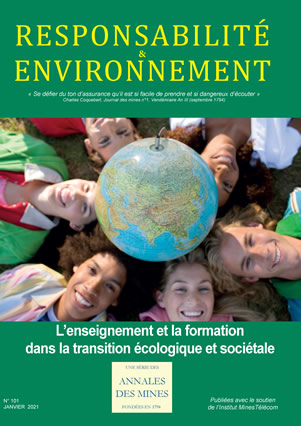
Issue 101
Which transitions to teach?
For a history of the energy and material symbioses
By Jean-Baptiste FRESSOZ
Historien, Centre de recherches historiques CNRS-EHESS
Given the climate emergency, the phrase ‟energy transition” has become so prestigious that historians now use it to describe all sorts of processes, including those that, strictly speaking, amount to ‟energy additions”. The problem with ‟energy transition” is that it projects a past that did not exist onto a future that, to say the least, is phantasmal. A new way to approach the history of energy as a dynamics of symbiotic accumulation…
Between crises and transitions: What education for public health?
By Cyrille HARPET
Enseignant-chercheur à l’École des Hautes études en santé publique de Rennes (EHESP), directeur adjoint de l’Unité de recherche mixte Arenes (UMR 6051)
Education in public health is too seldom taught outside occupational specialties, whether medical or nonmedical. Given the experience of the current COVID-19 pandemic, we realize how important public health issues are for our societies. Environmental health, a subfield of public health, is even less familiar and less taught. Questions about public health risks to the population have confounded ancient and our modern societies. What to teach about public health so as to be ready for crises and prepare the transition toward a sustainable model? Given the scope of health and environmental crises, it is urgent to build up a solid base of the knowledge to be conveyed. The pressures exerted on all ecosystems by destructive human activities do not have an environmental impact alone; they are also tied to public health.
An education for which environmental transition?
By Luc ABBADIE
Professeur d’écologie à Sorbonne Université
For decades, the regression in biodiversity has been downplayed, if not ignored. Nowadays, pollution, the overconsumption of energy and disruption of the climate on a planetary scale, not to mention other factors, are beginning to compel recognition as a structural dimension of any credible policy. A rapid, multifaceted change of our lifestyles is deemed inevitable. The environmental transition can be seen as a constraint to be put up with or as an occasion for asking major questions about who we are and what we want. Awareness of the situation and the capacity for imagining the futures we want, individually and collectively, will tip the scales to one side or the other… with consequences on the vitality of our democracies. Teaching the environmental transition does not simply mean updating teaching methods; it implies bringing them under question.
On the right use of mathematical models
By Ivar EKELAND
Professeur émérite à l’Université Paris-Dauphine et à l’Université de Colombie britannique, membre de la Société royale du Canada et de l’Academia Europea
Provided their limits are recognized, mathematical models are important for studying the environmental transition. However such models are not worth more than their underlying hypotheses. If the models are too ambitious, these hypotheses are too simple. Medicine provides an example of this: the sought-for objective ‒ health ‒ eludes a precise definition and thus escapes from the reach of a model. Although mathematical models provide valuable tools, ranging from medical imaging to antiviral therapy, they are just tools at the service of a practitioner’s global vision. Likewise, mathematical models of the environment have to be situated at the level where they are relevant.
Research professors faced with disciplines undergoing the transition
Educational issues related to the transitions in farming and the food supply: Diversity and complexity
By Patrick CARON
ART-DEV, Université de Montpellier, Cirad
There is no longer any doubt about the need to transform food systems. After explaining the health, environmental and social reasons for this as well as the issues to be addressed, attention is turned to the characteristics of the agro-environmental transitions for achieving this goal, in particular: the need to take account of the complexity and diversity of situations, the incompleteness of the knowledge available, and the relations to be made between local and global processes. Finally, the consequences are described for education and training, in particular the break with a vision of innovation centered on technological transfers so as to acquire the skills for mobilizing learning processes and the patchwork of our knowledge and for stimulating the conception of solutions and of how to follow up on them in an uncertain context.
A science of encounters: Ecology at the service of multidisciplinary educational approaches
By Hélène BARBÉ
Laboratoire Écologie, systématique et évolution (ESE) de l’Université Paris-Saclay
Caroline VINCENT
Laboratoire ESE de l’Université Paris-Saclay
Cécile BLATRIX
Professeure de science politique à AgroParisTech
and Nathalie FRASCARIA-LACOSTE
Professeure d’Écologie évolutive et ingénierie écologique à AgroParisTech
Looking back at the essence of scientific ecology is at the core of this article in which we try to show how this discipline can enrich, in many aspects, interdisciplinary trainings. Ecology has long been ignoring the integration of human beings into its field of study. However, in view of the crises we are currently experiencing, the ecological perspective has taken a turn towards more transversal approaches. We will see how this science of encounter (encounter of disciplines, schools of thought, values, rationalities) and of knowledge of the sensible allows a paradigm shift through key concepts such as (socio)-ecosystems, complexity, dynamics, interrelationships or uncertainties. Questions and knowledge that scientific ecology raises are therefore intended to promote a better general understanding of the functioning of human societies nested within living systems.
Metamorphoses of the law to cope with the requirements of the environmental transition
By Kathia MARTIN-CHENUT
Directrice de recherche en droit au CNRS, Institut de sciences juridiques et philosophiques de la Sorbonne (UMR 8103 ISJPS – CNRS/Université Paris 1)
and Camila PERRUSO
Post-doctorante à l’Institut des sciences philosophiques et juridiques de la Sorbonne
The environmental crisis has upended the law and is forcing it to reinvent itself. The law, as it appropriate norms and values, can serve to organize the social relations resulting from the environmental transition and orient the necessary changes. It can thus play an essential role not only ex post but also throughout the transition. This transition is complex, like the metamorphoses that the law must undergo to accompany it. The adaptation of certain classical legal categories, which seem to have been upended by the requirements made for an “environmental transition with solidarity”, is discussed. Among these categories that contribute to realizing the transition are: sovereignty, property, personality and responsibility.
Alternative educations: National and international examples
Educations for living in the Anthropocene epoch
By Nathanaël WALLENHORST
Maître de conférences HDR à l’Uco (Angers), docteur en sciences de l’éducation, en sciences de l’environnement et en science politique, et membre associé au Lisec
and Renaud HÉTIER
Professeur à l’Uco (Angers), collaborateur scientifique au Cren (Nantes) et membre associé au Lisec (Université de Haute Alsace)
For fifteen years now, ever more worrisome studies in the geosciences have been released at a fast pace. The darkness of this century calls for educators to enlighten, even scantly, the way so that we can continue our adventure without losing sight of the ultimate educational objective: learn to change the world. How to imagine educational approaches that will be adapted to living together during the Anthropocene epoch? The first part of this article focuses on the type of relationship with the world that is to be taught so that students learn to change the world? Will they have to learn to have a living, responsive relationship with the world or, on the contrary, to resist? Four approaches to this education, complementary to each other, are discussed.
A university education in the Anthropocene epoch: A Norwegian perspective
By Frédérique BROSSARD BØRHAUG
Professeure des sciences de l'éducation à VID Specialized University à Stavanger en Norvège
Since 2016, some universities in Norway have set the objective of significantly modifying their offer of education for the Anthropocene epoch. The objectives of this inter-university partnership are to transform the curricula, orient research toward this new theme and make universities aware of their ethical and professional responsibilities. A preliminary report in 2020 (‟SDG – Quality in higher education: Developing a platform for sharing ideas and practices within universities”) has presented the objectives and educational practices of seven universities. However Norway is deeply paradoxical: a country that produces and exports petroleum while claiming national and international leadership in matters related to the climate. This polyphony of positions should lead us to ask questions about the offer of education made by universities.
From knowledge to skills: Job training for the transition
From observations to actions: The issues of occupational training for the environmental transitions
By Jacques-Olivier GARDA
Ingénieur ICAM, MBA Sciences Po, Innov’Active
It is ‟easy” to successfully manage a transition: simply point to the destination, identify the distance from what exists, and bridge the gap with adapted solutions, especially in education. The ‟usual” approach to change seems suitable. As Albert Einstein pointed out however, a problem cannot be solved by thinking in the same way that caused it. In other words, an in-depth analysis and observation of the situation can reveal the need for much deeper changes than those initially imagined. This article invites us to face the issues raised about making the world livable and desirable, and to look at the practical consequences for training people in the labor force and in positions of responsibility.
Educating architects for the environmental and social transition
By Dimitri TOUBANOS
Architecte, urbaniste, Docteur en architecture, maître de conférences à l’ENSA Paris Val-de-Seine, enseignant à l’ENSA Paris-Belleville et à Sciences Po Paris, chercheur à l’EVCAU et chercheur associé au LIAT, animateur EnsaÉco
and Philippe VILLIEN
Architecte, urbaniste, Docteur en architecture, maître de conférences à l’ENSA Paris-Belleville, chercheur IPRAUS, UMR AUSser, pilote EnsaÉco
The small world of national schools of higher education in architecture and landscaping has borne the brunt of the environmental and energy transitions. An education in architecture is now committed to addressing key issues, such as finite resources, the climate, restrictions related to energy, and the conservation of life. Questions about the environment, resources and ‟materiality” are being formulated in relation to changes in the built environment and housing. They are articulated with remarks about the development of a society where risks have to be balanced with the need for environmental and social stewardship. From this perspective, the education that the aforementioned schools propose has to change in order to accelerate the shift of architecture toward ecology and solidarity. A thematic model for this shift toward a full commitment to the environmental transition is discussed.
Four families of “competences” for the socioecological transformation
By Gérald MAJOU DE LA DEBUTRIE
Chargé de mission Développement durable et responsabilité sociétale, vie étudiante et politique régionale à la Conférence des grandes écoles (CGE)
The socioecological transformation of human societies, in particular of their Western model, is a vital requirement given the major anthropic changes now affecting the climate and biodiversity. A ‟competence-based” approach is a powerful educational response to this situation under condition that a narrow, utilitarian version that claims to be “value-free” not be adopted. These ‟competences” should enable us to undertake actions individually and especially collectively as human beings living among nonhumans, as responsible citizens and professionals. They imply an ethics that respects life in all its diversity and takes into account the desires and fears that orient our actions. We thus come to understand and feel our relatedness to ‟others”, to accept our limits and recognize our planet’s limitations. Forceful, collective actions, whether technological or not, are the way to assume responsibilities on par with the invented futuristic narrative.
Training for the environmental transition in firms
By David LAURENT and Méliné REITA
Entreprises pour l’Environnement (EpE)
Besides their contribution to the evolution of society, firms have an important part in the environmental transition. They might have to undertake in-depth work on their own operations. Whether this transformation is ‟proactive” (changing the business model, creating or abandoning activities) or ‟reactive” (adapting, in full or in part, their business to the changing regulatory, market or societal context), all firms are concerned. Many big firms have started making their strategies compatible with an economy that is shifting toward ‟carbon neutrality” and the conservation of biodiversity. This might lead to plans for overhauling the firm. Firms have to ask several structural questions. How will this transition affect business processes? What technical and behavioral qualifications will employees need in order to cope with the coming changes? Do these qualifications now exist? How to translate these changes into a strategy and form of organization? How to lead corporate departments to appropriate these concerns?
Miscellany
Policies for protecting biodiversity and ‟ecological redlining” in Chine: What implications for COP15?
By Juliette LANDRY and Aleksandar RANKOVIC and Lucien CHABASON
Institut du développement durable et des relations internationales (Iddri)
During the past thirty years, China has lifted a large proportion of its population out of poverty thanks to an economic development with heavy repercussions on ecosystems, domestically and abroad. Since the 1980s, the government has adopted conservation policies for establishing ‟nature reserves” and national parks. In the first decade of this millennium, a keener awareness arose about pollution; and in the 2010s, an integrated approach was promoted for managing ecosystems. The ‟ecological protection red line”, a concept implemented since 2011, is a response to conflicts between the development of agriculture, urban areas and industry, on the one hand, and, on the other, the protection of ecosystems and biodiversity. As China is preparing to host COP15 (CDB: Convention on biological diversity), this ‟ecological redlining” is discussed in relation to both the development of Chinese biodiversity policies and the efforts made in territorial planning for the whole country. How can the Chinese approach affect the discussions leading up to COP15?