
July 2022
abstract
Responsabilité & Environnement
Environnement : Face à la longue urgence
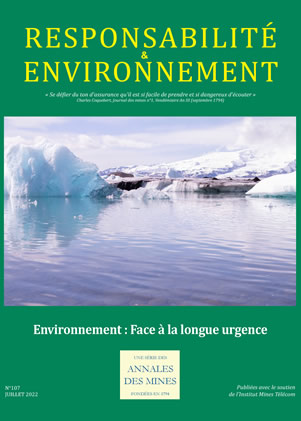
Issue 107
The battle of the confrontations in the long emergency
Confronting the limits: the battles of the long emergency
By Alice CANABATE
Sociologue, Docteure de l’Université́ Paris Descartes, chercheure au LCSP de l’Université de Paris
The greening of society is nowadays obvious, as is the apparent need to act without delay in the face of a permanent worsening of our planet’s situation. However, there is no consensus on the paths to take to change the trajectory we are on. Between the continuist narratives, which propose technological solutions, and the narratives, which suggest the need for a break and whose ambition is to promote sobriety, the gaps in socio-cultural transformations are high. Faced with this confrontation with limits, it is the project of modernity that is ultimately questioned. Behind these narratives, battles over political orientations and divergent visions of the future are above all apparent. We shall endeavour here to sketch out the fracture line through the example of degrowth, which far from circumventing the limits, accepts them and reorganizes itself accordingly, and that of geo-engineering, which embodies, on the contrary, a reforming techno-enthusiasm conceived as a function of the level of progress expected by a green growth with ordering ambitions.
Mixed forest or accelerated forest, two visions of forest management in the face of climate change...
By Pascal YVON
Président de Carbon Forest
and Franck JACOBÉE
Gérant de la SARL Sylvgest
The evolution of forestry management practices has always been dictated by man’s needs in terms of construction, heating and industrial development. The current period sees the appearance of new stakes with the increasing importance of environmental questions, the evolution of the societal demand, the climatic changes and their sanitary consequences. Wood becoming a more and more sought-after material, the management of the corresponding resources in a concern of sustainable development places the forestry-wood sector in the center of the debate. Forestry must change its management models and the associated monitoring towards more flexible systems, well adapted to an integration of diversity and more reactive in the face of rapidly changing constraints and hazards both economic and climatic. We want to believe that forestry and ecology continue to learn to work together for the improvement of our ecosystems.
The limits of a technical approach to confrontation: an analysis of geoengineering
By Ilarion PAVEL
Ingénieur en chef des Mines ‒ Conseil général de l’Économie
The consequences of climate disruption are giving rise to proposals to combat them that involve increasingly global and sophisticated techniques, notably geo-engineering. Geoengineering is a set of technologies that aim to control the Earth’s climate; they fall into two main families: solar radiation management and extraction of atmospheric CO2. These various technologies and the analysis of their limits were described in a previous issue of this journal. We recall here some of the limits and risks of these technologies and we present some reflections on the actors who carry these techniques and on the requirements of their governance.
The imaginations of the French in relation to the different visions of the long emergency
By Philippe MOATI
Professeur d’économie à l’Université Paris Cité
Is it possible to imagine an ideal model of society that could constitute a desirable horizon for a large fraction of the French population? Would such a model be compatible with the ecological emergency? The Observatory of Utopian Perspectives submitted three models of society, three ‟utopian systems”, to a representative sample of French people for evaluation: a techno-liberal society, an ecological society and a society based on identity and security. The ecological society brings together a majority of French people. The lifestyles and consumption patterns associated with it are supported by a large proportion of the population. However, they are also sensitive to the security and sovereignty dimensions of the identity-security society.
Resilience: a technology of consent?
By Thierry RIBAULT
CLERSE (Centre lillois d’études et de recherches sociologiques et économiques), CNRS-Université de Lille
Since the 1940s, the notion of resilience has left its original field of application ‒ the physics of materials ‒ to become the therapeutic Swiss Army knife of industrial society. There is no longer any catastrophe, personal or collective, that some promoters of resilience do not seize upon, urging everyone to turn their destruction into a source of reconstruction, and their misfortune into a source of happiness. According to the proponents of accommodation, being resilient means not only being able to live through adversity and suffering, but above all being able to live through them, to grow and adapt through disruption and disruption, and to take a leap of faith towards them. In reality, this idea is inapplicable in many situations of toxic, pathogenic or radioactive exposure. A critical analysis of these resilience policies applied to such disasters – from Fukushima to the constitution of a parliamentary mission on national resilience, to the military operation ‟Resilience” to wage ‟the war against the Covid-19 epidemic” and the ‟Climate and Resilience” law ‒ shows how they build around this notion a kind of new ‟state religion”. However, it can also be used to divert attention from the causes of disasters to their effects; to defocus on the objectivity of the disaster and to focus on the subjectivization of its management and narration; to put supposedly negative affects, such as fear and anger, under the bushel in favor of an overvaluation of supposedly positive ones, such as solidarity and responsibility. Resilience is therefore not a hijacked notion, but an instrument of detour: it becomes a technology of consent.
Metaphysics and imaginaries of the long emergency as aids to thinking about the present and the future
End of the world speeches in history
By Pierre COUVEINHES
Ingénieur général des Mines honoraire
Regardless of the scientific justifications on which it is based, the ‟long emergency” is part of the endless list of end-of-the-world discourses developed by humanity throughout its history. Whether they are of religious, philosophical, scientific origin or appear in works of literature or cinema, these discourses often have common features and can be analysed according to a few categories. Certain topics, essential at certain times, seem to disappear for several centuries, before reappearing in a similar form. The purpose of this article is to compare some of these discourses by trying to answer these three questions:
Religious visions of ecology
By François EUVÉ
Rédacteur en chef de la revue Études
Ecology and spirituality, or even religion, often go hand in hand, seeming to reverse the idea of an inevitable secularization of our societies. In this new topography, it is not Christianity that is put forward, but rather Eastern traditions such as Buddhism. However, if ecology is the science of relationships, it is indeed these relational links that we see being woven between the various spiritual currents. Going against the dogmatic fences, the rising ecological sensitivity incites religions to find the path of dialogue.
It won’t be a bang, but a long moan” Brief reflections on a slow-motion disaster
By Jean-Pierre DUPUY
Philosophe, professeur émérite à l’École polytechnique et professeur à l’Université Stanford, Californie
What we must fear most is not necessarily a huge disaster that will put an end to the evils of our time by discarding our species. It is rather that these evils will go on for long periods of time while their effects will be more and more dreadful as they follow a downward spiral. Adaptation to climate change will rest on the incredible capacity that human beings have to adjust to the worst conditions of hardship and oppression. Is it how we want to live? This kind of ‟slow motion disaster” can very well end in a sudden collapse. This paper examines the case in which the closer we get to this moment, the more we have objective reasons to believe that it is farther away from us. We infer from this case that optimists should be alarmists precisely because they are optimistic. Conversely, there are good reasons to believe that the kind of irrational exuberance displayed by the agents of the crisis, governments included, feeds on a diffuse apocalypticism.
Hollywood and the bioclimatic crisis: from Green Sun to Dune
By Jean-Michel VALANTIN
Docteur en études stratégiques et responsable de la section « Environment and security » du think tank The Red (Team) Analysis Society
It was after the Second World War and the Cold War that American cinema began to appropriate national security issues. Since the 1950s, this process has also taken into account the risks associated with environmental change. But since the early 2000s, as socio-environmental risks rise to prominence and are considered in the context of national security, these themes have begun to dominate the cinema, which popularizes them. In addition, issues related to the ‟long emergency” are becoming central to the world of television series. As a result, the association of security issues with bioclimatic issues in Hollywood is increasing.
The models of society in the visions of the long emergency
The bioregion in Île-de-France: a post-breakup ecological society
By Loïs MALLET
Chercheur et directeur de l’Institut Momentum
and Benoît THÉVARD
Consultant, formateur et enseignant
Imagining an ecological society based on a territory that is emblematic of the thermo-industrial society is the ambition of the Île-de-France 2050 Bioregion scenario. Produced by the Momentum Institute, the think tank on the issues of the Anthropocene, it helps us to imagine the gulf between a present that is dying and a future that is still in the making. This article begins by reviewing the context in which the scenario was developed and its prospective approach of rupture in a territory of systemic uncertainty. The scenario is then presented with an emphasis on bioregional governmentality and the ecological way of life. Finally, we discuss the current role of politics in the face of systemic uncertainty and risk in order to foster the emergence of bioregional societies. Rather than succumbing to authoritarianism, we argue that it is essential to adopt foresighted policies now that are appropriate to catastrophism and that promote autonomous and joyful human life despite the catastrophes expected in the coming decades, which we describe as the Dark Thirty.
Washington, the Pentagon and Climate Change: Political and Military Culture and Strategic Practices
By Jean-Michel VALANTIN
Docteur en études stratégiques et responsable de la section « Environment and security » du think tank The Red (Team) Analysis Society
For a quarter of a century, the US military and the many agencies linked to US national security have been developing a culture of geopolitical, strategic, operational and tactical risks and issues related to climate change. This culture is composed of foresight work, feedback from the increasing number of climate shocks that involve U.S. military intervention both on U.S. soil and in Iraq, the Asia-Pacific and the Arctic. This culture and experience is shared on an ongoing basis with political institutions, particularly the Senate and the House of Representatives, and creates a collective awareness and body of knowledge common to the Defense and National Security and the American political world.
Narratives and Responsibilities: Deliberating on the Evidence of Desirable Futures
By Bernard REBER
Directeur de recherche au CNRS, membre du Centre de recherches politiques (Cevipof) de Sciences Po
Narratives can motivate, represent actions and associated responsibilities. In foresight, narratives support the deliberation of collective choices for the future. They offer ‟evidence of futures”. They do not predict but inform decision support models. These narratives support pessimistic (apocalyptic) or optimistic (eschatological) scenarios, older than contemporary collapsology. They represent a polyphony of responsibilities, which everyone must assume for an adventure like that of a just ecological transition. The experience of the Citizens’ Climate Convention is discussed here in the light of these questions. It did not leave much room for narratives, uncertainties, quarrels about the future and their evaluation in terms of social justice with the conflicts of interpretation that it entails. Moreover, other communicative and rhetorical capacities have not been put to use, even though they allow for critical confrontation, political conversation, deliberation and for arriving at ‟all things considered” judgements.
Judgments and institutions in France and the United States: will there be a law of long urgency tomorrow?
By Corinne LEPAGE
Avocate et femme politique, présidente du parti écologiste Le Rassemblement citoyen – Cap 21
Environmental challenges, and in particular climate change, are increasingly being addressed by the law. The long urgency, i.e. the very long-term but irreversible effect, requires urgent treatment. The law does not take kindly to long-term uncertainty which makes it difficult to establish a causal link. It does not take kindly to irreversibility, especially if it exceeds the human lifespan. This explains the appearance of new concepts such as the precautionary principle and the rise of probability in place of certainty. These difficulties are reflected in recent French case law, such as the cases of La Faute-sur-Mer, the Signal, and the Maincy incinerator, three cases that have led to significant changes in case law. It is not only the law that is challenged by this subject of the long emergency, since political institutions are also questioning whether democracies have the capacity to respond to this vital challenge. If a positive response is possible, it is only insofar as justice in the distribution of effort, a more implicative democracy and finally a new imaginary become the new foundations of this renewed democracy. And, profound transformations are already underway with the emergence of soft law declarations such as the Universal Declaration of Human Rights and the development of climate justice that goes so far as to recognise the rights of future generations.
The long emergency on the territories today
The insurance industry faces the challenge of the ‟long emergency”
By Jean-Louis BANCEL, Roland NUSSBAUM
Président de la Fabrique d’assurance
Societal needs towards insurance services are increasing and require collaborative engagement of stakeholders, in an integrated risk management system. Therefore, the increasing call at a long urgency from the perspective of insurance comes in answer society assets in relation to climate and environment. They come along risk management devices together with different public and private actors for the sake of better insurability. In order to increase insurability, the insurance sector experiments adaptations and foresees modifications of its technical bases. This brings to consider why and how insurance can be impacted? Does this lead to a progressive resorption of the inventive capacity of Insurance? Or to emerging new paradigms for Insurance.
The Red Team Defense: when science fiction allows the French army to explore the future
By Marie ROUSSIÉ
Ingénieure de recherche ‒ Projet Red Team Défense
Cédric DENIS-RÉMIS
Vice-président de l’Université PSL
and Jean-Baptiste COLAS
Agence de l’innovation de Défense
Acting tomorrow is written in the present for many organizations. This anticipated temporality is particularly acute in the Ministry of the Armed Forces, which must respond to the Nation’s defense imperative, while respecting a long engineering cycle and the constraints of military planning. But looking into the future is a delicate exercise and projection errors are legion. Aware of these difficulties, the Ministry of the Armed Forces has had an original research program since 2020: the Red Team Defense. At the heart of this project is a new kind of commando composed exclusively of authors, scriptwriters and illustrators of science fiction. These different actors have the serious mission of imagining scenarios of adversity for France and threats to its interests in 2030-2060. The objective is to shake up the armies in order to conduct today the discussions necessary to manage tomorrow’s emergencies.
Forest fires and global warming: civil security facing ‟mega-fires”
By le lieutenant-colonel Luc MAHLER
Conseiller en matière de sécurité civile et de gestion de crises auprès d’organisateurs d’événements sportifs internationaux
Forest and natural area fires have been occurring for several years throughout the country. The flames are ravaging increasingly large areas, fanned by heat, drought or storms. In particular, there is an increase in vegetation fires during the winter period. The departmental fire and rescue services (SDIS) are strongly affected by global warming and, according to a study by the European Environment Agency, fires in natural areas, and therefore the demand for ‟climate soldiers”, will become even more important. This unavoidable phenomenon requires the adaptation of the SDIS response capacity, in close collaboration between the State and local elected officials, as well as the training and mobilization of all Civil Security actors, including citizens through awareness-raising actions. Faced with the increasing number of these natural crises, and with the aim of helping other Mediterranean countries also affected by this phenomenon, France remains a major player in European cooperation in this area.
The Netherlands and rising sea levels: what strategy for the long term and how to respond to the various challenges?
By Robert SLOMP, Yann FRIOCOURT
Tous deux en fonction à la Rijkswaterstaat, une agence du ministère néerlandais chargée des infrastructures et de la gestion de l’eau
In spite of their long experience with flood protection, the Netherlands face just as many challenges as any other country with respect to climate change and sea level rise. What to expect? How to prepare? When? How long can decisions be postponed and when is it too late? What decisions are right and will not cause their own future problems? Flood protection in the Netherlands relies on prevention through levees, dunes, dams, and beach nourishments. However, indications of an acceleration of ice melt in Antarctica raise the question of how long this strategy can last. The Dutch society can no longer postpone re-evaluating its flood protection strategy and taking difficult decisions whose consequences will be felt for the coming century. How can long-term stakes be dealt with as well as possible when economy and urban development request short-term profits?
Miscellany
The time(s) of nuclear disasters
By Franck GUARNIERI
Directeur de recherche à Mines Paris ‒ PSL
and Aurélien PORTELLI
Enseignant-chercheur à Mines Paris ‒ PSL
The nuclear accidents of Chernobyl and Fukushima have given rise to interpreta-tions that this article proposes to decipher through the prism of conceptions of time. According to the hypothesis, the question of the relationship to time is essential to understand the meaning of these catastrophes. In the West, Chernobyl and Fuku-shima have produced imaginary constructions that refer to a linear conception of time. In Japan, the interpretation of Fukushima is partly inscribed in this temporality, without exhausting the temporal imaginary in which the catastrophe is captured, which opens on an idea of rebirth, thus referring to a cyclical conception of time.
Hors dossier
Adapting cities: Paris to the test of climate change
By Celia BLAUEL
Adjointe de la Maire de Paris en charge de la Transition écologique, du Climat et de l’Eau (2014-2020), de la Prospective Paris 2030, de la Résilience et de la Seine (2020-2021), rêveuse et experte du monde de demain
In 2015, Paris was one of the first cities in the world to adopt an adaptation strategy. For the Capital City, it is a question of strengthening its climate strategy, addressing mitigation targets, which are essential to meet carbon neutrality by 2050, but also adaptation to the effects of climate change which are now perceptible at the scale of the Ile de France Region. Paris built its strategy on the basis of a vast study relating to the ‟vulnerabilities and robustness of Paris in the face of climate change and the scarcity of natural resources”. It has become a roadmap to transform the City, based on three pillars: the redesign of the urban vision, the securing of supply circuits, the role of citizens.