
October 2022
abstract
Responsabilité & Environnement
First lessons from the health crisis
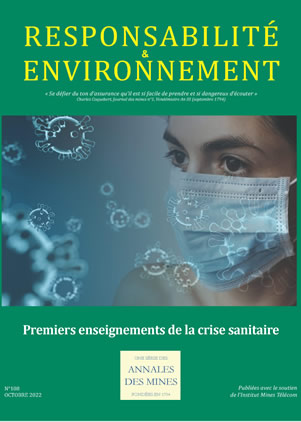
Issue 108
Biological and medical aspects
Vaccine development: a ‟before” and an ‟after” Covid?
By Bruno DONINI
Responsable des Politiques publiques pour Sanofi
Vaccines against Covid have been developed within a year. How did we manage to make it happen so fast? How are vaccines usually developed? Developing a vaccine is a long, complex and expensive road, which is regulated by many European and national texts and governed by a set of good practices. This cautious approach is a guarantee of their good tolerance and their effectiveness. Now, it is necessary to rationalize the administrative and regulatory requirements, in order to make vaccines accessible to the population as soon as possible.
Covid-19 pandemic: contribution of metrology to the evaluation of the filtration efficiency of protective masks
By François GAIE-LEVREL, Alexandre BESCOND, Axel FOUQUEAU, Tatiana MACÉ, Sophie VASLIN-REIMANN
Laboratoire national de métrologie et d’essais (LNE), Paris
In 2020, the scientific community and the World Health Organization confirmed the risk of airborne transmission of the Sars-CoV-2 coronavirus. Due to the worldwide shortage of masks, several countries have introduced new types of protection. In this context, the European Commission has identified the urgent need to harmonize the requirements in this area, particularly in terms of filtration performance and comfort associated with the wearing of masks. An Afnor guide and a European CEN guide were then drawn up, and in response to requests from the French authorities during the first containment in 2020, LNE was mobilized to address the key question of the effectiveness of protective masks, drawing on its expertise in aerosol metrology. To this end, an experimental platform was developed in record time to assess the filtration efficiency of different types of protective masks. Since the beginning of the crisis, this new test facility has made it possible to support public authorities, manufacturers and importers in the qualification of FFP2, surgical, barrier and consumer masks. In this article, we present the experimental bench developed by LNE to measure the filtration efficiency of barrier and consumer masks, as well as the inter-laboratory comparisons organized in this context. In terms of perspectives, we also present the axes of improvement of the normative context associated with each type of mask.
Covid-19 crisis: health care professionals in pain
By Alicia FOURNIER
Héloïse HALIDAY
Laboratoire de psychologie (Psy-DREPI) de l’Université de Bourgogne Franche-Comté, Dijon
Christine BINQUET
Inserm CIC 1432, CHU Dijon-Bourgogne de l’UFR des sciences de santé, Dijon
Jean-Pierre QUENOT
Service de médecine intensive-réanimation du CHU Dijon-Bourgogne, France-Équipe Lipness du centre de recherche INSERM UMR1231 et LabEx LipSTIC de l’Université de Bourgogne Franche-Comté, Dijon
and Alexandra LAURENT
Laboratoire de psychologie (Psy-DREPI) de l’Université de Bourgogne Franche-Comté, Dijon,
Since 2019, Covid-19 has rapidly spread worldwide, generating a pandemic. Healthcare organizations have been massively engaged in dealing with the large influx of patients. Most studies that considered the psychological impact of this crisis in health establishments focused on front-line professionals. However, recent literature showed that all professionals in healthcare organizations have been affected by the different stressors associated with this situation. Our research provides an update on the affective experience of these workers in French healthcare organizations during the first months of the COVID-19 crisis. Specifically, from a qualitative approach, we identified the common and specific stressors among the main stakeholders of such organizations.
Chemosensory disorders caused by Covid-19: long-term effects and a possible solution
By Coline ZIGRAND, Sarah BROSSE, Nouhaila BOUGUIYOUD, Simon BÉRUBÉ, Nicholas BUSSIÈRE, Johannes FRASNELLI
Département d’anatomie de l’Université du Québec à Trois-Rivières (Canada)
Symptoms of Covid-19 such as cough, fever and shortness of breath usually resolve within a few days of infection. A recent study from our Chemosensory Neuroanatomy research laboratory (Quebec, Canada) investigated the long-term effects of Covid-19 on the chemical senses (smell, taste and trigeminal system). Our results highlight that approximately one year after being infected with Covid-19, participants report suffering from chemosensory disorders.
Evolution of health crisis management in the post-Covid-19 era
By le Dr Clément LAZARUS, le Pr Jérôme SALOMON
Direction générale de la Santé, ministère de la Santé et de la Prévention
The frequency of major crises with a health impact is increasing, and their complexity and intensity are growing. The crisis linked to the Covid-19 pandemic was particularly exceptional in its severity and duration. While the management of uncertainty was a major challenge at the beginning of the crisis, the solutions provided afterwards called for multiple technological and organizational innovations. The major challenge of the post-crisis period will be to ensure the transmission of the knowledge and know-how acquired during the crisis through the establishment of a genuine institutional culture of crisis preparedness.
Digital aspects
Misinformation and health behaviors in the context of the Covid-19 pandemic
By Edmond BARANES, Marlène GUILLON, Pauline KERGALL
Montpellier Recherche en économie (MRE), Université de Montpellier
The development of the Internet and social networks has made information dissemination easier but has also contributed to the polarization of online communities, thus encouraging the spread of conspiracy theories. In particular, the Covid-19 crisis has led to an ‟infodemia”, i.e. an overabundance of information that makes difficult the identification of reliable information. During the pandemic, the circulation of false information sometimes led to serious health consequences and several studies have highlighted a negative association between conspiracy beliefs and adherence to Covid-19 preventive behaviors (social distancing, vaccination, etc.). The fight against misinformation appears crucial, especially during a pandemic. It requires the public regulator to work in collaboration with digital platforms and social media, given the financial stakes for the latter, in order to find sustainable solutions to limit the circulation of false information.
Measurement, estimation and representations of the Covid-19
By Éric GUICHARD
Maître de conférences HdR à l’Université de Lyon et chercheur au laboratoire Triangle de l’ENS de Lyon et du CNRS, et de l’IXXI
and Patrice ABRY
Directeur de recherche au CNRS et chercheur au laboratoire de physique de l’ENS de Lyon et de l’IXXI
Like many researchers, we engaged our scientific skills at the service of the fight against Covid-19. Starting in February 2020, we produced daily graphs to compare the evolution of the pandemic in different countries, and federated a scientific network that developed and documented relevant analyses. Then, we designed an estimation for a dialy assessment of the reproduction rate of the pandemic, using only the number of daily infections of each territory, and this both for all countries of the world independently, and for the French departments jointly. As the quality of these data remains limited, we focused on estimating realistic counts, using ‟inverse problem” type methods. Though aiming for daily estimation only, the proposed tool also permits a short-term trend assessment (nowcasting, rather than forecasting). Finally, to better analyze the spatial and temporal evolution of the pandemic, we achieved animated and interactive maps, integrating the production of graphs allowing comparison between two countries. We conclude with some epistemological guidelines.
Covid-19 crisis, democracy and collective intelligence
By Benoît DUCHEMANN
Laboratoire SPHere, UMR7219 de l’Université de Paris
The Covid-19 pandemic, which has been raging since the beginning of 2020, has been a real challenge for both national and international health organizations. Faced with the rapid spread of the virus, these organizations have been forced to adopt a crisis management approach that requires the development and implementation of innovative health responses. Beyond the very nature of the inventions thus implemented, there was a specific articulation of the intervention of different scientific, industrial and political infrastructures, making their emergence possible and, in fine, the management and control of the crisis. In this particular temporality, the political decision was explicitly based on an official discourse of scientific legitimization. Nevertheless, it also constituted a process of confiscation of the public sphere, implicitly freeing itself from the democratic deliberation and transparency that are nevertheless necessary, finally casting doubt on the modalities of the articulation between industry and politics and on its objectivity, and a veil over its possible biases. In April and May 2021, in parallel with public action, a collaboration between the MIT Center for Collective Intelligence (MCI), the Community Biotechnology Initiative at MIT Media Lab and the pharmaceutical company Merck, made it possible to launch an expe riment in collective intelligence with more than 200 experts in science, public health and public policy in order to respond to the health challenges that had emerged during the pandemic, in particular that of the info-epidemic, which gave rise to a real crisis of legitimacy in public health governance. If this innovative project proposes a hybrid process for optimizing public decision-making, the conditions for its claim to truth seem exaggerated. In addition to the epistemic opacity in which the recommendations are formulated, the lack of transparency of the motivations and rationality of the actions undertaken hinders this managerial technique in its capacity to fight against an infodemia and to re-establish an explicit balance between democratic principles of justice and the efficiency of public governance.
Interest and limits of modeling in epidemic management
By Laura TEMIME
Professeure, Laboratoire MESuRS, Conservatoire national des Arts et Métiers
Mathematical models are very useful for understanding and managing epidemic risk, as illustrated by their use during the Covid-19 pandemic. Used for more than a century, they allow, by proposing a simplification of reality informed by data, to explore a wide range of hypothetical scenarios. However, their proper use to help public health decision making requires interaction with the actors in the field, taking into account uncertainties and a communication effort.
Artificial intelligence and Covid-19, or the limits of ‟technological solutionism”
By Nicolas BRAULT
Enseignant-chercheur en histoire et philosophie des sciences, Interact UP 2018.C102, Institut polytechnique UniLaSalle
Since the beginning of the Covid-19 pandemic, the use of artificial intelligence and big data appeared to many scientists and policy makers around the world as the ultimate solution to manage the pandemic and its consequences. However, after more than two years and some fifteen million deaths, artificial intelligence has not kept its promises. In fact, it could not keep its promises for two reasons: first, because of problems related to the validity of the data and their algorithmic processing, and the risk of bias inherent to big data; second, because the epidemiological paradigm of the pandemic is not the right one, and it should be preferred to that of the ‟syndemic”, as the pandemic reflects economic and social inequalities while aggravating them. Thus, neither a purely biomedical nor a purely technological solution can work: a biosocial approach must be adopted that can enable societies to live with the virus, while protecting the most vulnerable populations.
Organization and monitoring of hospital capacities in times of crisis
By Thierry GARAIX, Camille BREEN, Mohamed El Habib MESSABIS and Raksmey PHAN
École des mines de Saint-Étienne
This scientific work proposes a decision support tool to accompany the strategic management of hospital capacity in a crisis situation similar to that of Covid-19. This pandemic has highlighted the lack of preparation of health systems worldwide, including the French health system. By following the projections of the evolution of the pandemic throughout a determined temporal horizon, we propose a policy of activation and dynamic deactivation of the exceptional resources released by the health care institutions to take care of the massive flow of patients generated by the crisis. Defining a management policy seems inescapable to avoid any overheating of the system and a too long pause in medical activities not related to the current health crisis, as hospital organizations need to plan in advance their important capacity deployments. This work is based on epidemiological forecasts and has taken into account the level of confidence given to these forecasts. We have focused our study on open intensive care beds, which require the mobilization of a whole series of resources to be aligned with available capacities.
Mentalities and ideas
The Covid-19 and its psychological impacts
By Alexis VANCAPPEL, Eline JANSEN, Wissam EL-HAGE
Clinique psychiatrique universitaire du CHRU de Tours
This article describes the psychological impact of the Covid-19 pandemic in the general population and with a particular focus on children, adolescents, students, health professionals and patients with psychiatric disease. This psychological impact is manifested by an increase in the affective symptoms and suicidal ideations.
What do public misgivings about Covid-19 vaccines tell us about ordinary relationships to science?
By Jeremy K. WARD
Chargé de recherche à l’INSERM (CERMES3) et membre de la commission technique des vaccinations à la Haute Autorité de la santé
In France, the Covid-19 epidemic occurred after a decade of debate about vaccines. Numerous studies have shown that reluctance to use vaccines is particularly widespread in our country. This reluctance is not only a public health issue, but has also been at the heart of recent debates about the evolution of ordinary relationships with science. In this article, we present the state of knowledge about the reticence towards vaccination against Covid-19. What do they tell us about ordinary relations to science? We will see that they lead us to distance ourselves from certain current commonplaces concerning mistrust of science.
The Covid-19 Scientific Advisory Board: an epistemological approach
By Stéphane TIRARD
Centre François Viète d’épistémologie et d’histoire des sciences et des techniques de l’Université de Nantes
The Covid-19 scientific council was established on March 10, 2020 to provide ‟the government with the latest scientific information to assist it in its decisions”. In the advices and notes produced by this council, the methods of argumentation and administration of evidence show specificities that call for an analysis. They seem to be adapted to the conditions of their elaboration and to the destination of these texts, and it appears that two levels of evidence are simultaneously mobilized. The first is constituted by evidence drawn from the scientific literature and from reports, and is directly based on scientific data. The second, more rhetorical, is the organization and formulation of a justification discourse designed to prove the accuracy and coherence of the council’s own words. This article proposes to highlight the epistemological tensions generated by this double necessity.
France’s strategic autonomy in the field of medicines depends on Europe
By Philippe LAMOUREUX
Directeur général du Leem
Whereas it was often ignored before the Covid crisis, ‟health sovereignty” is now a widely popularized concept, which was even at the heart of public debates during the 2022 French presidential campaign. This recent awareness is salutary after years of economic regulation of the drug industry in France, which led pharmaceutical companies to relocate. Now, one strategic autonomy is vital, but the details have yet to be defined. Can France really achieve on its own a complete autonomy in terms of medicines?
Epidemiological surveillance as a risk governance tool: the case of Covid-19
By Saliha HADNA
Maître de conférences en sciences de l’information et de la communication (Laboratoire CERTOP ‒ UMR 5044 ‒ Toulouse II & III, Université Paul Sabatier, Université Jean Jaurès, CNRS)
In France, for the past two years, the media have been constantly broadcasting figures of contaminations and deaths related to Covid-19, producing a paradoxical effect by creating fear, while at the same time making these dramas singular. Epidemiological surveillance was set up by Santé publique France (SPF), starting in March 2020. The governmental measures that were based on these figures have been the subject of much criticism, and even distrust. The urgency has placed a major problem in the background: the evolution of chronic diseases, particularly cancer. Yet, some cancers, such as pancreatic cancer, have had an increasing incidence rate between 2010 and 2018, with cancer remaining the leading cause of death in France. In this article, we will first focus on the SPF epidemiological surveillance system. We will then analyze how experts were mobilized during this health crisis. Finally, we will show that this crisis management was built on a short-termist approach, insofar as the deprogramming of operations deemed ‟non-urgent” to give priority to Covid-19 care over cancer-related care did not make it possible to anticipate the next wave of excess cancer mortality, despite the fact that several medical studies had predicted it.
Access to water in times of sanitary crisis: the public service tested by Covid-19 in Guyana
By Priscilla THÉBAUX and Damien DAVY
Laboratoire Écologie, évolution et interactions des systèmes amazoniens (CNRS-Université de Guyane-IFREMER)
and Agathe EUZEN
CNRS (LATTS) et Institut Écologie et environnement du CNRS
To allow the inhabitants of informal settlements to respect the barrier gestures, the Guyanese public authorities have set up a free access to drinking water system. In a context of chronic lack of access to this essential resource, we question the multiple issues to which this system responds and its impact on the construction of public services in Guyana. Our exploratory survey was conducted in 2020 with residents and actors in charge of the service in question. We show how, in this context of emergency, the ‟classic” actors of public service played a secondary role, leaving room for new actors. Also, the implementation of the system takes a singular form depending on technical and political choices. In its uses, it also responds to practical and symbolic issues. If the starting point for its installation is the fight against the spread of the virus, it must now be integrated into the logic of the public drinking water service.
Covid-19 and new economic regulation mechanisms
By Olivia CHEVALIER
Docteur en philosophie et enseigne notamment à l’IMT-BS, à l’École des Ponts et à Sciences Po Saint-Germain-en-Laye
In this article, we will discuss various aspects of the health crisis from an economic perspective. First, in a context of radical uncertainty that cannot be reduced to probabilistic risks, this specific crisis has given rise to strong public investment in all areas, giving rise to a new regalian function, in the words of Nobel Prize winner Edmund Phelps, of ‟systemic insurer”. Since the health crisis has mobilized health data, we will focus on the digitization of the French health sector, whose flaws, long pointed out by professionals, unions and associations, have been highlighted once again by the pandemic (in particular, the sector’s relative delay in the massive integration of AI). The result is difficulties relating to what is, de facto, an extension of state power into the economic domain, and therefore into civil society, and to the methods of financing the State-insurer, one of the most obvious and worrying effects of which is the inflationary trap.
Coping with the death of a loved one during a pandemic
By Chantal VERDON
Josée GRENIER
Université du Québec en Outaouais
Jacques CHERBLANC, Chantale SIMARD, Christiane BERGERON-LECLERC and Danielle MALTAIS
Université du Québec à Chicoutimi
Emmanuelle ZECH
UCLouvain, Belgique
and Susan CADELL
Renison University College (affiliée à l’Université de Waterloo)
The pandemic raises many questions related to the phenomenon of mourning, in which the circumstances surrounding the passing of a loved one are an extremely important. This context exposes us to new sources of knowledge that allow us to better understand the importance of the events surrounding the passing of a loved one. A Quebec study looked at people’s experience who have lost a loved one during the pandemic. Based on qualitative data, three themes emerge: 1) time, 2) meaning given and 3) caregivers. The study provides evidence on what can influence the trajectories of dying and mourning. From these chaotic and unpredictable circumstances, bereaved people find meaning when they can take concrete actions; bid farewell; see the deceased one last time; perform meaningful rituals and receive compassionate kind-heartedness.
Learning from the Covid-19 crisis to better manage future ones
By Sylvie ZNATY
Professeur titulaire de la chaire de prévention des risques professionnels et environnementaux et laboratoire de modélisation et surveillance des risques sanitaires (MESuRS), Cnam Paris
and William DAB
Professeur émérite du Cnam (MESuRS) et professeur associé à l’Institut catholique de Paris
The Covid-19 pandemic provoked a global crisis that foreshadows the systemic risk situations to come. The management of this crisis had strengths and weaknesses that can be used to better prepare for future crises and to limit their impacts. This article discusses the scientific, decision-making, organizational and operational elements that should be taken into account.
The social acceptability of health measures: a return to the imperative of public participation
By Alice FRISER
Professeure, département des sciences administratives, Université du Québec en Outaouais
Marie-Luc ARPIN
Professeure, département de management et gestion des ressources humaines, École de gestion, Université de Sherbrooke
Corinne GENDRON
Professeure, département de stratégie, responsabilité sociale et environnementale, Université du Québec à Montréal
and Stéphanie YATES
Professeure, département de communication sociale et publique, Université du Québec à Montréal
While the current of social acceptability has been built in close connection with public participation practices, to the point that many consider them to be consub-stantial, it must be noted that social acceptability is often tacit or passive. Thus, the legitimacy of decisions taken unilaterally is little questioned in a crisis context, as illustrated by the management of the Covid-19 pandemic. However, the containment measures have gradually given rise to a democratic malaise, as several observers have pointed out. This raises the following question: to what extent can urgency and recourse to institutional expertise substitute for public participation in legitimizing public decisions? By revisiting the literature on social acceptability in the light of the health crisis, we argue that, despite the fears of some administrations, it is advantageous to open up the debate about health management measures rather than confine the decision to a cenacle of political leaders and institutional experts.
One Health: Considering the links between human health, animal health and ecosystems
By Élisabeth TOUTUT-PICARD
Psychosociologue
Belonging to the family of zoonoses, the Covid-19 pandemic raises questions about the interactions between human health, wildlife and the environment.