
December 2004
abstract
Gérer & Comprendre
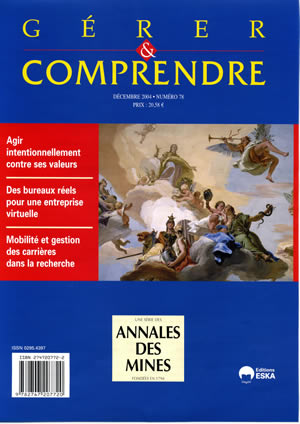
Issue 78
Editorial
By Francis LEFEBVRE
Secrétaire général du Comité de rédaction
OVERLOOKED…
Acting intentionally against one's values
By Alain ANQUETIL
Centre de recherche en Epistémologie Appliquée Ecole Polytechnique
When we think we should carry out an action, we can, after doing it, say it was rational. Weak will power (akrasia) describes an action that, though performed intentionally and deliberately, runs counter to our judgement and is, therefore, obviously irrational. Akrasia has been used to explain actions by executives who, faced with corruption inside their company, start by performing an action that runs contrary to what they think preferable and then undertake one in the opposite sense. Analyzing how they make decisions sheds light on these irrational actions, which enable them to restore coherence within their value system. In management, such situations are laden with problems, since avoiding akrasia apparently depends less on the quality of the occupational environment than on the person’s character.
TRIAL BY FACT
Hybridizing theory and practice: Managing company-university partnerships in research
By Chantale MAILHOT
and Anne MESNY
HEC Montréal
Does the funding of academic research by industry endanger the norms underlying the proper conduct of science? This question, so curtly put, might shock us. Everywhere around the world, are partnerships in research between companies and campuses not proliferating and diversifying? Governments want to develop production and further the processing and circulation of knowledge in what is now commonly called a knowledge-based economy. To this end, are they not stimulating, facilitating or even imposing this cooperation? Beyond celebrations of a new era in relations between science and industry, the hybridization of the “rationales” of science and industry is not automatic — evidence of this being the failure, for both the firm and academics, of the partnership analyzed in this article.
Real offices for a virtual enterprise
By Véronique MALLERET
Groupe HEC
and OVERLOOKED…
What’s the purpose of an office? In recent years, unexpected responses from new information technology to this simple question open the way toward separating the workplace from work itself. Is the office vanishing as a place where services are performed and wage-earners assigned, as during the 20th century? Maybe not! As this analysis of the original, deliberate approach adopted by a dotcom shows, company executives — with determination and clear objectives — turned the installation of their offices into a mighty means of leverage by combining a symbolic and organizational perspective.
TRIAL BY FACT
Phantasms and phobias among the Eurosceptical British
By Romain LAUNAY
Ingénieur des Mines
By announcing on 20 April 2004 his intention to organize a referendum on the European constitution, Tony Blair set off a political earthquake on the other side of the Channel. Given that only 16% of the British approve this text, we must admit the prime minister is running a major risk. Asked about the reasons for his decision, Blair argued that a real, open debate with the people was needed in order to counter the endless campaigns against European unification, which, according to him, distort the issues. What was he referring to? Who are the “Eurosceptical” British?
Mosaics
World map of organizational psychoanalysis
On Gilles Arnaud’s Psychanalyse et organisations.
By Nora Ilona Grasselli and Annabel-Mauve Bonnefous
The firm: Exploitation with no subject and no end?
On Albert David, Armand Hatchuel and Romain Laufer’s Les nouvelles fondations des sciences de gestion: Éléments d’épistémologie de la recherche en management.
By Olivier Basso and Éléonore Mounoud
From the engineer’s pragmatism to economic calculations
On Bernard Grall’s Économie de forces et production d’utilités: L’émergence du calcul économique chez les ingénieurs des Ponts et Chaussées (1831-1891).
By Blanche Segrestin
The office as a metaphor for life
On the BBC’s DVD, The Office (complete series 1& 2).
By Hervé Laroche
The captive?
On Franck Cochoy’s (ed.) La capitation des publics, c’est pour mieux te séduire, mon client.
By Élisabeth Tissier-Desbordes
L'épreuve des faits
Mobility and career management in research: A failure that was to be expected ?
By Séverine LOUVEL
CNRS - Université Pierre Mendès France, Grenoble
and OVERLOOKED…
Is it impossible to imagine career mobility in research in the French civil service? in The lost wager about mobility at the Institut de Recherche d’Informatique et d’Automatique (IRIA) leads us to look at this tool for managing careers through a different prism than economic incentives for changing jobs or sociological explanations about adapting skills. As in other organizations, mobility in this public research institute in new computer technology involved a complicated mixture of career expectations and commitments, which came into play together so as to make the management of jobs via mobility fail. Given IRIA’s scientific plans, labor markets should not be seen only from the angle of the formal rules organizing them but also in terms of the contents and meaning that various parties give to their career plans.
Réalités méconnues
Comprendre l'aluminium primaire
By René LESCLOUS
Ingénieur, Membre Fondateur de l'Institut pour l'Histoire de l'Aluminuim