
December 2008
abstract
Gérer & Comprendre
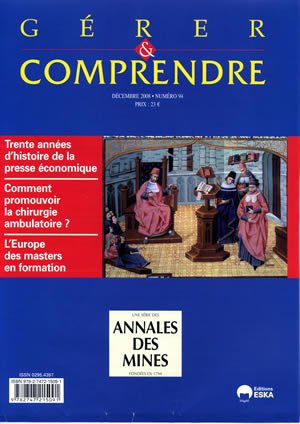
Issue 94
Editorial
By Pierre COUVEINHES
Rédacteur en Chef des Annales des Mines
TESTIFYING
Stimulating a fragile press: Echos from an agitated history
Entretien avec Jacques BARRAUX
By Nicolas MOTTIS
The French press specialized in the economy is fragile, having often experienced upheaval over the past thirty years. Its landscape has been remodeled several times, as periodicals have appeared, disappeared, merged… and as shareholders (sometimes the same ones) have bought in or sold out in a relatively short time, or as radical shifts have occurred in business models, especially during recent years with the Internet’s explosive growth. Based on interviews with a key player in this field, this article places in perspective the managerial issues with which the heads of firms specialized in the press must cope.
TRIAL BY FACT
Developing ambulatory surgery: The limits of policies with incentives
By François ENGEL
Professeur à l’École des Mines de Paris, Centre de Gestion Scientifique
and les Docteurs Maxime CAUTERMAN and Ayden TAJAHMADY
Mission Nationale d’Expertise et d’Audit Hospitaliers
Ambulatory surgery illustrates the difficulties of implementing decisions in public health. Given the lack of thought devoted to the coherence of messages, the behavior of patients, the impact of decisions and the way they are espoused at all levels of operation, a decision — even one deemed strategic by health authorities — runs a high risk of not being applied very fast. On the contrary, the development of ambulatory surgery might ensue from initiatives taken by players in the field, independently of incentives set at the national level.
The Europe of Master’s degrees: The Bologna Process through the German, English and French cases
By ESSEC and France
The management of institutions of higher education in Europe is undergoing a revolution: the harmonization of diplomas, international accreditation, international rankings, the “internationalization” of student bodies and teaching staffs, reductions in public funding, etc. Despite variations from country to country in application and in traditions, harmonization is under way as part of the EU’s Bologna Process for creating a European Area of Higher Education. The case of the “Master’s degree” called the MBA represents a cornerstone in these trends. This description of what is happening in Germany, Great Britain and France places the “elite institutions” there in the light of their common reference mark, namely the “typical” American model. Several European institutions now face strategic dilemmas about overhauling their curricula. Is it reasonable to copy the outdated MBA models? It would be wiser to take a second look: the determination to fall in line with norms that are not really normative would eventually be detrimental to higher education in Europe.
DÉBATS
Fighting against psychological harassment at the workplace: A proposal for intervention
By le Dr Gwénaëlle POILPOT-ROCABOY
Maître de Conférences à l’IGR-IAE de l’Université de Rennes 1, chercheur au CREM
and le Dr. Richard WINTER
Senior Lecturer, School of Business and Information Management, Faculty of Economics and Commerce, Australian National University
Many human resource departments admit that they feel unequipped for handling grievances related to psychological harassment. A real case serves to show how hard it is to make the diagnosis and handle the situation. This research is original since it uses information from human resource departments and does not, as in most studies on this topic, have is source in surveys and accounts made from victims’ viewpoints. Psychological harassment is taken to be a process in four phases; and a process of intervention is proposed that seeks to make a diagnosis, be preventive and manage psychological harassment at the workplace. This article is followed by a comment from a member of the editorial board,Rachel Beaujolin-Bellet, and by Gwénaëlle-Rocaboy’s reply.
Le harcèlement psychologique au travail : une affaire à traiter avec prudence
Commentaire de l’article de Gwénaëlle POILPOT-ROCABOY et Richard WINTER
By Rachel BEAUJOLIN-BELLET
Reims Management School
OVERLOOKED
Job-related cultures and integration after a merger: Integrating financial reporting systems when AXA acquired Nippon Dantai
Le cas de l’intégration des systèmes de reporting lors de l’acquisition de Nippon Dantai par AXA
By Michaël VIEGAS PIRES
Docteur en Sciences de Gestion, Université Paris-Est
Does it suffice, for acquisitions or mergers to be successful, that the right strategic choices and financial arrangements be made? The failure of half of these operations is proof that the answer is “no”. The ability to integrate the merged firms is a decisive factor in success, whence important human problems related to national, cultural and organizational differences. Given these impediments, do job-related “cultures” exercise the federating power of a “professional cement”? The acquisition of a Japanese firm (Nippon Dantai) by the insurance group AXA is examined, in particular the financial reporting systems in the two firms. Are shared ideas about professional roles synonymous with convergence? The finely shaded reply herein calls for devoting more thought to job-related cultures.
IN QUEST OF THEORIES
Distributed versus centralized governance, the two strategies of automotive telematics
By Gilles GAREL
Université Paris Est (Prism OEP)
and Christian NAVARRE
Telfer School of Management University of Ottawa (CIRP)
Automotive telematics is what makes a car communicative and interactive, specifically the services that, based on new information and communication technology, can be provided to automobilists through a telecommunications network. This Eldorado has spurred a gold rush among car-makers, telecommunication operators, auto-parts manufacturers, computer companies, multimedia firms and specialists in GPS systems. In many regards however, automotive telematics is a myth. Several projects have run aground, and the most frequently used system (General Motors’ OnStar) is not really a model to be copied. In fact, it is not being copied. Might the reason be that automotive telematics refers to three historically distinct realms: car-makers, telecommunication operators and the firms that provide contents to the new systems of information and communication? Might automotive telematics not lie outside the scope of any traditional competitive strategy based on a single big firm trying to win? An effective model would necessitate a strategy of cooperation and a governance distributed among all concerned parties. Otherwise, the supply of telematic services will fall far short of what current technology is able to accomplish.
The free gift: The case of a public establishment
By Yvan BAREL
Maître de conférences HDR en Sciences de gestion LEMNA (Laboratoire d'Economie et de de Management de Nantes-Atlantique)
and Sandrine FREMEAUX
Professeur associé, Audencia Ecole de Management
The dominant paradigm for analyzing on-the-job relations invokes reciprocity. Fitting into this paradigm, the “logic” of the gift/countergift (Mauss) postulates that exchanges cannot continue in situations marked by a too strong asymmetry; but it adds a new idea, namely the “calculation taboo” (Bourdieu): the desire for a countergift is not always shown, nor even conscious. Alongside the logic of reciprocity, another concept has cropped up: the “existential” or “free” gift that suffices in and of itself (Caillé and Godbout; Dumond). Is the existential gift, which is not linked to any expectation of a return, what gives meaning to work? A study of this phenomenon was conducted with wage-earners during the drawing up of an “establishment project” at CROUS (Centre Regional des Oeuvres Universitaires and Scolaires), a public organization in France that offers various services (cafeterias, dormitories, scholarships, social and cultural activities, international opportunities) to students. Some of the semidirective interviews conducted with a cross-sectional sample of 37 wage-earners provide evidence of an attachment to a logic of marketplace reciprocity, whereas others bear testimony to a logic of making gifts to students. For many of these wage-earners, the free, personal, nonstrategic relations with students in this public service were of special importance.
Mosaics
Public services faced with acts of violence
On Francis Ginsbourger’s Des services publics face aux violences. Concevoir des organisations source de civilité, (Paris: ANACT, 2008).
By Jean-Marc Weller