
June 2011
abstract
Gérer & Comprendre
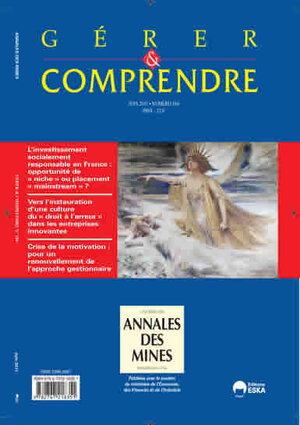
Issue 104
Editorial
By Pascal LEFEBVRE
OVERLOOKED
Thirty years after Myriam, or the fabulous bottom underneath teaser advertisements
By Franck COCHOY
Professeur de sociologie à Université de Toulouse/CERTOP (UMR CNRS 5044) ; Professeur de sociologie invité à l’Université de Göteborg, School of Business, Economics and Law, Suède
Myriam, an astonishing advertising campaign, stirred up public opinion in the tranquil France of 1981. The eponymous model’s hidden underpinnings are exposed through the vagaries of the campaign’s daring promises: “I’ll take off the top on September 2”, “I’ll take off the bottom on September 4”… As this attentive, enthusiastic playback of Myriam’s striptease shows, this gesture still arouses interest thirty years later since there is always something underneath the bottom. This fascinating, multilayered advertisement provides a glimpse of the hidden wellspring of teaser advertisements and seduction in commercials.
Socially responsible investment en france: a “niche” opportunity or a “mainstream” investment?
By Patricia CRIFO
Université Paris Ouest, École Polytechnique et Université Catholique de Louvain
and Nicolas MOTTIS
ESSEC Business School
The current and future activities are examined of the teams of analysts of socially responsible investments in France. The aim is to see whether the classical management of assets and the management of socially responsible investments are converging. For this purpose, a detailed study has been made of the tasks performed by these teams and of their positions in the financial industry. The results of a survey carried out in 2009 of major players in this field in France suggest a convergence even though the wide range of actual practices seems to be evidence of a phase of transition in a very fragmented domain.
The temptation of science: quantify the risks of highway tunnels
By Daniel FIXARI
Professeur à Mines-ParisTech
Since the fire in the Mont Blanc Tunnel, new regulations have been adopted requiring a risk assessment of every highway tunnel. A comparison with the risks related to alternative itineraries is to be made for shipping dangerous freight. When these new studies undergo implementation, the temptation is very strong to rely on sophisticated simulations of fires, analyses of possible scenarios, calculations of probability, the criteria for making rational decisions… The work group responsible for adopting the practices to be used for these risk assessments has solid experience both in the field and with scientific instruments. It has gradually converged on a “doctrine for a reasoned use of science” that allows for traditional arguments based on simple but robust rules. The complexity is described of arbitrating between two rationales, the one “hyper rational” and the other pragmatic, which are always more or less at odds in regulations related to risks.
TRIAL BY FACT
Toward a “culture of the right to be mistaken” in innovative companies
By Julien CUSIN
Maître de Conférences – IAE de Bordeaux, Erm / IRGO
For ten years now, more and more has been written about how to identify the levers of action for boosting innovation inside firms. In line with studies devoted to a “culture of innovation”, this article presents the current state of the art. Creating an atmosphere of “psychological security” is the only way to see to it: a) that the members of an organization are not paralyzed by the fear of failure and continue proposing audacious project; and b) that they draw lessons from the inevitable mistakes occurring during the process of innovation and be capable of not making them again. Suggestions are made for creating a “culture of the right to be mistaken” inside organizations. This would start by overhauling the system of sanctions and rewards, and by leading management to “legendize” failures. What might work in the American context is not necessarily possible in France however.
OTHER TIMES, OTHER PLACES
Translating a french code of ethics into vietnamese
By Alain HENRY
Directeur de l’Agence Française de Développement au Vietnam, chercheur associé à Gestion et société
Introducing international managerial practices in Vietnam runs up against behavioral and cultural patterns. Rather than asking questions about a hypothetical change of values, it is worthwhile understanding how the Vietnamese conceive of the individual’s place and relations with others. Comparing, line by line, a business’s code of ethics and its translation into Vietnamese brings to light quite different conceptions of the person’s relation to the world and of good governance. By proceeding from this understanding of differences between these two cultures, firms can adapt managerial practices to the local context.
Business, territories and social insecurity: notes on european investments in the bioethanol industry in Brazil
By Michel VILLETTE
Centre Maurice Halbwachs, ENS-EHESS-CNRS et AgroParisTech
A growing number of investors seek to gain money not primarily through business operations but, instead, through transactions involving corporate property rights. Huge sums of money change hands in a short period of time as industrial and commercial establishments are purchased and resold. Fortunes are made and lost. What consequences does this ceaseless exchange of property rights have on the long-term development of the establishments concerned? and on the growth or decline of stakeholders wage-earners, customers, suppliers, small investors and local governments? A case study of European investments in the bioethanol industry in Brazil serves to examine these questions.
DEBATED
The motivation crisis: for A new managerial approach
By Fabienne AUTIER
Professeur-chercheur en GRH – EMLYON Business School
and Sanjy RAMBOATIANA
Fondateur et Directeur de EVOLUANCE
Since the start of modern organizations, much has been said and written about work motivation. Managerial theories have focused on identifying the external stimuli that organizations and managers can activate to motivate individuals. A reverse approach is presented herein. Motivation for working is seen as a highly individual, dynamic force with three aspects: obligations, initiatives and aspirations. The latter are indispensable and specific to each person in the workplace; but their contents vary from person to person. They are constantly evolving as they are put to use and as the person grows older. This conceptualization underlies a new approach to managing work motivation in organizations. Each individual in the workplace is to be both the guardian and regulator of his/her obligations/initiatives/aspirations.
IN QUEST OF THEORIES
Fraud spreading through a firm: a case of tacit collusion
By Philippe JACQUINOT
Maître de conférences à l’université Évry Val d’Essonne, L@REM
Arnaud PELLISSIER-TANON
Maître de conférences à l’université Paris 1 Panthéon Sorbonne PRISM-Sorbonne
and Stéphane STRTAK
Enseignant-chercheur à l’ISC Paris
The case of a real estate company illustrates a sort of fraud overlooked in the literature, namely: fraud gradually spreading from the top of a company down toward the bottom through imitation and addiction, through tacit collusion. The literature in this field has focused more on maneuvers condemned as illicit by corporate leaders or the law. It has not described the process whereby fraud emerges and permeates an organization. This real estate company serves as a model of how fraud spreads. The pertinence of traditional measures for fighting against fraud is analyzed.
WHILE READING
A new “modern corporation”: a managerial rereading of berle and means
By Blanche SEGRESTIN
Professeur à Mines ParisTech
Americans from AES, after its acquisition of a majority holding in the Société Nationale d’Électricité du Cameroun, heavily insisted on “values” during meetings with wage-earners in the utility company. This signaled a new era with the goal of thoroughly transforming individual and collective behaviors. But the persons for whom this reform was intended were not prepared to hear the message…
Mosaics
Succeeding and lasting
On Danny Miller and Isabelle Le BretonMiller’s, Réussir dans la durée. Leçons sur l’avantage concurrentiel des grandes entreprises familiales (Québec, Presses de l’Université de Laval, 2010)
By Jean-Claude THOENIG
How to escape from commodification
On Richard d’Aveni’s Beating the commodity trap, (Cambridge, MA, Harvard Business Press, 2010)
By Cécile CHAMARET
What kills work
On Francis Ginsbourger’s, Ce qui tue le travail, (Paris, Éditions Michalon, 2010) Rachel BEAUJOLIN-BELLET THE STRUGGLE GOES ON On Sophie Béroud, Jean-Michel Denis, Guillaume Desage, Baptiste Giraud and Jérôme Pélisse’s, La lutte continue ? Les conflits du travail dans la France contemporaine, (Paris, Éditions du Croquant, 2008).
By Thierry BOUDÈS
La lutte continue ? Les conflits du travail dans la France contemporaine
À propos du livre de Sophie Béroud, Jean-Michel Denis, Guillaume Desage, Baptiste Giraud et Jérôme Pélisse, La Lutte continue ? Les conflits du travail dans la France contemporaine, Éditions du Croquant, 159 p., 2008
By Rachel BEAUJOLIN-BELLET
Professeur management à Reims Management School, Chercheur associé à l'IAE de Paris