
December 2013
abstract
Gérer & Comprendre
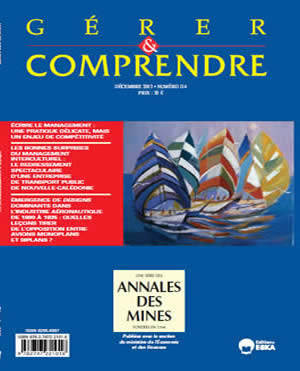
Issue 114
Editorial
By Pascal LEFEBVRE
Éditorialiste
IN MÉMORIAM
Michel Crozier est décédé le 24 mai 2013 à l’âge de 90 ans.
Personnalité majeure de la sociologie, il a fondé le Centre de sociologie des organisations, qui a œuvré à la création de Gérer et Comprendre, avec la participation initiale d’Erhard Friedberg, puis celle de Francis Pavé et de Jean-Philippe Neuville, et d’autres membres qui ont suivi ses formations. Gérer et Comprendre a tenu à lui rendre ce bref hommage.
OVERLOOKED
Anticipating changes in smalland mid-sided businesses: A study of a collective action plan
By Anne DIETRICH
associate professor, IAE in LILLE, LEM-UMR 8179
This article describes how a collective action plan for anticipating changes in smalland mid-size businesses (SMBs) was worked out and implemented. With the aim of exploring the characteristics and feasibility of following up on both the business and its employees as they cope with changes, this experimental plan, conducted in the Nord-Pas-de-Calais region, enrolled a plurality of stakeholders in detecting and following up on independent SMBs in the throes of change, and analyzing reflexively the interventions made and the difficulties encountered for the purpose of building a model and transferring this experiment to others. The dynamics are analyzed that turned this intervention — from the underlying theory of action till the activation of a space of collective action — into a group learning experience. The results shed light on the future of these businesses and list the conditions for successful adaptation.
Questions about creating a regional automobile industry: The institutional dynamics in the carmaking region of eastern France
By Stéphane HEIM
PhD. in Sociology, research assistant under contract, GERPISA, ENS Cachan
What forms of interfirm exchanges take place among the regional branches and subsidiaries of traditional automobile-makers? The emergence of the Japanese (and American) just-in-time paradigm has, along with a shift between 1990 and 2010 in this global industry’s geopolitics, spawned questions about the productive efficiency and competitiveness of traditional automakers since the end of the 1980s. These questions mostly revolve around interfirm exchanges, as currently illustrated by the automobile industry in Alsace and Franche-Comté, eastern France. Government actions and local initiatives (examined in the light of practices in this region) help us imagine the institutional trajectories between the promotion of an industry of “excellence” and forms of transactions inherited from past institutions.
TRIAL BY FACT
Writing about management: An intricate practice with competitiveness at stake
By Marie-Laure CAHIER
editorial coach and consultant
A book by Pascal Croset, a consultant and researcher, devoted to the Office Chérifien des Phosphates serves as the starting point for thinking about how to write about management and, more broadly, about the rela- tions between the world of ideas and the arena of actions. What impact does the written word have on the art of leadership? Who writes? What stand do they adopt? For what purpose? How are matters disclosed? To whom? Where to place the boundary between public relations, communication and managerial literature? Drawing on examples from the latter, the effort is made, without claiming to exhaust the topic, to show that writing about management is a complicated exercise with stakes that, far from academic, have to do with the power of ideas in a global economy.
The perspectives and blind spots of “excellence”
By Myriam MONLA
There is much talk about “excellence” in France. By placing it in a time frame, light is shed on this key word in French organizations. Questions are raised about the apparent obviousness of this concept. What does excellence mean? This word has undergone changes — even reversals — that have broken with its initial meaning and turned it into an oxymoron, namely “excellence for everyone”.
OTHER TIMES, OTHER PLACES
The emergence of a dominant design in aeronautics from 1890 to 1935: What lessons to draw from the switch between biplane and monoplane aircraft?
By Fanny SIMON
associa t e professor, University of Caen Lower Normandy, IAE, NIMEC
and Albéric TELLIER
associate professor, certified dissertation supervisor; University of Caen Lower Normandy, IAE, NIMEC
A historical approach can, under certain methodological conditions, help us better understand how a design becomes dominant and is replaced, as this analysis of developments in the aeronautics industry from 1890 to 1935 shows. During this period, two designs successively dominated: the biplane and then the monoplane. Although changes in a prevailing design are usually set down to technological breakthroughs, modifications in the nature of demand can also play a part in this process.
The pleasant surprises of intercultural management: A public transportation firm’s spectacular recovery in New Caledonia
By Jean-Pierre SEGAL
associate researcher at the CNRS, Centre Gestion & Société
During its ten years of existence, CARSUD, a firm in New Caledonia, experienced, an initial period rife with labor disputes between local Oceanian employees and a management from France, and then an astonishing renaissance under the leadership of a young, inventive manager, who succeeded where his predecessors had foundered. Two in-house surveys, conducted five years, apart are used to formulate a cultural explanation of this strange turnabout by analyzing the reinterpretations local employees made of the contrasting forms of management that they successively experienced.
Mosaics
International teams: From ideal types to hybridization
On Sylvie Chevrier’s Gérer des équipes internationales: Tirer parti de la rencontre des cultures dans les organisations (Presses de l’Université de Laval, 2012, 208 pages) Jean-Claude MOISDON, senior researcher at École des mines ParisTech: The doctor’s necktie and the computer bug On Ross Koppel and Suzanne Gordon’s (eds.) First, do less harm: Confronting the inconvenient problems of patient safety (Cornell University Press, 2012, 280 pages) Jérôme TUBIANA, senior advisor Danone: Made in Germany On Guillaume DUVAL’s Made in Germany (Paris: Éditions du Seuil, 2013)
By Université de Paris-Dauphine
Les équipes internationales : des idéaux-types aux métissages
À propos du livre de Sylvie Chevrier, Gérer des équipes internationales : tirer parti de la rencontre des cultures dans les organisations, Les Presses de l’Université de Laval, 208 pages, 2012
By Pierre Robert CLOET
Université Paris-Dauphine
La cravate du médecin et le bug informatique
À propos de l’ouvrage First, Do Less Harm: Confronting The Inconvenient Problems Of Patient Safety, édité par Ross Koppel & Suzanne Gordon, Cornell University Press, 280 p., 2012
By Jean-Claude MOISDON
Directeur de recherche émérite de l’École des mines ParisTech
Made in Germany
À propos du livre de Guillaume DUVAL, Made in Germany, Éditions du Seuil, 2013
By Jérôme TUBIANA