
June 2014
abstract
Gérer & Comprendre
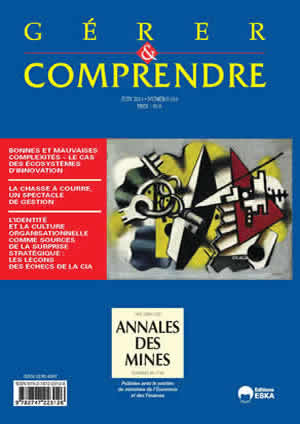
Issue 116
Editorial
By Pascal LEFEBVRE
Editorialiste
DEBATED
When appearances are deceptive — the heads of medical poles: Becoming hybrid “after all”?
By Annick VALETTE
associate professor in Managerial Sciences at the University of Grenoble
Franck BURELLIER
associate professor in Managerial Sciences at IGR-IAE, Rennes
and Frédéric Kletz
research professor at Mines-ParisTech
A reform in 2007 created a new role for doctors in French public hospitals: the head of a medical pole. This hybrid, doctor-manager role is supposed to resolve tensions between clinical and managerial practices under condition, of course, that doctors accept to assume it. This article has come out of three years of research in three hospitals outside the Paris area. Despite the reform’s prescription of this hybrid role, the heads of the medical poles declare that they are “doctors first of all” — evidence that their deep sense of identity is still medical. When looking more closely at the positions that these doctors adopt during meetings however, we notice that they use economic arguments. The passage from the self-declared role to the one actually played can largely be set down to budgetary pressures, managerial tools and interventions by third parties. The identity of these managers is still medical, but these doctors are “enrolled” in management through the context of their actions. This hybridization is more a matter of “individual bricolage” — makeshift arrangements related to the career paths of individuals and local contexts of action — than a question of organization.
La tectonique des pôles
By Frédéric KLETZ
Enseignant-chercheur à Mines-ParisTech
Le présent texte se présente non pas comme une critique de l’article précédent, mais comme un contrepoint, une mise en perspective permettant au lecteur de compléter son regard sur la problématique, en commençant tout d’abord par un rappel du contexte de la « mise en pôles » des établissements hospitaliers.
OVERLOOKED…
Good and bad complexity: Optical illusions? The case of ecosystems of innovation
By Daniel Fixari
and Frédérique Pallez
professors at Mines ParisTech
The need to reduce the many layers of the French public administration seems obvious. As shown by the example of ecosystems of innovation, it might, however, be wiser to add a layer of coordination than to enact spontaneously imagined simplifications. The notion of administrative complexity turns out to be rife with ambiguity…
How to develop a dynamic capacity for improving performance? The technological gatekeeper’s key role of in small and medium-sized companies
By Guy CAVEROT
Docteur de l’Université Rennes 1, Directeur de l’Innovation BA Systèmes
Dominique Philippe MARTIN
Professeur, CREM UMR CNRS, Université Rennes 1
and Jean-Claude BOLDRINI
Maître de conférences, LEMNA, Université de Nantes
How can a “technological gatekeeper” stimulate a small or mid-size business’s dynamism by helping it overcome its difficulties in matters of innovation? During an intervention research conducted for five years in a small robotic firm, we were able to improve, thanks to a gatekeeper’s activities, this dynamic capacity in three respects: a) the capacity for establishing lasting relations with the world of research; b) the capacity for fostering and managing projects of open innovation; and c) the capacity for making money with innovations in the marketplace. As this study’s experimental results show, a small or midsize company can develop in a context of open innovation through a technological gatekeeper’s actions.
TRIAL BY FACT
Hunting, a show of management
By Rachel Beaujolin-Bellet
NEOMA Business School
Thierry Boudès
ESCP Europe
and Nathalie RauletCroset
IAE de Paris, University of Paris 1 and PREG-CRG, École polytechnique
Hunting on horseback with hounds might be seen as a form of organization tightly structured through a ritual wherein the signs used by members of the hunting party signal their domination over the environment. It might also be seen as an activity that takes form in a space — often in a forest or on land owned by the state — open to the public. Several persons (residents, hikers, etc.) are present who might facilitate or hinder the hunt, persons with whom the hunting party might interact. The hunters cannot ignore them, given the controversy that, surrounding the chase, has implications for the image and future of hunting. Besides, the hunt itself depends on these interactions.
Anglicization, a challenge for organizations: A contrasting view of situations in a firm and in higher education
By Jérôme Saulière
Centre de Recherche en Gestion, École polytechnique, CNRS
The practice of English is gaining ground inside organizations. Two highly internationalized French organizations — a transnational corporation and a major university — are used to shed light on two major factors in this process. The first is economic: the goal of avoiding translation costs might favor, or hinder, the penetration of a partner’s language inside an organization. The second has to do with power: a foreign language creates an uncertainty that, to be controlled, calls for language skills. The acceptance of anglicization depends, first of all, on the perception that stakeholders have of its legitimacy and, then, on their competence in English. This view reasserts the role of “rational speakers” in a situation of linguistic change.
Electric vehicles, an extreme object that “innervates” the social sciences
By Rémi Maniak
associate professor in Managerial Sciences at Télécom ParisTech, associate researcher at Centre de Recherche en Gestion, École polytechnique
The breakthrough of electric vehicles owes much to the actions of the manufacturers and social activists who took the initiative and to the reasons that galvanized them. This innovation requires modifying specifications for evaluation, steering and sales that were well established in both practice and theory. This overview of the changes under way refers to several recent studies in the various disciplines (management, economics, psychology, sociology) mobilized in support of this industrial adventure.
OTHER TIMES, OTHER PLACES
Identity and organizational culture as sources of a strategic surprise: Lessons to be learned from the CIA’s failures
By Philippe SILBERZAHN
Professeur à EMLYON Business School et chercheur associé à l’École polytechnique
and Milo JONES
Professeur à IE Business School (Madrid) et associé au cabinet Insight Advisory partners
Set up in 1947 to prevent another Pearl Harbor, the CIA failed on at least four major occasions in spite of the considerable means at its disposal. How was this possible? Researchers who have studied strategic surprises have worked out explanations that, though not incompatible with each other, are unable to explain the full situation. Since Max Weber, social scientists know that regular behavior patterns are to be understood in relation to their cultural context. Because social facts are ingrained in the work of intelligence, the latter is under the sway of the organization’s identity and culture. On the basis of this initial observation, a paradigm of strategic surprises is presented that emphasizes how the internal organization of the producer of intelligence is shaped through the identity of its analysts and the traits of its organizational culture. By examining the CIA’s endogenous characteristics, we come to understand how such surprises happen.
IN QUEST OF THEORIES
The ambiguities of language as a reflection of cultural ambiguity: A forgotten dimension in studies devoted to organizational cultures?
By Jennifer Urasadettan
associate professor in Managerial Sciences at the University of Rennes 2
Language, a major vector of “corporate culture”, enables a firm’s leadership to value certain behavior patterns. Its use and comprehension are not free of ambiguity however, since a language is laden with the ambiguities specific to the corporate culture. Managerial science often analyzes this culture as a factor reducing ambiguity, since it generates a coherence between the ideal and practical dimensions. By placing the ambiguities of language and, thus, of corporate culture at the center of our analysis, we explain how an organizational culture evolves concomitantly with its utilization by various stakeholders (the personnel as well as the leadership), how ambiguity can become a resource whereby stakeholders justify their practices.
Mosaics
The sociology of management tools: Introduction to the social analysis of the instrumentation of management
On Eve Chiapello and Patrick Gilbert’s, Sociologie des outils de gestion. Introduction à l’analyse sociale de l’instrumentation de gestion (Paris: Éditions La Découverte, 2013).
By Loïc Andrien
The big data revolution
On Viktor Mayer-Schonberger and Kenneth Cukier’s, Big data: A revolution that will transform how we live, work and think (London: Murray, 2013).
By Cécile Chamaret
Evaluate me! Evaluation at work: The wellspring of a fascination
On Bénédicte Vidaillet’s, Évaluez-moi! L’évaluation au travail: les ressorts d’une fascination (Paris: Éditions du Seuil, 2013)
By Vincent Meyer