
September 2017
abstract
Gérer & Comprendre
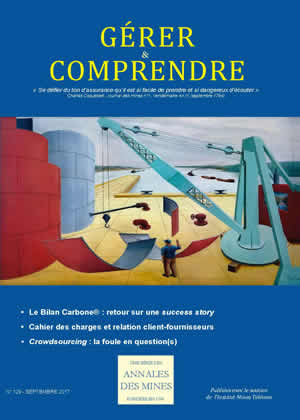
Issue 129
OVERLOOKED
Build-design: a thoroughgoing change in the construction industry? The British and French cases
By Flora Aubert
École Polytechnique.
New technical and environmental requirements, along with the exigencies of delivery schedules and costs, are changing the organization of the building industry. The build-design process, under which the phases of designing and building overlap, compels recognition as an apparently efficient method. Through the permeability of the know-how and qualifications of various actors, this process, a tremendous success in the United Kingdom, has aroused a degree of controversy in France. Concrete British cases serve to explore the possibilities opened to build-design in the French construction industry. The build-design revolution is operational thanks to this project delivery system’s flexibility, which is of interest for organizational rather than technical reasons.
L’élaboration d’une politique publique environnementale, le Bilan Carbone®. Entretien avec Thomas Gourdon, de l’Agence de l’Environnement et de la Maîtrise de l’Énergie (ADEME)
Propos recueillis pour Gérer & Comprendre par Morgane LE BRETON et Frédérique PALLEZ
Mines ParisTech, PSL Research University, CGS - Centre de gestion scientifique, i3 UMR CNRS
TRIAL BY FACT
“Immobile careers”: A challenge for management! The advantages of an understanding based on actual work and wage-earners’ expectations
By Lætitia Pihel
Laboratoire d’Économie et de Management de Nantes-Atlantique (LEMNA), Nantes University.
Immobile careers - of persons looking for stability in the position currently held and not being attracted by mobility - are a challenge to human resources, its strategy, tools and, more broadly, conceptions. This article is based on seventeen months of field work in a private clinic, where management claimed it had to cope with “contagious immobility”. The program for managing careers, though based on good practices, had not had the hoped-for results among registered nurses. Our research tried to answer three main questions: a) What were the origins of this immobility? b) What processes underlaid it? c) What were the blind spots in management’s way of thinking that led to this blockage? This immobility came out of a complex, dynamic process with several dimensions: initial training, the organization of work, and the individual (their attachment to their own career plans). These factors were chained and overlapped in actual, everyday work activities and relations at the workplace. The turbulence of work, with its demands on time and energy, imposed mobility but within this job category and allowed some nurses to benefit from informal promotions. Behaviors related to career management must be handled as closely as possible to the context and individuals’ backgrounds and plans. Immobility is not coupled with the absence of career plans or ambitions, which, quite contrary to expectations, can bolster immobility. Besides the recommendations formulated for management, this article shifts academic and practical discussions of this topic toward shared reflexes in career management.
IN QUEST OF A THEORY
Specifications and Buyer-Seller Relationship : Towards a Fair Synthesis
By Paul Bouvier-Patron
CERGAM – IAE – Aix-Marseille University.
Buyer-Seller relationships are strategic one and specifications, however neglected, a key point of analysis. On the topic of Specifications, Management Science is borrowing to Engineering Sciences. It induces sometime an over-statement in terms of research interest focused on a single aspect (“Black Box Part”). However, a rationalisation is about to give a coherent and stable basis of buyer-seller relationships and specifications classification. A such tool is required to investigate modern firms based on their core business and contractual buyings of different types. The methodology used is a critical one based on academic literature and the result is a rigorous analytical table of buyer-seller relationships.
Crowdsourcing: questioning and questions about the “crowd”
By Sophie Renault
Institut d’Administration des Entreprises - Laboratoire Vallorem, Orléans University.
Although at the heart of “crowdsourcing” the definition of the word “crowd” is prone to controversy. In its original meaning, the word “crowd” refers to a multitude of people gathered in one place. However, in the context of crowdsourcing this “place” is mostly virtual, we are here talking about the digital crowd. Therefore, many of the facets of what we call a crowd are called into question: does it consist of a large number of individuals? Are they all in the same place? Does this crowd produce good quality? This article questions seven misconceptions surrounding the word “crowd” in order to better understand its morphology and contours.
Participation in the world of work: Self-government
By Benjamin CHAPAS
École Supérieure pour le Développement Économique et Social (ESDES) – Université catholique de Lyon (UCLy), Institut de Recherche pour l’Économie Politique de l’Entreprise (IREPE)
and Xavier HOLLANDTS
Kedge Business School & CRCGM
Since the 19th century, the question of how employees can participate arises as a central issue in business life as in the literature. This question is crucial for both small organizations and major groups, public and private. Nevertheless, this topic can appear as controversial or explosive, some seeing it as a new instrumentalization or even an extension of people’s exploitation that primarily benefits the CEOs and managers. Given the risk of a potential instrumentalization of participation, it is increasingly necessary to suggest a theoretical framework to clearly understand what participate really means and implies for the employees, managers and the whole organization. After defined what we mean by participation, we suggest that this concept entails, to be fully realized, to implement a self-government framework. In this sense, our approach to work participation is an ideal of self-government that initiates a debate on the conditions of a real “empowerment”, meaning a real “power to act” for people and groups in the process of their own emancipation.
Mosaics
A clinical approach to managerial discourse and its effects
On Agnès Vandevelde-Rougale’s La novlangue managériale: Emprise et résistance (Toulouse: Éditions Érès, 2017), 207 p.
By Ken Fukuhara
A (belated) tribute to bosses by the state elite
On Michel Offerlé’s (ed.) Patrons en France (Paris: La Découverte, 2017).
By Michel Villette