
April 2022
abstract
Responsabilité & Environnement
Adaptation au changement climatique
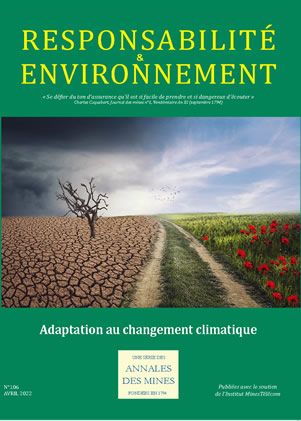
Issue 106
What will be the climate in 2050 and its consequences?
The main findings of the 6th IPCC Group I report
By David SALAS Y MÉLIA
Chercheur climatologue au Centre national de recherches météorologiques (Météo-France et Centre national de la recherche scientifique)
The IPCC (Intergovernmental Panel on Climate Change) Working Group I published its 6th report on the physical science basis of climate change in August 2021. This report reaffirms that the human origin of climate change observed since the second half of the 19th century is unequivocal, whether it is the observed global warming (+1.1°C), the retreat of snow and ice, ocean acidification or sea level rise. One of the major advances of the report is to highlight the human influence on the intensity and frequency of extreme phenomena such as heat waves or heavy rainfall. The observed changes in the climate system will continue ‒ in particular, it is certain that the global temperature will reach the 1.5°C threshold within 20 years ‒ but they can still be contained by taking strong, rapid and sustained action to reduce CO2 emissions.
Global Climate Change Impacts: Key Findings of the Latest IPCC Working Group II Report
By Éric BRUN and Lisa BOSTVIRONNOIS
ONERC
In this article, we present the main impacts of climate change on natural and human systems, on a global scale. We rely on the latest report of the IPCC WG2 ‒ a document of several thousand pages ‒ and intend to give the reader some keys to better understand the results in the areas that interest him.
Overview in Europe and France of the present and future effects of climate change
By Jérôme DUVERNOY
Chargé de mission Adaptation au changement climatique au ministère de la Transition écologique
In this article, we present the main impacts of climate change at the European and French scales, already observed and projected on the basis of IPCC reports, a recent report by the European Environment Agency, as well as ONERC thematic reports.
What climate in France in 2050 and 2100?
By Virginie SCHWARZ
Présidente-directrice générale de Météo-France
and Jean-Michel SOUBEYROUX
Directeur adjoint scientifique de la direction de la Climatologie et des Services climatiques de Météo-France
France is not spared the extent of climate change that has been observed and that will occur in the future. A new set of climate projections ‟DRIAS2020”, made available by Météo-France, details the climate changes described in the work of the IPCC for metropolitan France. Up to the middle of the century, the evolution is not very dependent on the greenhouse gas emission scenarios, with an average warming of +1.7°C but also the multiplication of extreme events such as heat waves or soil droughts. By 2100, however, the evolution will depend heavily on greenhouse gas emissions, with a totally disrupted climatology for our country and major impacts on all our activities if emissions are not significantly reduced. These projections are a reminder of the urgency to act to reduce greenhouse gas emissions. They are also the basis for the development by Météo-France of climate services that provide the various sectors of activity with decision-making aids for adapting to changes that are already inevitable.
The effects of global warming are already visible
Rethinking water in an era of climate change
By Denis SALLES
ETTIS Inrae
‟Preparing to live in a different world” is what climate change seems to require from us. The refusal to give in to the fatalism of collapsology, as well as to the disillusionment of thirty years of promises of sustainable development, condemns us to optimism. ‟Water for quality of life” rather than ‟water for use” is the current shift from the extractivist reference framework of water, which has prevailed since the industrial era, to a conception of water as a ‟matrix” of life. This contribution explores the cognitive dimensions, the conflicts of interest, the worldviews as well as the anticipation science approaches (scenarios, trajectories) that are able to accelerate the social-ecological transition towards desirable and just water futures.
Climate change in the mountains: impacts, risks and adaptation
By Samuel MORIN
Université de Toulouse, Univ. Grenoble Alpes, Météo-France, CNRS, Centre national de recherches météorologiques, Toulouse et Grenoble
Mountain regions concentrate characteristics that make the effects of climate change particularly visible. They are therefore sentinels of ongoing and future changes and impacts. They have natural and socio-economic features that distinguish them, particularly in terms of water resources, biodiversity, agricultural and cultural heritage, including the specific high mountains environment, which supports emblematic leisure and tourism activities. They are also characterized by many natural gravitational hazards that complicate and increase the cost of their socio-economic development. Climate change affects almost all of these interconnected issues, modifies their characteristics, and undermines traditional management methods of these features and intrinsic difficulties. Interdisciplinary knowledge and tools are being developed to take this into account in territorial development strategies.
Health impacts of climate change already visible: the example of heat waves
By Lucie ADÉLAÏDE & Olivier CHANEL & Mathilde PASCAL
Aix-Marseille School of Economics, Santé publique France
Climate change, loss of biodiversity and environmental degradation affect the public health. In particular, the increase and persistence of high temperature spells could put a large part of the population at serious risk, and drastically limit human activity. Yet, heat waves are underrepresented in analyses of extreme weather events, and particularly in economic assessments. This lack of study, combined with the low risk perception of the population, limits the will to implement adaptation measures even though the impacts are avoidable. This article presents the evolution of the global economic impact of the health effects of heat waves in France between 1974 and 2020.
The effects of climate change: what adaptation for coastal territories?
By Patrick BAZIN
Directeur de la gestion patrimoniale au Conservatoire du littoral
The coastline is a moving environment subject to the considerable forces of the sea, wind and coastal rivers. Over the centuries, Man has sought to control these natural dynamics and to fix the shores. Today, the logic is reversed: with the gradual rise in sea level, coastal management can no longer rely entirely on the rigid defense of the coastline. Faced with uncertainties, a new engineering of the management of coastal territories is emerging, which must integrate different disciplines in terms of expertise, different strategies over time and reinvented governance. The considerations developed in this article come mainly from the lessons learned from the Adapto project conducted by the Conservatoire du littoral since 2018. They concern above all the less urbanized coastal sectors. Some of them can be applied to more developed and inhabited sectors, but the stakes involved are not comparable and transposition is therefore not self-evident.
Resilience of electrical systems to climate change
By Alain BURTIN, Sylvie PAREY
EDF R&D
The resilience of electrical systems to weather and climate risks is a fundamental issue for the security of electricity supply and for ensuring a quality supply. Current electrical systems have been developed on the basis of climatic reference systems derived from historical observation of weather and climate phenomena. The current climate change leads us to reexamine the relevance of our reference systems in the light of current climate changes and future climate projections made within the framework of the IPCC work. In this article, we discuss the example of the French power system based on studies conducted at EDF R&D in order to characterize climate change and its potential impacts on the power system, before looking at the adaptation process undertaken by the EDF Group.
Climate change and its economic consequences
By Laurent MONTADOR
Directeur général adjoint de la Caisse centrale de réassurance (CCR)
While the successive IPCC reports consolidate the projections of climate change for the year 2050, the modeling of the impacts of climate change on extreme weather events is becoming more precise and operational. The models developed by the CCR for more than 15 years provide a territorial vision of the potential evolution of the cost of natural disasters in France. This perspective of worrying evolution for the safety of people as well as for the economic resilience of the country will most probably put under tension a natural disaster compensation system, which is based on national solidarity and is unique in Europe. Faced with these developments, there is hardly any other path than that of adaptation, revitalization of prevention practices and reinforcement of the effectiveness of public policies in this area.
Adapting and Mitigating: An Inclusive Systemic Approach
Mitigation and adaptation: a race against time
By Hervé LE TREUT
Professeur à Sorbonne Université et à l’École polytechnique
In a few years or decades, adaptation to climate change has become an essential necessity in the face of an ever-growing constant, that of a very insufficient control of greenhouse gas emissions, which keeps us further and further away from stabilization scenarios proposed by the Paris agreements. The modalities of this adaptation are therefore themselves very constrained. Firstly because it is of course not a question of competing with mitigation actions, but of determining what makes the common denominator of these two approaches. Also because the scale of the territories, which is often that of adaptation, must take into account a complex reality which is also that of the living, of biodiversity and of humans, all of which we have a duty to protect.
European and French strategies for adaptation to climate change
By Jérôme DUVERNOY, Marie CARREGA, Sarah VOIRIN
Observatoire national sur les effets du réchauffement climatique
In this article, we present a brief history of climate change adaptation policies in the European Union and France, followed by an overview of current policies. An overview of the climate policies currently being developed also shows the link between mitigation and adaptation policies.
The links between adaptation and mitigation: when adaptation worsens climate change
By Vincent VIGUIÉ
Chercheur au CIRED (École des Ponts ParisTech)
Although, at first glance, ‟adaptation” to climate change and ‟mitigation” of climate change are two relatively distinct subjects, in practice they are not independent. Indeed, they often mobilize the same public policy tools, and constrain each other. In particular, certain adaptation choices can lead to massive energy consumption (widespread use of air conditioning, desalination of sea water, etc.). This runs the risk of a vicious circle in which climate change itself contributes to the increase in emissions. Favoring the deployment of other strategies, even if this is not always easy, is therefore essential. Beyond mitigation, similar questions arise with other social or environmental issues, and avoiding the risk of unintended adverse consequences associated with certain adaptation choices is one of the crucial issues of the coming years.
Adaptation to climate change: first of all, intelligence put into the projects
By Morgane NICOL, Vivian DÉPOUES
Institut de l’économie pour le climat (I4CE – Institute for climate economics)
While the benefits of anticipation are widely demonstrated, the level of adaptation to climate change in France remains low. This observation calls for a detailed analysis of the barriers encountered by actors seeking to fully address the issue. Based on case studies conducted as part of the Finadapter research project, this article looks at some of these barriers. It focuses on two of these cases located in an urban context: the implementation of the adaptation plan of the European Metropolis of Lille, and an urban development project in a flood zone in the Nantes metropolis. These cases illustrate the nature of the responses to be deployed, which, far from being solely ready-made technical solutions, most often take the form of combinations of different types of measures, always specific to a given context. The analysis of these situations tends to demonstrate that adapting a territory to climate change does not systematically generate significant additional costs but requires human resources, time and expertise to question how to conduct projects and policies.
What prospects for water and agriculture by 2050 in the context of climate change?
By Hugues AYPHASSORHO
membre du Conseil général de l’environnement et du développement durable (CGEDD),
Michel SALLENAVE
ancien membre du Conseil général de l’agriculture, de l’alimentation et des espaces ruraux (CGAAER),
Nathalie BERTRAND
François MITTEAULT
ancien membre du CGEDD,
and Dominique ROLLIN
ancien membre du CGAAER
The IPCC’s projections of future tensions over access to and sharing of water raise questions about the ways and means of adapting agriculture between now and 2050. The Ministry of Ecological Transition and Solidarity and the Ministry of Agriculture and Food have taken up this issue, entrusting the CGAAER and the CGEDD in 2019 with a mission on the evolutionary trajectories of agriculture over a thirty-year horizon. On the basis of a rich bibliography and extensive fieldwork, it has been shown that the response to the climate crisis requires both a change in the agricultural model, which is more water-efficient and protects the soil, and, wherever possible, a strengthening of the water resource used for irrigation, while respecting the renewal of the resource and the good condition of the environment. The mission thus proposed an ambitious deployment of agro-ecology and the transition to ‟resilient” irrigation, which is more water-efficient. To this end, it formulated seven main recommendations in a draft roadmap.
Biodiversity and climate: nature-based approaches
By Denis COUVET
Président de la FRB (Fondation pour la recherche sur la biodiversité)
and Hélène SOUBELET
Directrice de la FRB
Better management of ecosystems could contribute to significant climate change mitigation. To achieve this, a certain number of conditions must be met: preserve and restore the biological diversity of these ecosystems, including that of animal and microbial communities; facilitate the adaptation of these ecosystems to global changes by maintaining corridors and reducing disturbances; and take into account the diversity of territories by integrating the associated knowledge and values.
Climate extremes: perceptions and social and political issues
By Solange MARTIN
Sociologue au Secrétariat du Haut Conseil pour le climat
While climate change is getting real in France and worldwide, environmental concern is still a forefront issue, even after two years of Covid-19 pandemic. Especially tangible, destructive and frightening, extreme climatic events strengthen the idea of climate emergency in the public opinion. As they are to occur more frequently and with an increased intensity, the extreme climatic events make necessary to know what new environmental risks produce on individuals and societies. Human and social sciences, and economics enlighten the multiples stakes of this question. Increased eco-anxiety, tensions and conflicts underline the necessity to face this situation in a collective way. The fact that everybody has to ‟do its part” should not hide the fact that climate emergency is also and even most of all a political and social one.
Geopolitics of climate change adaptation: the survival and power of nations
By Jean-Michel VALANTIN
Think tank The Red (Team) Analysis Society
Adaptation to climate change is a geopolitical issue, as this adaptation ‒ or maladaptation ‒ is becoming the driving force behind the international distribution of power. In order to study the reality of this evolution, as well as the interdependencies that are emerging, we propose in this article to study the way Russia and China are entering this process. This case study also allows us to highlight the military dimension of this issue, where geophysics and geopolitics intermingle to recompose the modalities of power. fuels ‒ France will have to transform itself. The Shift Project’s Plan for Transforming the French Economy allows us to project France on trajectories that are both consistent in physical terms (energy, materials) and in terms of employment, as well as in terms of the stakes. Among the technological solutions that can be mobilized, we find carbon capture and storage. This innovation is the most capable of capturing fatal emissions from industry and is a real asset, but its technical, economic and societal limits will force us to use it where it is most efficient. Its identified potential must therefore be mobilized as a priority to decarbonize heavy industry. Only the combination of the three types of levers available ‒ continuous progress, disruptive technologies and sobriety ‒ will ensure a transformation that meets national decarbonization objectives.
Miscellany
Carbon Capture and Storage (CCS): a real asset, but necessary trade-offs
By Maxime EFOUI-HESS
The Shift Project
Faced with an inevitable double carbon constraint ‒ decarbonizing all of its activities by 80% by 2050 and becoming almost entirely free of fossil fuels ‒ France will have to transform itself. The Shift Project’s Plan for Transforming the French Economy allows us to project France on trajectories that are both consistent in physical terms (energy, materials) and in terms of employment, as well as in terms of the stakes. Among the technological solutions that can be mobilized, we find carbon capture and storage. This innovation is the most capable of capturing fatal emissions from industry and is a real asset, but its technical, economic and societal limits will force us to use it where it is most efficient. Its identified potential must therefore be mobilized as a priority to decarbonize heavy industry. Only the combination of the three types of levers available ‒ continuous progress, disruptive technologies and sobriety ‒ will ensure a transformation that meets national decarbonization objectives.