
July 2021
abstract
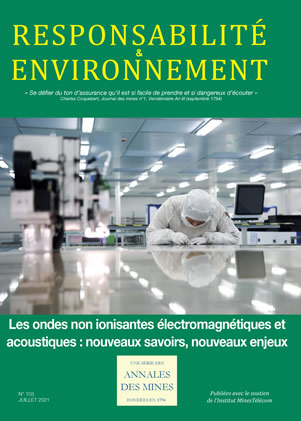
Responsabilité & Environnement
Les ondes non ionisantes électromagnétiques et acoustiques : nouveaux savoirs, nouveaux enjeux
Issue editor:
Dominique DRON et Ilarion PAVEL
Issue 103
Introduction: Nonionizing, electromagnetic and acoustic radiation: An underexplored, sensitive but promising, field
By Dominique DRON, Ilarion PAVEL
Conseil général de l’Économie, de l’industrie, de l’énergie et des technologies (CGEIET)
In nature, plants as well as animals use nonionizing, electromagnetic and acoustic waves whether by emitting, perceiving or interpreting them. However the frequency range of this sort of radiation when generated by human activities is constantly expanding. Knowledge about these waves and their uses are growing fast, along with the discovery of their unsuspected effects. Despite its recognized level of public research, France seems to underestimate the medical, industrial and agribusiness potential of these fields of radiation.
Nonionizing, electromagnetic and acoustic radiation: A subtle, multifaceted universe
A panorama of nonionizing, electromagnetic radiation and its major uses
By Dr René de SEZE
Médecin et chercheur à l’Institut national de l’environnement industriel et des risques (INERIS)
Electromagnetic fields have several applications, some of them well known to the public. These applications, especially in radiocommunications, have a function of information conveyed by the waves. Other applications have a narrow scope in industry or medicine. Several forms of technology put to use the energy function (heat) of radiofrequency waves or microwaves. To bring to light some surprising phenomena, new mechanisms of interaction have to be introduced between electromagnetic fields and living organisms, thus opening new horizons for technological developments. This requires bold research and sustained support from imaginative industrialists with a long-term vision and strategy.
A panorama of nonionizing acoustics waves and their major uses
By Paul AVAN
Université Clermont Auvergne, Institut de l’audition
Among physical agents, waves have the capacity for being propagated while conveying information, and, sometimes too, danger due to their energy or the changes induced. Hearing, which relies on acoustic waves, is a prime sense for intra- and interspecies communication. It is even more important for human beings since it is the very basis of speech and music. One of the major health problems in the coming decades, as the WHO has pointed out, is the nuisance or even danger of audible sound waves, when they interfere, often subtly, with the comfort or health of the people exposed to them. However acoustics is also contributing to progress in the field of health. The use of inaudible hyperfrequencies has served to develop the imaging and high-resolution techniques that, used to examine the body without danger, are not expensive and are, therefore, affordable in less developed countries.
Which biological processes are affected?
Is there a cellular biology of sounds? From plants “listening” to cellular acoustics
By Olivier GALLET
Laboratoire ERRMECe (Équipe de recherche sur les relations matrice extracellulaire-cellules, CY Cergy Paris Université)
What if plants could not only hear but also, and listen and even tell the difference between sounds so as to use them purposefully in their strategies of growth and adaptation to their environment? A few years ago, a set of circumstances led the author to design a group research program on this topic, which is the target of much skepticism. By examining a recent, detailed review of the literature, proposing a strict triple-blind protocol and using simple, tried and tested, biological concepts, this research showed that, indeed, plants can recognize and use sounds subtly to modulate their growth in response to environmental stresses, specifically a hydric stress related to dryness.
The cumulative effects of nonionizing, electromagnetic radiation: Coexposure and a thermal factor
By Amandine PELLETIER, Jean-Pierre LIBERT
Laboratoire PERITOX, Unité mixte INERIS, Amiens
The direct effects of nonionizing, electromagnetic radiation on living organisms are, often, studied alone. By using innovative materials, the authors were able to examine the effects of an exposure to this sort of radiation on an organism’s reactions to variations in another environmental parameter. The effects of coexposure to both this radiation and a thermal factor were analyzed with regard to energy homeostasis. As the findings show, animals, in the presence of this radiation, react by ‟fighting against the cold”, a sort of reaction that should be observed only at lower ambient temperatures. Furthermore, they adopt a strategy of avoidance that leads them to look for a warmer environment. This means that a peripheral ‟cold” signal with an origin in the TRPM8 receptors could cause paradoxical reactions. These receptors, the main ones for coldness, might modify their conformation under the action of nonionizing, electromagnetic radiation and emit a signal toward the central nervous system, which exercises controls over these functions.
Open questions about the effects of electromagnetic and acoustic waves on health and the environment
By Olivier MERCKEL
Agence nationale de sécurité sanitaire de l’alimentation, de l’environnement et du travail (Anses)
The acoustic and electromagnetic spectrums are far from similar, in terms of the interactions between waves and living beings. While some frequency ranges ( e.g. , the audible frequencies or those used by mobile telephones) have been the subject of research programs about their possible effects on health, others have been little explored. Even for those that have been studied the most, the knowledge accumulated till now does not point to major effects on public health, but it leaves many questions hanging. Questions can be asked about the hypotheses regarding the mechanisms of action related to: the modulation or frequency of signals, the possible effects on brain activity, or the symptoms that some people associate with their exposure to electromagnetic or sound waves. The effects of these waves on the environment have still been little explored.
Emerging uses of nonionizing, electromagnetic and acoustic radiation
From innovation to their clinical and commercial transfer: One hundred years after their discovery, ultrasounds in medicine are undergoing a second revolution
By David ATTALI, Alexandre DIZEUX, Jean-Francois AUBRY
Physique pour la médecine Paris, ESPCI Paris, INSERM, CNRS, PSL Université, Paris
Since the discovery of the piezoelectric effect by Pierre and Jacques Curie in 1880, France has staked out a solid position in the field of ultrasounds. This can be corroborated by the number of biomedical applications of this technology. French companies and research laboratories are on the cutting edge of major innovations in ultrasonic diagnosis (ultrarapid imaging) and therapy (the focalization of high-intensity ultrasounds). Our knowledge of the effects of these acoustic waves on biological tissues has increased considerably over the past ten years ‒ from the pinpointed delivery of medication to immunotherapy. This field of research must be supported and reinforced in France. It might spark a revolution in neuroscience owing to the possibilities not only of imaging but also of modulating the brain’s activity with the administration of transcranian ultrasounds.
The life and prospects of a French medium-sized firm in the field of ultrasonic medical technology
By David CAUMARTIN
Theraclion
Founded in 2004, Theraclion is an innovative medium-sized French firm with the ambition of developing a scalable, efficient robotic platform for noninvasive treatments that use ultrasounds, thanks to echotherapy. Theraclion’s history is presented while insisting on the ups and downs of its development, in particular in France, and on its prospects.
Electromagnetic waves in medicine: The case of millimeter waves
By Morgane LEBOSQ, Yves LE DRÉAN
Université de Rennes, Inserm, EHESP, Irset (Institut de recherche en santé, environnement et travail) – UMR S 1085
The idea of using electromagnetic waves to heal is as old as their discovery. Apart from radiation therapy for treating cancer, applications of this idea have often been marginal, while Western medicine has tended to specialize on using drugs and pharmaceutical products. For a few decades now, the need to develop alternative methods has drawn attention to research in this field, and applications are now being used worldwide. After an overview of the many applications that clinics are already using, this article focuses on millimeter waves. Uses of these waves in medicine were developed empirically during the 1970s in eastern Europe. Their impact on the sensation of pain is discussed, this topic having been the subject of detailed scientific studies.
Sonochemisty, a relatively untapped source of innovation?
By Dr Grégory CHATEL
Chimiste, Laboratoire EDYTEM, Université Savoie Mont Blanc/CNRS
Sonochemistry ‒ the use of powerful ultrasounds for applications in chemistry ‒ is based on the physical and chemical effects of acoustic cavitation in liquids. This breakthrough technology is the subject of academic research, which has explored the new properties resulting from this process and the advantages for a green chemistry with applications in organic chemistry, catalysis, polymer chemistry, extraction and even environmental remediation. Demonstrating the innovativeness of sonochemical processes on a large scale would draw attention to the relatively untapped potential of sonochemistry in industry.
Integrating microwave technology in processes of chemical synthesis on an industrial scale: Impediments and levers
By Dr. Marilena RADOIU
Microwave Technologies Consulting
The transition towards more sustainable industrial chemical processes implies proposing alternative technologies to help resolving the environmental issues attributed to the industrial chemical sector. This paper presents some aspects of the microwave-assisted technology which, if correctly applied from the R&D phase and up to the industrial scale, may lead to significant savings in energy consumption, process time and environmental remediation connected with chemical processing. The objective of the article is to provide scientists and industrials (end users) with basics elements of the microwave technology and some practical issues associated with industrial processing using microwaves as to enable a better understanding of microwave assisted processes and what it takes to scale them up.
Emerging applications of terahertz radiation
By Ilarion PAVEL
CGE
Owing to their remarkable properties, T-rays are suitable for a wide range of applications. These properties are reviewed along with the various forms of technology necessary to fine-tuning the emitters and detectors of T-rays for the purpose of industrializing applications. A few elements about the terahertz (THz) market are presented along with a glimpse of French R&D on this topic.
Nonionizing electromagnetic waves in all stages of production in agribusiness
By Hervé FLOCH, Patrice GAMAND, Clément DAIGNAN, Nicolas PICARD, Laure SANDOVAL
Pôle de compétitivité ALPHA ‒ Route des Lasers & Hyperfréquences ‒ ALPHA ‒ RLH
The agrofood domain shows a rapid evolution in order to take into account the reduction in the usage of pesticides, the end of the glyphosate, the in time agricultural follow-up and the digitization of the agriculture. Climat changes has also an impact in this evolution. In order to answer to the requirements of crop protection, food preservation, contamination, taste preservation while preserving the quality of the final product for the consumer and while taking care of the environnement, technologies dealing with non-ionizing waves can help. Ultra-violet light, in particular the UVC, and the micro-waves are good candidates to provide an answer to the needs. We show in the paper the effects of the micro-waves on the plant growth providing possible solution for field weeding for instance. Also, while UV light can have negative impact on the plants, we can show that pusled UV light provides decontamination of vegetables or fruits which improve the preservation of food in a clean and economical ways. In the paper, we describe that waves used in radio-communications and imaging systems play an important role in the modernization of agricultural techniques in view of optimizing the yield, the cost and the resources. Radio-frequency waves allow the deployment of wireless sensor networks (IoT) which are then used to in real time follow specific parameters in the field such as humidity, temperature, localization of some area or robots. Imaging technologies are also very useful to detect specific plant disease or to give information os hydric stress for instance. Xe show that non-ionizing waves can contribute to ecological transition either by providing solutions for weeding or decontamination of vegatables without chemicals. However, challenges remain such as the training of the people involved in the field and their accepttion as well as the economical business model in particular for the farmers.
Genodics: From the emergence of a new scientific field to its validation in the field and in academia
By Pedro FERRANDIZ
Genodics
This article describes the history of a discovery whose concrete effects are observable and repeated, but which has been overlooked for decades by academic circles because of its strangeness and the insufficient elucidation of the phenomena involved. At the same time, China and India, to name but two countries, are developing similar systems on a large scale, without being any further ahead in terms of in-depth understanding, perhaps even less so. This history thus raises the question of the ways in which breakthroughs in scientific knowledge are recognised. It also shows that science is above all a human adventure.
A decisive factor: The public and professional context
Health and environmental regulations about nonionizing, electromagnetic and acoustic radiation
By Natalie COMMEAU, Philippe BODÉNEZ
Ministère de la Transition écologique ‒ Direction générale de la Prévention des risques (DGPR)
In the United States, a strong public-private, scientific and industrial policy in favor of research on nonionizing, electromagnetic and acoustic radiation
By Yves FRENOT, Xavier BRESSAUD, Kévin KOK HEANG
Service pour la Science et la technologie de l’Ambassade de France aux États-Unis (Washington)
In the United-States and elsewhere, the uses of non-ionizing radiations (NIR), electromagnetic and acoustic, are thriving in very diverse domains. Research is specially dynamic on the issue of their interactions with living beings, be it for medical use or about their impact on health. The ubiquity of this topic across so many scientific fields provides us with an angle to review the whole American ecosystem: the study of NIR is promoted by federal agencies through ambitious research programs. Funded projects are undertaken in the best universities and in deep tech companies who seize innovation opportunities flowing from research under the auspices of corporate technological groups. This thriving ecosystem is scrutinized and, somehow lightly, regulated by federal regulation agencies who seek the right balance between precaution and innovation.
Multifaceted research, innovative small and medium-sized companies, and exports: The keys to Germany’s success in photonics
By Julien POTIER
Service pour la Science et la technologie de l’Ambassade de France en Allemagne (Berlin)
Standing among the frontrunners of research on non-ionizing radiations (NIR), Germany benefits from a polycentric research landscape, based on academic, extra-academic and industrial capabilities, and significantly supported by both public and private investments. The research on the use of NIR mainly focuses on the photonics field, from ultraviolet to terahertz radiation. The innovation dynamic in this photonic sector supports the rise of a rich production activity, in particular in the field of processes, tools and devices for industry and medical use. Small and medium enterprises play a prominent role in this sector, in which the significant share of the revenue from foreign markets tends to compensate a stagnating domestic market. Germany has also built a highly institutionalized regulation of NIR. Federal radiation protection agencies support a developing field of research of NIR potential side-effects on health and the environment, contributing to a cautious legislation.
Miscellany
Carbon credits at the service of development in Africa
By Michel VILLETTE
Professeur de sociologie à Agro-ParisTech et chercheur au centre Maurice Halbwachs (ENS/EHESS/ CNRS)
It is vital to both reforest arid zones in Senegal and provide villagers with the means for improving their crops so as to earn enough income to avoid being forced to move toward cities. These two objectives are the mission of IRRIGASC, an association and a firm with the same name. Its plans originated in an irrigation technique for growing young fruit trees in arid zones. Despite initial difficulties in obtaining corporate sponsorship, agricultural improvement programs have now become a source of carbon credits. Firms are investing in programs for planting and irrigating crops. The cultivated trees that survive for more than five years earn negotiable carbon credits after each five-year audit. This approach has advantages for the three partners. Multinational firms eventually recuperate these credits in exchange for their investments; the company IRRIGASC thus pays for its management of the program; and farmers have access for free to techniques for cultivating fruit trees, and they may sell the produce.