
October 2020
abstract
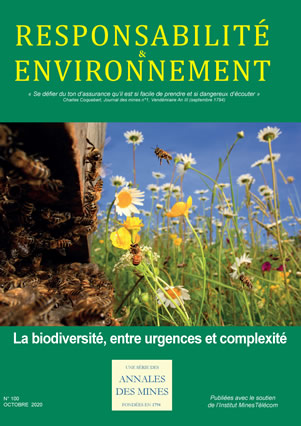
Responsabilité & Environnement
La biodiversité, entre urgences et complexité
Issue editor:
François LETOURNEUX et Claire TUTENUIT
Issue 100
The view of scientists
Human societies and the erosion of biodiversity: From observations to recommendations, the lessons drawn from the 2019 IPBES report on biodiversity
By Jean-François SILVAIN
Fondation pour la recherche sur la biodiversité
The ‟Global assessment report on biodiversity and ecosystem services” made in 2019 by the Intergovernmental Science-Policy Platform on Biodiversity and Ecosystem Services (IPBES) marked a key phase in making decision-makers aware of the issues related to the accelerated decline in biodiversity and the loss of the services related to it from which human societies benefit. The international media have widely reported the conclusions from this report’s summary and thus helped in raising the awareness of decision-makers and a wide section of the population. After describing how an IPBES report is organized and drafted, this article focuses on the major lessons to be drawn from it and the preferred options for obtaining leverage to reverse current trends. Criticisms are formulated; and some gaps, pointed out. This landmark report in the recent history of worldwide environmental policies draws conclusions that carry even more weight since the Covid-19 pandemic.
Biodiversity in the long run
By Bruno DAVID
Président du Muséum national d’Histoire naturelle
The planet has come through five major extinctions since the start of the Phanerozoic eon. After each of these, with its specific characteristics, the biodiversity that emerged was quite different from before the extinction. There were winners and losers. The biosphere seems to be undergoing a sixth crisis. Is this so? Are the processes under way comparable with those during the previous extinctions? What lessons to draw from the past?
Biodiversity: A crisis and adaptation
By Pierre-Olivier CHEPTOU
CEFE UMR 5175, CNRS, Université de Montpellier, Université Paul-Valery
The current biodiversity crisis is a cause of concern for human societies, mainly owing to the ecosystemic services rendered by other species. Biological crises are, paradoxically, periods of renewal, when, as past crises have shown, biodiversity rapidly adapts. In response to the changes under way, species are likely to adapt through natural selection. As the scientific literature shows, plant and animal species do adapt to changes: global warming, the decline of pollinators, etc. The evolutionary rescue model has formally described this sort of selection as a defense against the extinction of populations. The function of adaptation in attenuating extinction processes is open to discussion however, since adaptation has not usually spared species from extinction (a factual observation). Adaptation entails major modifications of the dependency between species in an ecosystem (e.g., food webs) and, thus, in the system’s operation.
Research in agronomy and the biodiversity turning point
By Philippe MAUGUIN
PDG d’INRAE
and Thierry CAQUET
Directeur scientifique Environnement d’INRAE
Several recent studies at the global level have raised questions about biodiversity’s apparent antagonism with agriculture and food systems. An issue for agronomic research in the XXIst century is to explore the means for turning this antagonism into a synergy. Through research on and for biodiversity, the objectives are: to help transform agricultural and food systems in order to ensure the security of a wholesome food supply, in particular via diversification and the agroecological transition; to conserve and restore biodiversity while promoting a sustainable use of resources; to protect and sustainably manage the natural resources (water, soil, air) indispensable to life; to preserve the health of human beings and of the environment; and to help, via a twofold strategy of attenuation and adaptation, in the struggle against climate change.
Biodiversity, security of the food supply and climate change: Which path to take to transform agriculture?
By Pierre-Marie AUBERT
Institut du développement durable et des relations internationales (Iddri)
Diego GARCIA VEGA
Institut du développement durable et des relations internationales (Iddri) ‒ Sciences Po, Écoles des Affaires internationales
and Xavier POUX
Institut du développement durable et des relations internationales (Iddri), Application des sciences de l’action (AScA)
The agricultural sector lies at the center of several major issues related to the climate, biodiversity and the safety and security of the food supply. All parties now admit that it is necessary to switch paradigms, but few agree on the direction to take. This debate revolves around the question of how to take responsibility for biodiversity.
In biodiversity… There is diversity
By Luc ABBADIE
Professeur d’écologie à Sorbonne Université
We should be pleased that the word ‟biodiversity” is now in current usage, usually pointing to a set of plants or animals, sometimes replacing the words ‟nature” or ‟landscape”, or referring more or less directly to environmental processes. This apparent polysemy hides, however, what is essential: the diversity in biodiversity! Biodiversity is a fundamental property of what is living, an inherent property of life: variety, variation, disparity, plurality ‒ in short, a diversity that appears at all levels, from molecules to ecosystems, right now and over time, through forms, colors, physiology, the organization of collections of organisms and the patterns of their interactions.
Will we stop environmental degradation at the global level?
By Yann WEHRLING
Ambassadeur à l’Environnement
The health crisis we have just undergone has upset the diplomatic agenda. All environmental indicators are flashing red. Greenhouse gas emissions are still increasing along with average temperatures. Ecosystems such as the oceans or tropical forests are still deteriorating at a staggering rate. Beyond the current pandemic, the road before us branches out in two directions: either putting expectations for the environment on hold as recovery plans and stimulus packages are blindly implemented to the detriment of the environment, or else moving faster toward the environmental transition in line with the scientific data in our possession. France and the European Union, as well as many other states around the world, not to mention economic agents, want to take this second path. The meetings planned for the coming months will be decisive. Should we be satisfied with new commitments made? Above all, will we move from words to deeds?
The French Office of Biodiversity at the heart of public actions for biodiversity
By Pierre DUBREUIL
Office français de la biodiversité
The French Office of Biodiversity (OFB) is a mixed institution owing to its many assignments and its governance with a national and a territorial basis. Internationally, there are few similar establishments. The OFB will be ready to take part in defining an ambitious framework for the 2020s, a framework we all want given the biodiversity crisis.
Nature works for us: it is our business to protect it
By Sylvain VANSTON
AXA Group CSR
Biodiversity loss endangers ecosystemic services, which threatens both society and businesses that depend on them, and in turn investors and insurers that rely on a well-functioning economy. We view the biodiversity challenge as a natural extension of our climate efforts. Indeed, climate change is severely compounding the destruction of ecosystems all around the world, adding pressures related to drought, ocean acidification, more intense natural catastrophes, etc. This is why in 2018 we publicly decided to investigate how biodiversity loss is impacting society and how we can act both as an insurer and an investor. We have made progress since then. We encourage public-private collaboration as well as a strong ‟Kunming Agreement” in 2021 to ‟mainstream” biodiversity action.
Mobilize and transform the fashion industry to preserve biodiversity
By Marie-Claire DAVEU
Chief Sustainability Officer, Kering
Géraldine VALLEJO
Sustainability Programme Director, Kering
and Dr. Katrina OLE-MOIYOI
Sustainable Sourcing Specialist, Kering
Environmental degradation is occurring everywhere around the world at an unprecedented pace in human history. We have left an ‟operational space” that was safe given the planetary limits established by science. Unless humanity adopts radical measures, no fewer than a million species are menaced with extinction in the coming decades. The fashion industry with its complicated global supply chains must take the lead in responding to this situation. Not only does it depend almost entirely on goods and services provided by nature, but it also has a relatively important impact on natural ecosystems. Responding to this crisis calls for understanding the materiality of this impact, setting ambitious objectives, improving logistics, and making a revolution in the production of raw materials and dominant business models. The biodiversity crisis, a major challenge for our generation, calls for unprecedented collaboration in the industry to reverse the trend toward less biodiversity. This is an emergency.
Trafficking in protected species and deforestation: Madagascar, biodiversity held hostage by corruption
By Mialisoa RANDRIAMAMPIANINA & Dr. Frédéric LESNÉ & Vatsy RAKOTONARIVO & Dr. Ketakandriana RAFITOSON
Réseau Malina, Transparency International Initiative Madagascar
Biodiversity in Madagascar is imperiled by trafficking in rare species and the destruction of natural resources, degradations often abetted by corruption. In Atsimo Andrefana, the radiated turtle is the subject of unlawful trade. Smugglers benefit from a well-oiled chain of corruption implicating law enforcement and village heads. Villagers who witness these crimes keep silent out of indifference or fear of retaliation. In Menabe, villagers ‒ paid to turn wooded areas into maize and groundnut fields ‒ are massively destroying the Antimena forest. An investigation has accused a former MP of financing this operation. He used his status as an elected official to escape the reach of the law for a long time. As many of these cases suggest, the apparent severity of Malagasy legislation is on par with the lack of application of laws and court decisions. In this complicated situation, authorities are unable to control sensitive locations, address the issue of poverty, or cope with ever more influential criminal networks.
Corporate mobilization and public policy needs for nature
By Claire TUTENUIT, Eva ZABEY
Déléguée générale d’Entreprises pour l’Environnement (EpE)
Nature loss has serious consequences for business, and many companies are already making nature a priority through the way they sustainably use natural resources across their supply chains, create clean jobs, and produce greener products. To speed and scale business action for nature and biodiversity, we must help businesses 1) navigate the complexity of identifying and assessing impacts and dependencies on nature, 2) embed the value of nature in decision-making and disclosure, and 3) set concrete, evidence-based targets informed by science, which provide clear direction and ambition for further business action. Political leadership is needed to spur more business action, and companies are increasingly calling on governments to enact more ambitious policies for nature.
How and why measure the biodiversity footprint of economic agents?
By Marc ABADIE
PDG de CDC Biodiversité
and Antoine CADI
Directeur Recherche et Innovation, CDC Biodiversité
After three years of development, CDC Biodiversité launched its ‟global biodiversity score” on 12 May 2020. Using this GBS, firms and financial institutions can measure their biodiversity footprint, a calculation that involves two phases for quantitatively linking the business’s activities to their impact on biodiversity. First of all, the link is made between a firm’s activities and the pressure on biodiversity; this entails quantitatively analyzing the contribution of the firm’s activities to these pressures. Secondly, the impact of these pressures on biodiversity is assessed.
How to integrate biodiversity in economic and business decisions
By Simon BUCKLE, Katia KAROUSAKIS, Edward PERRY, Geraldine ANG
Head of the Climate, Biodiversity and Water Division in the OECD Environment Directorate
Biodiversity and ecosystem services loss are resulting in massive costs to our environment, human health and well-being, and our economies. While efforts have been made to integrate biodiversity in economic decision-making, progress is still slow and not at a scale needed to ensure the required shifts to sustainable production and consumption patterns. Integrating biodiversity in decisions made by the business and financial sector have lagged even further behind. This article provides an overview of the status quo today, and key actions needed to better mainstream biodiversity in economic and business decisions.
What to do for biodiversity?
By Bernard CHEVASSUS-AU-LOUIS
Humanité et Biodiversité
Stating in the mid-XIXth century, France took initiatives to protect remarkable natural sites. These actions were expanded during the second half of the XXth century. Following the Rio Conference in 1992, which formally accepted the concept of biodiversity, they were extended to cover our natural heritage and its uses. Despite these efforts, biodiversity has continued declining even though some successes offer evidence that this decline is not inevitable. Since new ten-year strategies will be adopted nationally and internationally in 2021, what lessons can we draw from this long history of protecting nature so as to finally stop this degradation and set off a positive trend?
Miscellany
The physical limits of renewables
By Ilarion PAVEL
Ingénieur en chef des Mines, Conseil général de l’Économie (CGE)
The various sources of renewable energy (sun, wind, biofuels, geothermal power and hydroelectricity) are reviewed; and their potential in France is assessed by calculating the average available flow of energy. The question of improving the conversion of each of these forms of energy into electricity is also discussed.