
July 2020
abstract
Responsabilité & Environnement
Matières premières et nouvelles dépendances
Issue editor:
Isabelle WALLARD
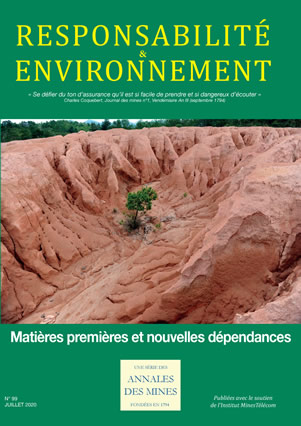
Issue 99
Increased pressure on raw materials because of the energy and digital transitions in developed countries and economic development elsewhere
From value chains to pricing mechanisms: A comprehensive analysis of base metal markets
By Patrice CHRISTMANN
Consultant et chercheur indépendant, société Krysmine
and Yves JÉGOUREL
Maître de conférences à l’Université de Bordeaux, directeur-adjoint de Cyclope et Senior Fellow au Policy Center for the New South
Mineral (nonenergy) raw materials are an indispensable factor of production in human societies. The structure of the complex, globalized value chains that underlie the production of most of the goods and services that contemporary societies commonly use is described and then illustrated with an account of the major transactions in copper from the production and trading of minerals to the supply of this metal to the world market for the production of consumer goods. Products of mining (concentrates) and metallurgy (refined metals, alloys) are intensely traded internationally; the major players in these transactions often are not mining companies or metal-working firms. The mechanisms of commercialization and for setting prices (which connect mining companies or metallurgical firms to manufacturers downstream in the value chain) are then described along with the key role played by traders in raw materials and the functions of the markets of secondary products.
Various energy scenarios and the future availability of raw materials
By Olivier VIDAL
Institut des sciences de la terre (ISTerre), Université Grenoble Alpes, CNRS
The world’s population, the average GDP per inhabitant, and the consumption of energy and raw materials all follow the same trend: a nearly exponential growth rate for more than a century now. Humanity is using an unprecedented level of mineral resources: 70 billion tonnes of minerals extracted from under the earth per year and a consumption per inhabitant that we have never previously observed. Future consumption is predicted to fall in the line with this past trend. The annual quantity of metal to be produced from now till 2050 could amount to from three to ten times more than the current quantity. The cumulative amount of metals to be produced during the next 35 years will exceed the cumulative quantity extracted since Ancient Times. For mineral resources, the stakes are enormous ‒ with major implications for all sectors of the economy and technology, in particular, energy. This overview insists on the many factors and dynamic nature of the trends observed.
The importance of rare earths for information and communications technology: The case of Orange
By Samuli VAIJA
Analyse cycle de vie et économie circulaire, Orange
and Éric PHILIPOT
Conseiller environnement
Since 2016, when its business processes started taking account of the circular economy, Orange has undertaken several programs to improve its knowledge of materials. It has carried out life-cycle analyses to identify materials with the heaviest environmental impact and then expanded them to cover the equipment used for ICT networks. A program was launched in 2018 for updating the map of the Orange Group’s exposure to critical materials. It focuses on the new forms of technology for which specific materials will probably be necessary. Orange has also worked on setting standards (at ADELE and ITU-T) for the efficiency of materials. It intends to draft a state-of-the-art proposal about these efficiency requirements and integrate them in its procurement processes.
Recycling will not satisfy needs
Grains of wheat on a chessboard, an illustration of the limits on the growing consumption of metals and on recycling as a source of metals
By Jean-François LABBÉ
Ancien géologue économiste, ancien analyste de la criticité des matières premières minérales au BRGM
Calculating the number of grains of wheat necessary to fill the 64 squares on a chessboard by starting with one and then doubling the amount in each successive square, as the legend has told us, provides an image that corroborates the impossibility of an endlessly rising demand for metals. The worldwide demand for most metals has grown without hardly any interruptions since the start of the industrial era. A variant on this legend that takes account of recycling confirms that we are deluded to imagine that recycling ‒ even optimal or at 100% ‒ will offer us a sustainable economic growth without any need of new raw materials.
Recycling circuit boards in France
By Christian THOMAS
Fondateur et directeur scientifique de TND, président du pôle de compétitivité TEAM
Printed circuit boards at the end of the life cycle of the equipment containing them are, once recuperated, a rich source of precious, critical minerals. Recycling them is not only useful but also profitable. Thanks to the adoption of regulations about waste electronic and electrical equipment (WEEE) and the end of the life cycle of motor vehicles, the waste collection and primary processing of these materials has improved. France has devoted major R&D efforts to extracting and purifying the metals contained in WEEE wastes, which are hard to process. However the country does not yet have a strong enough metal-working industry. Most metals in our wastes are sent abroad, mainly to southeastern Asia. An overview of the current situation, of players on the French market and of emerging projects…
Recycling will not satisfy needs
CSF Mines et Métallurgie and the supply of metals and strategic materials
By Christel BORIES
Présidente du CSF Mines et métallurgie et PDG du Groupe ERAMET
The supply of strategic metals is a major issue of national sovereignty. It is also a concern for CSF Mines et Métallurgie, a multiparty organization and the inescapable partner in the relations between public authorities and firms in mining and metallurgy. The Covid-19 pandemic has made it even more urgent to see to the security of our supply chains, especially in strategic metals and materials, and to develop an ambitious public policy.
Metals critical to the French economy
By Gaétan LEFEBVRE
BRGM, direction des Géoressources
A metal is said to be critical following an assessment and, therefore, in relation to our perceptions. A critical metal strongly risks being in shortage, and this shortage would have a heavy impact. For French industrialists, there are many sorts of risks: bottlenecks on the supply chain; stiff competition between sectors; the impossibility of replacing scarce materials for precise uses; and the unavailability of metals for geological or technical reasons. Studies of criticality, as conducted by BRGM, seek to improve our knowledge of these risks so as to orient economic agents toward the best solutions for protecting themselves and conducting concrete actions.
French industry’s titanium supply: The current situation and prospects
By Pierre-François LOUVIGNÉ
Consultant
Titanium is an irreplaceable chemical element for several industrial processes in high technology: aeronautics, nuclear power, weaponry, medicine, petrochemistry, the space industry, etc. France and Europe depend on importations of titanium from great powers such as the United States, Russia or China ‒ countries that are competitors in the sectors that use this element. Drafting a supply chain strategy thus calls for solid knowledge about the market and a dynamic analysis of the risk factors of dependency, especially during a crisis. For these reasons, titanium is subject to an economic and geostrategic monitoring supported by big industrial groups in France and by the state’s services concerned with the access to raw materials.
Ambition 2025: The Orange Group’s strategy for developing a digital technology that is less energy-intensive and more economical in critical materials
By Philippe TUZZOLINO
Directeur Environnement du Groupe Orange
Even as customers are increasingly using it, digital technology must, given the climate emergency, reduce its environmental footprint. In compliance with the objective of limiting global warning to 1.5°C and with the recommendations of the Intergovernmental Panel on Climate Change and the Paris Agreement, Orange wants to pursue a path toward lowering the CO2 emissions stemming from its activities. It has set the ambitious objective of reducing the absolute quantity of its CO2 emissions in 2025 by at least 30% compared with 2015. Orange will achieve this mainly by relying more on electricity from renewable sources (more than 50% by 2025). In pursuit of these new goals, studies are being planned of the resources necessary for this policy. Orange manufactures nothing directly; it purchases all its equipment. Its Strategic Committee on the Circular Economy, set up in 2017, has among its fields of action the risks related to raw materials and scarce resources. Its actions include new research on the materials critical to the Group, their procurement processes and relations with suppliers.
Raw materials, their criticality and the automobile industry’s strategic axes
By Gildas BUREAU
Pilote du groupe de travail PFA Filière « Automobile et Mobilité » sur les matériaux stratégiques pour l’automobile
The automotive sector with 400,000 jobs in France is one of the national strategic industries. This industry uses many increasingly complex technological equipment that it has managed to make reliable and affordable. The integration of these technological functions is necessary for active and passive safety, passenger compartment comfort, compliance with environmental standards and for on-board connectivity. These technical, economic, sustainable and safe performances are the fruit of technological developments and breakthroughs that have been made possible thanks to the industrial use of raw materials with exceptional properties, whatever they can be electronic, electrical, magnetic, optical... If we go up the supply chain of these automotive components, there are materials and raw materials. Even at the time of digitalization, an automobile remains a collection of more than a ton of materials. As we will see, these raw materials are at the heart of a complex, international and interdependent ecosystem with high stakes. In this context, different levers can be used to establish one ‒ or should I say several strategies ‒ for the management of strategic raw materials.
The war for rare metals, the hidden face of the energy and digital transitions
The US government’s strategy for seeing to the security of the supply of critical minerals for industry
By Alexis SAHAGUIAN
Direction générale du Trésor
FERNANDEZ
and David KREMBEL
Ambassade de France aux États-Unis – Service économique régional
The response to the question of critical raw materials in the United States has taken shape around many axes: geopolitical (rivalry with China), industrial (repatriating the production of goods in strategic sectors, seeing to the security of the supply chain) and ideological (the country’s autonomy for reasons of national security). The federal government’s strategy has methodically been designed like a pyramid, each ministry providing input and means of action under a presidential order of December 2017. However this leaves out of account several questions related to local environmental issues and multilateral trade, questions overridden by the objectives set by the federal government.
A sustainable consumption of natural resources: A planetary issue
By Doris NICKLAUS
Ingénieur en chef des ponts, des eaux et des forêts
and Dominique VIEL
Contrôleur général économique et financier honoraire
Given the increasing extraction of resources worldwide, the sustainability of using them has become a full-fledged public policy question at the international, European and national levels. France’s first “resource plan” was introduced in July 2018. As part of the roadmap for a circular economy, a second plan is being drafted with a focus on mineral resources for the low-carbon transition and on an industrial policy with ambitious goals for recycling materials. As the work on these plans has shown, France and Europe are dependent for their supply of minerals and metallic components even as demand is constantly growing ‒ including for satisfying needs related to the low-carbon transition and development of digital technology. The Covid-19 economic recession is revealing this fragility. It raises questions about the relocation of industrial activities, including mining and the processing of raw materials.
France’s policy of mineral (nonenergy) raw materials
By Rémi GALIN, Jean-François GAILLAUD
Direction de l’Eau et de la Biodiversité (DGALN/MTES)
France's dependency on metals is not new. When setting objectives for the supply of metals however, the situation to be taken into account has changed. The vulnerability of our leading industries, the multiplication of substances, and the pressure on the planet’s resources are new parameters that require placing the question of the supply of minerals in a more virtuous economic model: the model of the circular economy. France has dynamic strategic guidelines in its “resource plan”. Furthermore, it can rely on the operational expertise of the CNI’s industry-based strategic committees, in particular the committee on mining and metal-working industries. By mobilizing European forces and our industries in mining and metallurgy and in innovation, industrial programs should take shape on the basis of national resources and in collaboration with operators with whom we share the same values.
The European raw materials strategy
By Gwenole COZIGOU
Directeur, direction Industrie durable et Mobilité, direction générale Marché intérieur, Industrie,
Raw materials, essential to our modern lifestyle, are used in a wide variety of products ranging from construction materials to the food industry, not to forget electronics or “clean” energy. They will, in the future, remain essential to the competitiveness and resilience of industrial value chains on the scales of the European Union and the global economy. Given that the Covid-19 pandemic has exposed points of vulnerability in supply chains, Europe must actively pursue a more strategic approach that considers the access to resources to be an essential factor for carrying out the green transition and reducing its dependency on critical raw materials.
Miscellany
A carbon-free production of hydrogen: The third method
By Laurent FULCHERI
Directeur de recherche, Université PS
Hydrogen will probably play a key role in the next decades. Unfortunately, the most current method for H2 production, often referred as “grey H2”: Steam Methane Reforming (SMR) is responsible, in average at the worldwide scale, for more than 10 tons CO2eq per ton of Hydrogen! Water electrolysis is obviously an ideal long term option for the production of decarbonized H2 (“green H2”). Unfortunately water splitting reaction is extremely energy intensive. A third way which is today coming back on the front of the wave, often called as “Blue H2”, is based on the high temperature Natural Gas pyrolysis for the co-production of Hydrogen and solid carbon. The main advantage of this approach is that is thermodynamically much less energy intensive than water splitting. Research on Methane pyrolysis by thermal plasma have been carried out at MINES-ParisTech for more than 25 years. The technology is now mature and a first commercial plant for the co-production of hydrogen and carbon black is today under construction in the US by MONOLITH Materials, Inc.