
January 2020
abstract
Responsabilité & Environnement
Le nucléaire civil, enjeux et débats
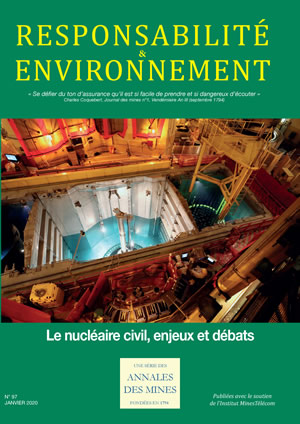
Issue 97
A situation analysis
The evolving framework of activities in the nuclear electricity industry worldwide since 1950
By Marc DEFFRENNES
Analyste principal en énergie nucléaire – Division de l’économie et du développement des technologies nucléaires, Agence de l’OCDE pour l’énergie nucléaire (AEN)
and Daniel IRACANE
Directeur général adjoint et directeur des Affaires nucléaires, Agence de l’OCDE pour l’énergie nucléaire (AEN)
For more than fifty years, energy from nuclear fission has been used for civilian purposes, mainly to generate electricity. After a first phase of building prototypes and demonstrator units based on a wide range of fuels, coolants and moderators, the choice was usually made for light-water-moderated reactors, which now make up the large majority of the 450 reactors that generate 10% of the world’s electricity. In the OECD countries that use nuclear technology, the construction of new reactors is slowing down, a result of the combined consequences of: the impact of the three major nuclear accidents on public opinion; the opening of the electricity market; and the priority given to developing intermittent, renewable sources of energy. China is catching up fast and now becoming a supplier of nuclear technology. Some new countries are showing interest in the nuclear industry or have even built their first nuclear power stations. The world has considerably changed from what it used to be twenty years ago. Climate change, in particular, has created an urgent situation, like the sword of Damocles. Apart from Russia, the countries that were pioneers in civilian nuclear technology do not now have as strong a capacity for innovation and leadership in nuclear engineering. Given this context, it is worthwhile to briefly review the past fifty years of the history of nuclear energy in order to learn lessons that might inform policy-makers, who have the responsibility of choosing a sustainable energy mix that is clean, economic and reliable.
What place for nuclear energy in open electricity markets?
By Patrice GEOFFRON
Université Paris-Dauphine, Université Psl
The initial investment cycle in civilian nuclear energy occurred during the 1970s, before the trend in the OECD toward opening electricity markets. Now, nuclear power is competing with renewable sources of energy, which are pulling prices down (in Europe) and/or with thermal energy production (in the United States). This pattern, which might shorten the life span of the nuclear power stations placed in operation during the 20th century, gives rise to uncertainty about how to finance plans for future power stations (supposing that, as in the British Hinkley Point project, a guarantee from “outside the market” is provided). These observations proceed from market interactions between electricity production systems depending on their “merits” (i.e., marginal costs) and, too, from imperfect assessments of how each system contributes to the electricity grid’s capacity, services and, above all, carbon footprint.
Nuclear energy in scenarios for decarbonizing the European energy mix by 2050
By Fabien ROQUES, Yves LE THIEIS
Compass Lexecon
Following ratification of the Paris Climate Agreement, the European Union reasserted its determination to “decarbonize” its energy mix by 2050. As various studies have shown, this entails increasing the share of electricity in final uses and removing carbon from the processes for generating electricity. To quantify the nuclear industry’s potential contribution to the goal of a low-carbon economy, a study requested by FORATOM (presented in this article) has drafted three contrasting scenarios about the capacity for producing nuclear electricity in Europe. These scenarios for achieving “decarbonization” are analyzed and assessed using several criteria. The nuclear industry thus turns out to be a big contributor to the energy transition; in particular. This study sheds light on the difficulties and extra costs that would result from a scenario with a low share of nuclear energy, in which the life span of existing nuclear power stations would not be prolonged.
What happened at Three Mile Island, Chernobyl and Fukushima Daiichi? And where are we now?
By Jean-Christophe NIEL, Jean COUTURIER
IRSN
Certain objectives, principles and approaches related to the safety and protection from radiation of the environment and people (the public and employees) are taken into account to design and run nuclear power stations. Safety is being continually improved by taking under consideration: changing perceptions of risks; the new knowledge acquired about the complex phenomena that might occur inside reactors; and the experience gained from operating nuclear power stations, in particular the lessons learned from the big accidents involving the fusion of a reactor’s core at Three Mile Island (1979), Chernobyl (1986) and Fukushima (2011). From these three accidents, quite different lessons can be drawn about operating nuclear reactors to generate electricity. The ultimate purpose of all the concrete measures adopted following these experiences is to reinforce prevention and limit the effects of such accidents. Since the 1990s, an internationally adopted principle is, when designing a new generation of reactors, to garner feedback from accidents involving the fusion of a reactor’s core.
The Competitiveness of Nuclear Energy: From LCOE to System Costs
By Jan Horst KEPPLER, Marco COMETTO
Senior Economist
Economists used to compare the costs of electricity based on the discounted average lifetime costs of power plants, a metric known as the levelised costs of electricity (LCOE). This transparent and comparatively simple metric worked well in a context of regulated markets. Nuclear, coal, gas and hydro thus competed based on their respective capital, labour and fuel costs at the level of the individual plant. Three forces compel a move away from LCOE. First, the social costs of CO2 and local pollutants are becoming an important decision criterion. Second, the liberalisation of electricity markets introduces price and market risk as a dimension of investor cost. Third, the rise of variable renewable energies (VRE) such as wind and solar PV requires new costs metrics, as the system needs to back up variable resources with added capacity of dispatchable plants. A study by the OECD Nuclear Energy Agency (NEA) shows that integrating system effects increases the costs of a MWh produced by VREs up to USD 50 when they have a 75% share. While precise amounts vary with penetration and flexibility resources, policymakers need to understand that the presence of VRE requires a new notion of competitiveness that includes system effects.
Calculating the costs of relaunching the nuclear industry and understanding the economic cycle
By Jean-Guy DEVEZEAUX DE LAVERGNE, Michel BERTHÉLEMY
Société française d’énergie nucléaire
Several worksites where the first reactors of the third generation are being built have encountered major difficulties with several causes. This can, in large part, be set down to the absence, for twenty years now, of big programs of this sort in the United States and Europe. The costs of the first reactors of a new generation have ballooned. Thanks to accumulated feedback, this article shows how and why tomorrow’s nuclear industry will be competitive, not only as it already is in Asia but also in other geographic zones. The range of economic results presented herein is coherent with public authorities’ strategic analyses. The findings are: that a program for updating France’s fleet of nuclear reactors is needed and should be started fast; that the closed cycle should be pursued; and that the first phase of the Cigéo Plan (for a nuclear waste repository) should be launched.
Managing radioactive wastes in France and the world
By Pierre-Marie ABADIE
Andra
Since the properties of radioactivity are being put to use in several branches of the economy, radioactive wastes have been produced. These wastes, a risk for people and the environment, must be managed as a function of their radioactivity and halflives. Wastes with short halflives amount to 90% of the volume of French wastes but to a low proportion of total radioactivity. They can be stored at ground level. Meanwhile, plans are being made for handling wastes with long halflives. For the storage of such wastes with an average to high level of radioactivity, Andra is in charge of the Cigéo Plan for an underground nuclear waste repository that, deep in a bedrock with remarkable properties, will isolate these wastes for a very long time. France is not the only country to have made this choice. Internationally, the geological storage of wastes with long halflives is considered to be the key solution.
Jointly managing nuclear power and intermittent renewables for a low-carbon economy
By Alain BURTIN
EDF R&D
Climate change is for real; and the scientific community mostly claims that it is anthropogenic. Fighting climate change means reducing CO2 emissions. The electricity industry must remove carbon from deep within its production processes, since it accounts for 40% of CO2 emissions worldwide. Nonetheless, this challenge is also an opportunity that bears stronger prospects for electrification in transportation, the building industry and manufacturing. As their costs decrease, renewables (wind and solar power) are, along with traditional nuclear and hydraulic power plants, expanding the production of carbon-neutral electricity. Jointly managing nuclear energy and renewables could help us deeply decarbonize the electricity mix.
Debates and policies
Managing nuclear wastes
By Laurent MICHEL, Aurélien LOUIS
Direction générale de l’Énergie et du Climat (DGEC/MTES)
Like all other industries, the nuclear industry, civilian and military, produces wastes – substances without use value that are to be eliminated. In comparison with other industries, the quantities and nature of these wastes are relatively well known (cf. Anda’s national inventory: https://inventaire.andra.fr/). Although these wastes are now being stored in good conditions, nuclear waste management is regularly presented as a major obstruction that will keep this industry from attaining the status of being “sustainable”. Why? Partly owing to the very nature of these wastes: they are radioactive, hence potentially dangerous if poorly managed. But above all because they have a much longer life cycle than ordinary wastes. Time is a key factor in the management of radioactive wastes.
Nuclear safety and protection from radiation in France
By Bernard DOROSZCZUK, Lydie ÉVRARD
Autorité de sûreté nucléaire (ASN)
The French Nuclear Safety Agency’s (ASN) main assignment is to protect people and the environment from the harmful effects of radiation. It now has to cope with unprecedented issues related to nuclear safety: firing up the EPR, controlling plants that have outlasted their initially planned life span and keeping them in operation longer, managing wastes, dismantling old installations and, too, handling problems of radiation in medicine (due to the increasing use of imagery and radiopharmaceutical products). For the ASN, the key issues are related to foresight, the maintenance of safety margins and the reinforcement of skills and qualifications. The ASN will have to take up three principal challenges: adopt methods for public consultation, adapt to the digital transition, and control its financial resources in order to safeguard its autonomy.
Toward an international convergence of regulations on nuclear safety?
By Anne-Cécile RIGAIL, Julien COLLET
Directeurs généraux adjoints, Autorité de sûreté nucléaire
Although the nuclear industry is distinctively national, most of the frameworks set up for international trade have proposed a convergence of national regulations. There are two “weak” driving forces behind this convergence: industrialists want uniform rules for their exportation plans, and public opinion expects ambitious safety requirements in all countries around the world. Thanks to France’s efforts, in particular at the European and then international levels, safety requirements have been pulled up. However these efforts have reached their limits in a multipolar world, where the big powers do not want to tighten the requirements that apply to their national champions and where each country in the nuclear club wants to keep full control over its nuclear industry.
How to develop transparency and participation in civilian nuclear energy?
By Jean-Claude DELALONDE
Président de l’ANCCLI
Transparency, pluralistic appraisals, participation in decision-making… How are international, European and French regulations now being applied? Have NGOs been capable of using their rights of access to information and of participation in decision-making to understand nuclear energy and play a role in this field? The French National Association of Local Information Committees and Commissions (ANCCLI) has drawn up an inventory of the regulatory tools designed for this purpose. How have “civil society” and the nuclear industry put these tools to use as genuine means of action? What positive points come to light? And what are the points to watch and to improve? Between the (oft emphasized) urgency of finding a solution and the necessity of taking time (to obtain information, improve skills and confer with stakeholders), “civil society” expects more sincerity, even humility, from players in the nuclear industry. Above all, NGOs want to see to it that their participation carries weight when decisions are made.
Can we overcome the fear of nuclear energy?
By Myrto TRIPATHI
Fondatrice et présidente des Voix du Nucléaire
In its report in October 2018, the Intergovernmental Panel on Climate Change (IPCC) emphasized that the share of nuclear power in the world’s energy mix must increase. It pointed out the major obstacle to doing this: “The current deployment pace of nuclear energy is constrained by social acceptability […]. Though comparative risk assessment shows health risks are low […], the political processes triggered by societal concerns depend on the country-specific means of managing the political debates around technological choices and their environmental impacts”. Unprecedented efforts are being made to move civilization from one model to another within a single generation. Societal obstruction stems, as the report recalls, from erroneous perceptions. Overcoming it, which would open the way for rapid, significant advances, should be a priority, which is not now the case. The parties in charge of lifting these obstacles seem to have made them heavier. A few persons (in particular members of the association Voix du Nucléaire) have decided to tackle the herculean feat of, above all, “informing”, a task that most stakeholders have sidestepped. Will our children realize that we knew this choice was difficult and that this was the reason for doing something?
The French nuclear industry in transition
By Augustin BOURGUIGNAT
CFDT
The French nuclear industry stands at a juncture. It has not settled its liabilities, and has not imagined what future would be desirable. Its prospects depend on its ability to address economic, technological, industrial and societal questions as well as the issue of sovereignty. The French nuclear electricity industry must stake out its place in the energy transition by redefining the energy mix, designing a process for managing end wastes, and sponsoring units for dismantling plants. To accomplish this, “social accompaniment” is indispensable, as are activities that create jobs (notably in renewables).
Civilian nuclear energy’s strategic dimension
By Marc-Antoine EYL-MAZZEGA
Institut français des relations internationales (IFRI)
French stakeholders in civilian nuclear energy are making a full diagnosis of the industry in order to cope with disappointments and lay down the conditions for relaunching programs for building reactors. This is the time to envision this industry’s strategic dimension. Given global technological warfare and bipolarization (United States vs. China), France and the European Union must work out a strategy for controlling value chains in all forms of low-carbon technology. A key component is civilian nuclear energy. The risk is that China, Russia and, to a lesser extent, the United States come to dominate exportation markets and lock out other countries. France and the EU might lose influence over the world governance of this sector and the nonproliferation of nuclear weapons. Meanwhile, several countries want to acquire nuclear technology, which is now oriented toward small modular reactors.
A firsthand account from the mayor of a commune where a nuclear power plant is installed
By Bertrand RINGOT
Maire de Gravelines
Built from 1975 to 1985, the nuclear power plant in Gravelines (near Dunkirk) has had an impact, in particular economic and demographic, on local development. An industrial synergy was locally possible owing to the nearby installation of electricity-intensive industries. The very strong presence of the nuclear power station in this local area has been attested by the creation of a committee of governance for preparing and monitoring the big programs to be carried out. Given the constant concern for anticipating energy needs, a concern that fits into a long-term vision, special attention is to be paid to the security of the energy supply and to the dismantling and renovation of plants and equipment. Major questions remain about informing the population and about various players’ roles.
The end of nuclear electricity, a science fiction
By Bernard LAPONCHE
Président de l’association Global Chance
Starting out from the military-industrial development of the production of electricity from nuclear power, the history of this industry from 1950 to 2018 is told, from its success to its decline. This decline can be set down to the big nuclear accidents at Three Mile Island, Chernobyl and Fukushima and to the loss of competitiveness due to increased production costs and to the spectacular drop (which accelerated in the 2010s) of the production costs of competitors who produce electricity from renewables (wind power, photovoltaics). The argument that nuclear power has a low level of CO2 emissions has not tipped the balance in its favor. The trend toward the end of nuclear electricity is described in various countries and regions around the world, and particularly in France. The turning point will take place during the decade 2020-2030, when an energy policy with sobriety and efficiency on the demand side and with renewables on the supply side will halt the production of nuclear electricity in the world during the period 2040-2050.
Industrial and technological aspects
The Nuclear Mission in an Integrated, Carbon-Free Energy Future
By Sherry BERNHOFT, Andrew SOWDER, Robert AUSTIN
Senior program manager for Strategic Programs and Long-Term Operations at the Electric Power Research Institute (EPRI)
As the global community strives to curb carbon emissions from the energy sector, focus has sharpened on the role nuclear energy can play in the effort throughout the 21st century. While the light water reactor fleet provides the nuclear generation backbone for meeting future capacity needs and emission goals, more than half of the world’s nuclear power plants have surpassed 30 years in service. The Electric Power Research Institute (EPRI), in collaboration with research entities around the world, helps turn the world’s carbon neutrality challenges into opportunities. EPRI’s work delivers research to answer key questions about modernization efforts that can provide safe and cost-effective life extensions for long-term operation, increase operational flexibility to support stable power grid dynamics, reduce nuclear power plant operating costs, and the examine the latest reactor technologies for more viable new nuclear power plant construction.
Reactors of the 4th generation: Forms of technology and their prospects
By Didier PILLET
Ingénieur général des Mines, Conseil général de l’Économie
Nuclear reactors of the third generation are being fired up around the world. In particular, the Taishan 1 and 2 EPRs have recently been connected to China’s electricity grid. Meanwhile, Generation IV Forum, which groups fourteen countries, has been conducting studies on reactors of the fourth generation since 2000. The intent is to identify the best solutions for addressing the many issues related energy and the climate that have arisen since the start of the century. For example, fissile uranium (U-235) might become scarce by the century’s end. After presenting the technology in the pipeline, focus is shifted to the work conducted under the ASTRID program and to the conditions, under this program, for rolling out sodium-cooled fast reactors in France.
Nuclear Power in a Clean Energy System
By Keisuke SADAMORI
International Energy Agency (IEA)
Nuclear power, along with hydropower, forms the backbone of low carbon electricity generation today; together they provide three-quarters of global low-carbon generation today. Over the past 50 years, nuclear power has reduced CO2 emissions by over 60 gigatonnes – nearly two years’ worth of global energy-related emissions. Yet in the advanced economies, nuclear power has begun to fade, with plants closing and little new investment, just when the world requires more low-carbon electricity. This paper focuses on the role of nuclear power in the advanced economies today and the factors that put nuclear power there at risk of decline tomorrow. The paper shows that without action nuclear power in the advanced economies could fall by two-thirds to 2040. It examines the implications of such a decline for emissions and for electricity security. Achieving the pace of CO2 emission reductions in line with the Paris Agreement is already a huge challenge, requiring large increases in efficiency and renewables investments, as well as an increase in nuclear power. This paper identifies the even-greater challenges of attempting to follow this path with much less nuclear power, including an additional USD 1.6 trillion in investment needs and 5% higher cost to consumers in advanced economies. This paper recommends several actions to governments open to nuclear power that aim to ensure existing plants can operate as long as they are safe, support new nuclear construction, and encourage new nuclear technologies to be developed.
Replacing France’s fleet of nuclear reactors
By Valérie FAUDON
SFEN
Between 2030 and 2050, France will have to replace many of its nuclear reactors with new means of production, including reactors of a new generation. Several issues crop up. Energy-related issues: given the extremely fast pace at which reactors were built in the 1980s, France might discover that it is standing on the edge of a cliff in the 2040s. Economic issues: to trim the costs of new reactors, leverage can be gained from an optimized program for assessing competitive advantages in terms of the services delivered to the electricity grid. Industrial issues: skills and qualifications are needed to build new reactors. Though partially kept up to date through the construction of the EPR in Flamanville, these skills risk once again becoming obsolescent if the nuclear industry, which has difficulty recruiting, does not soon gain better visibility of the worksites to be planned.
Industrial leverage for competitiveness in the nuclear industry
By Xavier URSAT
Directeur exécutif d’EDF en charge de la direction Ingénierie et projets Nouveau nucléaire
The French fleet of nuclear reactors will reach a turning point during the 2030-2035 period. This legacy of a long-term policy for seeing to the country’s energy independence is also an economic, social and environmental asset. This industry’s time scale is long-term. We should start giving thought to the conditions for replacing reactors. For the construction of the first EPR in Flamanville, the industry had to deal with several problems. The lessons it learned have already been integrated in the plans being drawn up for new reactors. To build them, industrialists and the whole society have to be mustered. The French nuclear industry must be ready and continue trying to consolidate its industrial control and economic performance in a world undergoing change.
The supply of uranium and strategic metals for the nuclear industry: Is dependency the problem?
By Philippe KNOCHE
Directeur général d’Orano
A key factor in sovereignty is a country’s energy independence. Since it has developed a vertically integrated nuclear industry, France is able to control the design and construction of its own installations for generating electricity, enriching uranium and making fuel through processes for recycling and waste management. It controls its supply of uranium, which is an abundant resource, via, in particular, Orano, which operates mines on three continents. Thanks to its control over this industry’s vertical integration, in particular for enriching uranium and recycling spent fuel, France has stored what amounts to a strategic reserve. Nuclear materials can also be used in other fields important to the country’s sovereignty, such as space or medicine.