
September 2018
abstract
Gérer & Comprendre
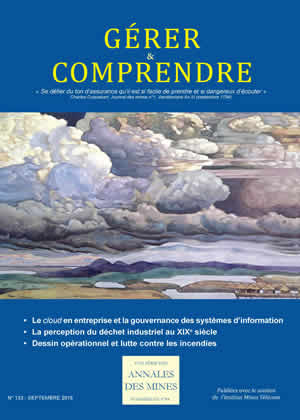
Issue 133
OVERLOOKED…
Operational drawings for the Paris Fire-Fighters’ Brigade: The improbable story of an organizational resource
By Anne DIETRICH
Maître de conférences habilitée à diriger des recherches à l’Université de Lille, IAE Lille, qualifiée professeur des universités et membre du LEM (Lille Économie Management) UMR-CNRS 9221
Jérôme RIBÉROT
Doctorant au RIME Lab, EA7396, Université de Lille ‒ IAE
and Xavier WEPPE
Maître de conférences à l’IAE de Lille, membre du LEM (Lille Économie Management) UMR-CNRS 9221
An improbable story: the unusual collaboration that lasted nearly fifty years between a draftsman and a military organization in charge of protecting goods and persons in the Paris area, the Brigade de Sapeurs-Pompiers de Paris (BSPP). Light is shed on how the draftsman and his operational drawings gradually changed from being a peripheral resource to a core input for the work of fire-fighters. This draftsman’s foreseen departure raised questions about the transfer of his knowledge and skills, and their appropriation by the brigade. Operational drawings for the Paris Fire Brigade: The improbable story of an organizational resource
TRIAL BY FACT
The cloud computing paradigm: Beyond new solutions, the issue of renewing the governance of information technology
By Valérie FAUTRERO
Maître de conférences en sciences de gestion au sein du département Sciences économiques et Gestion de l’Université Toulouse-Jean-Jaurès, UMR i3 (CNRS, Télécom ParisTech, Mines ParisTech, École polytechnique)
Valérie FERNANDEZ
Professeur, directrice du département Sciences économiques et sociales de Télécom ParisTech, UMR i3 (CNRS, Télécom ParisTech, Mines ParisTech, École polytechnique)
and Sabine KHALIL
Enseignant-chercheur en Management des systèmes d’information à l’ICD (Institut international du commerce et du développement, laboratoire LARA)
Cloud computing is a corporate fad, both in the firms rolling out this solution and in those adopting it. How to integrate cloud computing solutions in an organization? What are the sakes for information systems? Based on comparisons of the analyses in the academic and professional made by the various professional groups involved in cloud computing, this article also draws from an original corpus of interviews with 39 information system directors in big firms, French and international, which are typical of the market for this type of solution. This research has made three main findings about: the strategies of adoption as a function of the type of cloud computing; the strong pressure that, from the supply-side of the market and, too, from the demand-side of actors within the firm, weighs on the choices made; and the effects of this two-sided pressure and of the very important issues for the organization’s design that call for a specific governance of information systems. To be both efficient and effective, the move toward cloud computing entails strategic decisions that have to be coordinated and steered using this new form of governance – this is necessary to keep control over what has become the “cloud computing paradigm”.
IN QUEST OF A THEORY
Adapting the model for calculating the costs of information systems and the need for accountability when resources are pooled
By Isabelle Lacombe
assistant research professor of finance, head of the department Droit, Finance, Contrôle & academic director of M2 (Audit et Finance d’Entreprise), EM Normandie, Laboratoire Métis.
A bank can improve its competitive edge via its information system and better cost-controls. A case study of the merger of two information technology services in a French bank confirms what the literature has reported: the need for a specific methodology to calculate costs in information technology services. An Activity-Based-Costing model (ABC), ameliorated by including technical services, uses benchmarks and technological choices to directly relate costs to the services using them. Adding a level of analysis of bookkeeping data makes it possible for operatives to interpret and improve these data, thus making possible a better distribution. A reinforced governance via service contracts (with a need for more accountabi-lity and thus for auditing the resources and the services delivered) proves to be crucial when services are merged and their resources, pooled.
OTHER TIMES, OTHER PLACES
The social construction of risks: Storing solid wastes from mills underground (1810-1917)
By Serge Boarini
PhD, agrégé professor at Lycée de l’Oiselet (Bourgoin-Jallieu), member of the Haut Conseil des Biotechnologies and of the Comité de Protection des Personnes Sud-Est V.
How did the 19th century view the mills that had sprung up and the risks of burying their solid wastes? Why was underground storage not seen as a risk? After describing the context and motives for burying wastes, the effort is made to understand how people perceived the responsibility for these wastes; and an explanation of this “social construction of risk” is proposed. Mill wastes were seen in relation to the ordinary reality of rural life; and the ideas formed about them were copied on those about animal excrements. Although mills “denatured” the environment, their production was interpreted as being natural (“things fix themselves”) in a rural setting (“everything is put back to use”). In this way of thinking (before modern industrial catastrophes), the surroundings “naturalize” wastes and refuse from the mills. Owing to the context and ideological factors, there was no awareness of a specifically industrial risk. The social construction of risks: Storing solid wastes from mills underground (1810-1917)
The invention of logistics by Antoine-Henri de Jomini
By Aurélien Rouquet
professor of logistics, NEOMA Business School.
In managerial science, not much serious thought was given to logistics prior to the 1980s. Nevertheless, Antoine-Henri de Jomini, a Swiss who had fought in the Napoleonic army, had, as early as 1838, laid the grounds for modern logistics in his Précis de l’art de la guerre. How did he manage to imagine, in the field of military actions, the ideas that would be applied to logistics in corporations at the start of the 1980s? An article for researchers on logistics and management that expounds the ideas and approach adopted by Jomini, which make him one of the founding fathers (along with Taylor, Fayol, Vauban) of management…
Mosaics
Why would you work for a Big4?
On Sébastien Stenger’s Inside consulting and audit firms, from excellence to submission (PUF, 2017)
By Nicolas BERLAND
Elon Musk
On Vance Ashley’s Elon Musk. Tesla, SpaceX, and the Quest for a Fantastic Future ( Eyrolles, 2015)
By Hervé DUMEZ
The giant factory and its destiny
On Joshua Freeman’s Behemoth. A History of the Factory and the Making of the Modern World (New York, Norton, 2018)
By Hervé DUMEZ