
April 2018
abstract
Responsabilité & Environnement
Le bâtiment dans la transition énergétique
Issue editor:
Mireille CAMPANA et Richard LAVERGNE
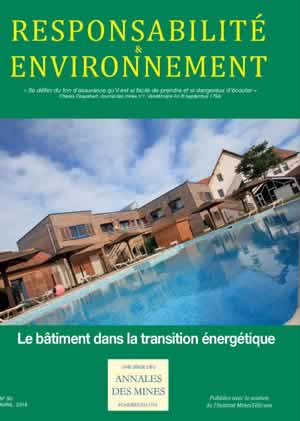
Issue 90
1 ‒ Energy in buildings, an inventory
Energy and buildings: Statistics for France since 1950
By Françoise DUPONT
Directrice générale du Centre d’études et de recherches économiques sur l’énergie (Ceren)
Energy consumption in the residential and tertiary sectors ‒ mostly owing to buildings ‒ amounted to 45% of aggregate final consumption expenditures in 2015. After housing conditions were improved during the 1950s and 1960s, the first oil shock in 1973 spawned successive policies for saving energy that, apart from a short period in the 1990s, laid down energy-related requirements for constructing new housing units and, as of 2007, for rehabilitating older buildings. Heating in residential housing, the largest final expenditure, has been divided by 2.5; and electricity consumption accounted for nearly 20% of overall consumption in 2015. Given the tertiary sector’s growth in the economy, the surface area being heated has increased by 55%. Installed at a regular pace, air-conditioning is now provided in a little less than a third of this surface area. The consumption of heating per square meter in the tertiary sector is steadily decreasing, regardless of the energy source, thanks to the efforts for improving energy performance.
Energy and buildings: Statistics for Germany
By Sven RÖSNER
Directeur de l’Office franco-allemand pour la transition énergétique (OFATE)
and Marie BOYETTE
Office franco-allemand pour la transition énergétique (OFATE)
The situations of France and Germany are much alike. These two neighbors in Europe are pursuing similar objectives for energy efficiency in buildings. As in France, buildings in Germany are the main consumer of energy. Changes in thermal regulations have led to less energy consumption and the installation of renewable heating sources in new buildings. Nonetheless, the renovation of buildings so as to improve their energy performance also provides a way to make buildings carbon-neutral. The German government wants to pair the improvement of energy efficiency in buildings with the development of renewable energy sources with the aim of “decarbonating” government buildings. Given the German real estate market and the country’s demographic structure, funding these measures is a real challenge. After an overview of the stock of buildings in Germany, a short description is made of the federal government’s strategy for improving the energy efficiency in this domain.
Energy and buildings: A look at the rest of the world
By John DULAC
Analyste principal du secteur du bâtiment à l’Agence internationale de l’Énergie (AIE)
and Thibaut ABERGEL
Division des technologies de la demande énergétique à l’Agence internationale de l’Énergie (AIE)
Despite some progress, the demand for energy in the buildings sector is rising while the consumption of fossil fuels is not decreasing. Financial barriers and a lack of strong political signals are impeding the rollout of low-carbon solutions that help save energy. However energy efficiency could be compatible with growth in this sector while also reducing its carbon footprint. Support could also be given to universal access to clean, affordable energy by 2030. An effective management of demand would facilitate the integration of renewables in the energy mix. To meet the UN’s sustainable development goals however, this sector must undergo a thoroughgoing change, a transformation impelled by strong political commitments, innovative funding schemes and new business models so that the construction industry takes part in overhauling the whole energy system.
Architects, the planet’s ambassadors
By Didier LENOIR
Président d’honneur du CLER – Réseau pour la transition énergétique
and Dominique GAUZIN-MÜLLER
Architecte-chercheuse et auteure
Science now proposes a new vision of life on Earth: humanity as a part of nature has to respect natural equilibria in order to live in security on our planet. In each place and for each energy need, the solution must be chosen that is best for the planet. The environmental transition is a necessity; and the energy transition, one of its aspects, can no longer impose general norms. For the building industry, the obligation of performance and the acceptance of mistakes replace the current administrative system, now incapable of adaptation. Architects realize that their teams and partnerships are diversifying, as is happening in all engineering fields with which they have contact. The architect’s role has become essential for integrating contributions from all parties and giving the building industry the coherency and significance expected by its users and environment.
Saving energy: Buildings and their occupants
By Marie-Christine ZÉLEM
CERTOP UMR 5044 du CNRS, Université de Toulouse Jean Jaurès
Plans for the energy transition in the building industry have aroused a technological imagination stymied by problems of ownership, uses, behaviors, learning experiences, skills, qualifications, etc. This so-called “social part of energy projects” is normally hidden behind the idea of “social acceptability”, which is generally brought up when technology is poorly used or when a technique’s presumed effectiveness is not realized. A few keys to understanding the social aspects that shape energy practices, an invitation to break free from a technocentric approach and move more toward social engineering…
Energy vulnerability, a new dimension to take into account
By Robert DURDILLY
Président de SoliNergy
and Bertrand LAPOSTOLET
Directeur du fonds de dotation SoliNergy
Energy vulnerability is constantly increasing. Awareness of its impact on the living conditions of poor households and on their health has made this recent phenomenon a growing concern to public authorities. Affecting more than 5.6 million households in 2013, energy poverty calls for responses on the right scale in terms of volume and of the residential housing units targeted for energy efficiency (so as to funnel aid to the neediest). Rehabilitating housing units that are “thermal bridges” is a priority, but reducing energy poverty is not just a matter of the energy performance of buildings. The occupants must adopt practices that save energy and are adapted to their situation. This calls for specific forms of support to occupants and for information on their consumption patterns and level of comfort.
Making buildings carbon-free without forgetting the indirect emissions of greenhouse gases
By Alain GRANDJEAN
Économiste, associé fondateur de Carbone 4
Roman LEDOUX
Manager, Carbone 4
and Julie DAUNAY
Manager, Carbone 4
To fight against climate change, France made the commitment, more than ten years ago, to reach by 2050 the goal of dividing its greenhouse gas emissions by four (compared with 1990). The TECV Act on the energy transition for green growth in 2015 restated this goal as a set of objectives for reducing the consumption of energy, in particular fossil fuels, and increasing the proportion of energy from renewable sources in household consumption. It is easy to prove that, globally, the fight against climate change has two major levers: “decarbonation” of energy sources and a reduction of energy consumption. Nevertheless, the objectives of energy efficiency in the building industry do not automatically fall in line with objectives measured in terms of carbon neutrality.
2 ‒ Stakeholders and users
Energy efficiency in buildings: The European Commission’s vision and ambitions
By Mechthild WÖRSDÖRFER
Directrice en charge des Énergies renouvelables, Recherche et Innovation et Efficacité énergétique au sein de la Direction générale (DG) Énergie de la Commission européenne (CE)
The European Union has resolutely set out on the road to “decarbonate” its economy, thus remaining in the role of leader in the energy transition. This falls in line with the ambitious commitments made as part of the Paris Climate Agreement. For this transition, the European Commission is undertaking a legislative reform based on its package of new measures, “Clean Energy for All Europeans”, adopted in November 2016. Of interest to the building sector ‒ the biggest energy consumer in the EU ‒ the Directive on the Energy Performance of Buildings has been modified to assign priority to renovating and modernizing buildings, in particular through more funding for energy efficiency.
The tools at the service of public authorities for boosting the energy efficiency of buildings
By Gilles AYMOZ
Chef du service Bâtiment de l’Agence de l’environnement et de la maîtrise de l’énergie (Ademe)
The French government has set ambitious objectives for reducing energy consumption not only in housing but also in buildings in the secondary and tertiary sectors of the economy. This has a heavy impact on the conditions for constructing or renovating buildings in these sectors. To reach these objectives, measures must be taken to inform, motivate and accompany the parties concerned, in particular professionals in the building trades and households (with special attention for those characterized by energy poverty). How to advance arguments that address the genuine concerns of the people affected? How to make it easier for homeowners to obtain appropriate funding? How to motivate professionals to adapt their offers by improving their qualifications and the quality of their services? Given the importance of these issues, public authorities, both national and regional, are led to intervene. The tools are succinctly described that they can use to promote the rehabilitation of old buildings, in particular private housing units.
An assessment of the 2012 thermal regulations
By Mireille CAMPANA
Ingénieur général des Mines, Conseil général de l’économie
Michel JEAN-FRANÇOIS
Ingénieur général des Ponts, des Eaux et des Forêts, membre permanent du Conseil général de l’environnement et du développement durable
Anne FLORETTE
Ingénieure en cheffe des Ponts, des Eaux et des Forêts, Conseil général de l’environnement et
and Didier PILLET
Ingénieur en chef des Mines, Conseil général de l’économie
According to a recent assessment of the thermal regulations introduced in 2012 in France, the very ambitious objective set for consumption (50 kWhep/m2/year) by the “Grenelle of the Environment”, which assembled officials and organizations for a wide-ranging discussion on environmental issues. This success can be set down both to more efficient and complicated equipment (heat pumps, condensing boilers) and to better coordination among stakeholders. This coordination came from public interventions in support of training programs, information services and innovation. This report observed a “majority effect” with regard to the sources of energy, namely a preference for natural gas in apartment buildings but of heat pumps in houses. Problems of overheating were pointed out, even in well-insulated buildings. Cost overruns were also observed, but they might be offset by lower costs as the new equipment is used (even though it is not now possible to verify this). By paying more attention to the “piloting” of certain types of equipment and by taking into account the kilowatts consumed from nonrenewable sources (adapted to load management on the electricity grid), it might be worthwhile to more often allow less complicated electric heating devices and air-conditioning. This could contribute to rolling out renewables, in particular solar power.
Environmental regulations for new buildings
By Romain GAËTA, Laurent GULDNER, Florian PITON, Laetitia PRIEM, Aloïs THIÉBAUT
Ingénieurs des Travaux publics de l’État, ministère de la Transition énergétique et solidaire, ministère de la Cohésion des territoires
To sharply lower greenhouse gas emissions in France, actions must be undertaken on the buildings sector, the biggest energy consumer among all sectors of the economy. The 2012 thermal regulations, now in effect, set an ambitious objective for reducing the energy consumption of new buildings. The 2015 TECV Act on the energy transition for green growth has raised the objective set for 2020: the construction of “energy-positive” buildings with a high level of “environmental performance”. To raise the level of qualifications in the building trades, France launched in November 2016 the experiment “Positive Energy, Carbon Reduction”. It will help prepare future regulations for new buildings that will be not just about energy but also about the environment
Energy transition of Europe’s building stock - Implications for EU 2030 Sustainable Development Goals
By Dr Yamina SAHEB, Dr Heinz OSSENBRINK, Dr Sandor SZABO, Dr Katalin BÓDIS, and Strahil PANEV
Senior Climate and Energy Policy Analyst at Openexp
Energy transition of the EU building stock, from being an energy waster to being highly energy efficient and an energy producer, is a prerequisite for Europe’s carbon neutrality, as well as for meeting Europe’s Sustainable Development Goals (SDGs). Achieving these targets requires shifting the emerging energy renovation market from a market of step-by-step and shallow energy renovation financed by grants to a market of industrialized and holistic energy renovation leading to zero energy buildings financed by long-term loans. This paradigm shift is an opportunity for the construction industry to improve its productivity by industrializing the energy renovation process through the use of modern production technics and innovative technologies as well as business models. The industrialization of energy renovation will lead to cost reduction, making zero energy buildings affordable for all EU citizens, regardless of their income.
Placing thermal regulations at the service of the energy transition
By André POUGET
Bureau d’études POUGET Consultants
Since 1982, Pouget Consultants, a team of fifty persons at two locations (Paris and Nantes), is eagerly and decidedly involved at worksites for constructing and renovating buildings. Starting at the phase of design, these “advocates of non-energy” intervene ‒ motivated by the pursuit for ever more “sobriety” (energy consumption, CO2 emissions, etc.) ‒ to imagine sustainable buildings that are comfortable to live in. Following a brief review of successive thermal regulations since 1974, proposals are made about the paths for reaching the goals set for 2050. These proposals still (necessarily) insist on more sobriety and on actions targeting “environmental performance” and renewables. To reduce both energy consumption and CO2 emissions, it is necessary to harmonize the approaches to construction/renovation and simplify the methods for pooling interventions and creating value thanks to a gradual “massification” of renovation projects. Pouget Consultants shares its nearly forty years of experience in designing and managing energy renovation projects.
The barriers in France to investment in the energy efficiency of buildings
By Isabelle CAMILIER-CORTIAL
Ingénieure des Mines, direction générale du Trésor
Alexis LOUBLIER
Direction générale du Trésor
and Étienne PERROT
Étudiant à l’École polytechnique
The thermal renovation of residential housing is a major lever for the energy transition and for reducing energy bills. What potential does residential housing hold for saving energy in France? Several barriers (market shortcomings and cognitive biases) might keep us from tapping this potential, which is shown to be profitable for households: from 32 to 51 TWh (without counting “carbon costs”). Restrictions on loans are examined in relation to the hoped-for gains and the differences between owners and renters. Establishing a price for CO2 would make this profitable potential even more attractive, but it would not suffice to trigger the necessary investments. Some renovation projects are profitable from a socioeconomic but not from a private viewpoint; and this justifies subsidies that target this potential for saving energy.
How can public interventions increase the number and quality of renovations of housing units in France so as to reduce energy consumption and greenhouse gas emissions?
By Hadrien HAINAUT, Ian COCHRAN, Benoît LEGUET
I4CE – Institute for Climate Economics, Paris
The government’s ambitious objectives for the “energy performance” of buildings, in particular private housing units, call for major investments, approximately €15 billion/year. Current incentives have proven capable of raising but half of this amount, and most of these funds go to dispersed interventions with little heed for energy efficiency. A will and a way are necessary to meet these objectives. Households have to be offered the opportunities for concretely realizing home improvements. This can be achieved only through a combined use of regulatory, economic and financial tools. Existing tools must be overhauled; and new ones, created at the national and local levels.
Energy efficiency: A user’s guide
By Myriam MAESTRONI
Présidente-Fondatrice de la société Économie d’énergie et de la Fondation E5T
At the core of issues related to the energy transition, there is unanimity about “sobriety” and “energy efficiency”. But these values suppose a global approach that is far from being as clear as it should be…
Major orientations have been set, now to follow them…
By Jean BERGOUGNOUX, Jean-Pierre HAUET
Association Équilibre des énergies
In France, buildings represent 43% of final energy consumption and 31% of CO2 emissions. Fossil fuels (natural gas and heating oil) account for 70% of these emissions. A considerable effort must, therefore, be made to reach the goal of reducing both energy consumption and greenhouse gas emissions. This goal, set in the TECV Act on the energy transition for green growth in 2015 , will not be reached spontaneously. Public policies are needed to orient investors’ and consumers’ decisions. The current regulatory system, based on incentives and taxes, is much too complicated. Nor is it very effective, since the signals it sends no longer correspond to priorities, in particular for carbon neutrality. This system is reviewed in order to: 1) draw the consequences of the major objectives set in the aforementioned act of law; 2) identify and promote solutions effective for reaching these objectives; and 3) set up an appropriate system of incentives and regulations.
3 ‒ Technological prospects
The construction industry between ideals and reality: The key factors for the success of the energy transition
By Étienne CRÉPON
Président du Centre Scientifique et Technique du Bâtiment (CSTB)
and Hervé CHARRUE
Directeur général adjoint du CSTB et directeur Recherche et Développement du CSTB
As a major player in climate change and given its many interactions with urban systems, the building industry is having difficulty undertaking the called-for changes for three reasons. First of all, little is known about the stock of old housing units; and the existing information is unsatisfactory. Secondly, innovations are incremental, and not very systemic, since they are limited to the sector. Finally, this sector’s production capacity and quality are still insufficient when measured against the objective set for housing renovations by 2050 and the hoped-for results. Three major axes for a massive, integrated, efficient renovation of housing units are proposed so as to optimize the various uses of the urban system: 1) the installation of an observatory of the stock of housing units and of plans for new housing in order to identify the need for specific innovations related to the uses of housing units; 2) an assessment of the socioeconomic and technical “performance” of housing renovations on the scale of the sustainable building, neighborhood and city; and 3) the development of an industrial approach ranging from components and systems to buildings in view of increasing the economic performance of stakeholders in this sector, the quality and efficiency of buildings and the attractiveness of an industry as value is restored to it. The digital transition ‒ owing to data processing (in the broadest sense), analytics, simulations, optimizations, training (all digital?) ‒ is the breakthrough innovation that the building industry must grasp but without losing its essential ability to adapt in time, its resilience, which guarantees its durability.
How EU programs for funding R&D take account of innovations in the buildings sector
By Antoine DUGUÉ, Germain ADELL
NOBATEK/INEF4
Research is financed under the EU’s framework programs and, since 2009, via a few public-private partnerships (PPPs) involving industry and its value chain. The partnership Energy Efficient Buildings, managed by ECTP, contains a program specific to the building industry. This PPP is organized through roadmaps that all stakeholders have helped design ‒ a guarantee of the relevance both of its research priorities and of its offers of contracts for funding annual programs. These very competitive offers provide major opportunities for developing new technology and validating the results through pilot programs anywhere in Europe. This activity is necessary to maintain the EU’s competitive edge and to orient this industry toward the goal of excellence. NOBATEK/INEF, a major partner in this PPP, has coordinated projects on topics related to the EU’s priorities.
Miscellany
The energy balance sheet, 2016
By Ministère de la Transition écologique and solidaire Commissariat général au développement durable Sous-direction des statistiques de l’énergie (SDES)