
March 2018
abstract
Gérer & Comprendre
Crowdfunding: Entrepreneurs attracting crowds
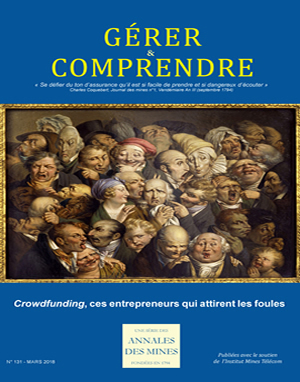
Issue 131
Introduction: Entrepreneurs attracting a crowdces
By Faten BEN SLIMANE, Evelyne ROUSSELET and Sylvie CHEVRIER
IRG (EA 2354), Université Paris-Est Marne-la-Vallée
Strategies for winning a new place in the market: Crowdlending
By Héloïse BERKOWITZ
CNRS (UMR 5303 TSM-Research)
and Antoine SOUCHAUD
ESCP Europe, Labex ReFi (ESCP Europe, ENA CNAM, La Sorbonne)
Till a few years ago, it was utopian to imagine a crowdlending platform in France. Realizing such an apparently unrealistic idea was at odds with the traditional financial sector and the regulations protecting it from disruptive innovations. In this hostile, uncertain environment, how to develop a business model that is innovative in comparison with established firms and, too, future competitors? The competitive and cooperative strategies are explored that a crowdlending operation in France adopted to expand and maintain control over a new place in the market.
Crowdfunding, lessons from a success story: Hyperfinancing a comic book
By Sophie Renault
associate professor at the IAE d’Orléans, member of the Laboratory of Research in Management (Orléans and Tours Vallorem universities)
Through crowdfunding, a project initiator addresses the “crowd” to obtain all or part of the funds needed for the project. The focus herein is placed on one type of crowdfunding: “donations with a counterpart”. Based on a study of a project for self-publishing the comic book Comme convenu , an interpretation and analysis Is made of the “hyperfinance” situation of this crowdfunding operation. Posted in October 2015 on Ulule, a French platform, this fund-raising campaign turned out to be a genuine success. Although the comic book’s author had asked for $10,300, 7,962 persons contributed more than $294,000. In addition to the key factors in this success story as explained in the literature, this research sheds light on other elements: educational skills, the for-free strategy and the quality of the illustrations. The issues related to “stretch goals” (funding targets) are scrutinized.
Crowdequity and crowdlending, two alternatives for very small, small and medium-sized firms: The case of Gifts for Change
By Imen MEJRI
Enseignant-chercheur à NEOMA Business School
Malek HAMOUDA
Enseignant-chercheur à l’ISG Programme Business & Management
and Donia TRABELSI
Maître de conférences à Télécom École de Management IMT — Institut Mines Télécom et membre du laboratoire de recherche LITEM
Reward-based crowdfunding has thrived in recent years. It offers an alternative solution to the funding problems of very small, small and medium-sized companies. The advantages and limits of reward-based crowdfunding are examined in comparison with traditional funding; and light is shed on the specific characteristics of crowdlending and crowdequity used by the company (Gifts for Change) at the center of this study. Since the conditions related to reward-based crowdfunding are adapted to some projects but not to others, the choice between crowdlending and crowdequity varies depending on the company’s stage of growth. Key recommendations are formulated for entrepreneurs who want to use reward-based crowdfunding.
When a mayor calls on crowfunding to rebuild a school: Interpretation and analysis
By Sophie Renault
associate professor at the IAE d’Orléans, member of the Laboratory of Research in Management (Orléans and Tours Vallorem universities)
In December 2014, the Mayor of the village of Yèbles asked the crowd to finance a reconstruction project for their primary school. The mayor decided to use MyMajorCompany platform to support them in this project. This atypical project has been a success. Indeed, after three months of campaign, 44 050 euros were collected from 238 backers. In a qualitative perspective based on the case study of the project managed by the Mayor of Yèbles, our research analyzes the challenges associated with citizen crowdfunding.
Miscellany
The development of electric vehicles in China: Market facts and regulatory trends
By Bo CHEN
Centre de recherche en gestion de l’École polytechnique, Institut interdisciplinaire de l’innovation
Christophe MIDLER
Directeur de recherche au CNRS, Centre de recherche en gestion de l’École polytechnique, Institut interdisciplinaire de l’innovation, membre de l’Académie des Technologies
and Joël RUET
Centre de recherche en gestion de l’École polytechnique, Institut interdisciplinaire de l’innovation, CEPN (UMR CNRS 7234) Université Paris 13
How does the development of electric vehicles in China affect global automakers’ strategies? Alongside an exiguous, regulated market, China has an informal market for low-cost electric vehicles. The gap between these two markets is analyzed in the light of Chinese policies with regard to automobile transportation standards; and the problems raised for global automakers are discussed. Whereas the literature on the strategies of multinational firms in emerging countries generally concentrates on the question of the use value for customers, our research shows the importance of taking account of the forms of regulation that strongly determine market dynamics. The development of electric vehicles in China: Market facts and regulatory trends
Mosaics
L’intelligence du travail
On Pierre-Yves Gomez’s, Intelligence du travail (Paris: Desclée De Brouwer, 2016)
By Nicolas Berland
Blockchains and unchained questions!
On William Mougayar’s, The business blockchain: Promise, practice, and application of the next internet technology (New York: John Wiley & Sons, 2016), Don Tapscott and Alex Tapscott’s, Blockchain revolution: How the technology behind Bitcoin is changing money, business, and the world (Harmondsworth, UK: Penguin, 2016), and Blockchain France, La Blockchain décryptée ‒ Les clefs d’une révolution (Paris: Netexplo, 2016)
By Thierry Boudès
The “force of equilibrium”, a Tunisian lesson in governance
On Héla Yousfi’s, L’UGTT, une passion tunisienne: Enquête sur les syndicalistes en révolution ‒ 2011-2014 (Paris: Karthala-IRMC, 2015)
By Alain Henry
Can management and disobedience form a happy couple?
On Frédéric Gros’s, Désobéir (Paris: Albin Michel, 2017)
By Antoine Masingue