
January 2018
abstract
Responsabilité & Environnement
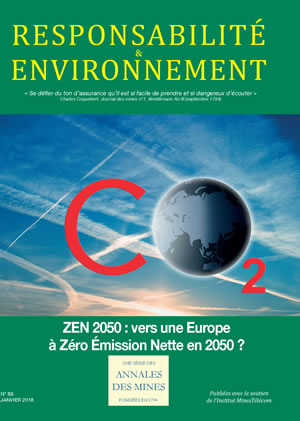
ZEN 2050 : vers une Europe à Zéro Émission Nette en 2050 ?
Issue editor:
Claire TUTENUIT
Issue 89
Technical possibilities
Berlin, carbon neutrality by 2050
By Michael MÜLLER
Maire de Berlin
The Berlin Senate, the city’s executive body, is pursuing long-term objectives for making the city “carbon neutral” by reducing its CO2 emissions by at least 85% till 2050 (in relation to 1990). Like many other international metropolitan areas, Berlin is reacting to climate change. The objectives of climate conservation are legally binding since the enactment, in 2016, of a municipal ordinance on the energy transition. The latter required that the Senate submit to the parliament a “roadmap on carbon neutrality”. In June 2017, the Senate adopted a program on “energy and climate conservation”, which contains strategies and concrete measures for reaching this objective in five fields (energy, transportation, buildings and urbanism, households, and consumption). Since implementation will extend up till 2030, this program for adapting Berlin to the effects of climate change will have to be regularly updated.
Maximize the efficiency of carbon sinks: The options
By Didier HOUSSIN
Président d’IFP Énergies nouvelles
The natural carbon cycle involves vast biogeochemical exchanges between the biosphere, atmosphere and ocean. These exchanges are now out of balance due to the CO2 emitted from human activities, mainly the combustion of fossil fuels. Deforestation has made the situation worse. The CO2 accumulated in the atmosphere is causing global warming. Natural carbon sinks (CO2 dissolved in the ocean, converted by the biosphere via photosynthesis, etc.) reabsorb half of this excess, but the capacity of these sinks for absorbing emissions could be curtailed by the warming now under way. We can act, first of all by reducing their CO2 emissions, and also by maximizing the efficiency of three carbon sinks that could significantly reduce accumulation in the atmosphere: changes in land use, the geological storage of CO2, and the conversion of this gas into various products. Improving the complementarity between these different approaches will help fight more efficiently against global warming.
From the Michelin Bibendum Challenge to Paris Process Mobility and Climate
By Patrick OLIVA
Ancien directeur de la prospective et du développement durable chez Michelin, co-fondateur du Paris Process on Mobility and Climate (PPMC)
Cornie HUIZENGA
and Claire BERNARD
Responsable Mobilité durable – Groupe Michelin
The PPMC coalition (Paris Process on Mobility and Climate) has proposed an approach already copied by countries such as France, Portugal and the Netherlands. This approach lays out a vision that is credible (because it is technically feasible) and desirable (since it offers growth via innovations and investments in new services for “mobility”). It entails a systemic, planned overhaul of transportation systems via a sequencing of phases, both successive and synergic.
Conducting the transition of the whole agribusiness sector toward carbon neutrality: Long-term trajectories and short-term paths
By Sébastien TREYER, Pierre-Marie AUBERT, Aleksandar RANKOVIC, Marie-Hélène SCHWOOB
Institut du développement durable et des relations internationales (Iddri),‒ Sciences Po, Paris
Most greenhouse gas emissions in agribusiness come from primary production. Reducing to zero net emissions in this sector implies changes of such a magnitude that they can be made only by revamping the whole sector. For this sector, it is necessary to cope both with the radical issues raised by carbon neutrality in the long run and with the urgency of short-term actions for immediately making a start on these changes.
From the circular to the “permacircular” economy
By Dominique BOURG
Philosophe et professeur ordinaire à la Faculté des géosciences et de l'environnement de l’Université de Lausanne
On the global scale, a “permacircular” economy seeks to reverse the trends that lead to trespassing the planet’s limits and to return to an environmental footprint on a dimension with Earth. Various approaches can, however, be taken toward this demanding objective: economic pathways that give a free rein to human inventiveness, ranging from stiffly competitive high tech through the “social and solidarity economy” to experiments mixing permaculture and lifestyle changes. Thus defined, the permacircular economy is a fulcrum for a decidedly pluralistic and democratic society. It does not exclude other, less demanding, approaches, which it could even incorporate.
Modalities: The economy and politics
The ambitious French objective of net carbon neutrality by 2050
By Jérôme BOUTANG
Directeur général du Centre interprofessionnel technique d’études de la pollution atmosphérique (CITEPA)
and Mark TUDDENHAM
Responsable de l’information du CITEPA
The Paris Climate Agreement (COP21) of 12 December 2015 sets the clear goal of carbon neutrality for the second half of the 21st century. In France, the 2015 TECV Act on the “energy transition for green growth” set high climate-energy objectives. The objective of dividing by four greenhouse gas emissions by 2050 (in comparison with 1990) already figured in the 2005 Energy Act and in the 2009 Grenelle I Act. Attention is drawn to three key points in France’s mobilization for the climate: the ambition, model-building, and participation. France has set a high level to adapt planetary goals to the nation while moving forward to 2050. The second version of the National Low Carbon Strategy calls for additional exercises in model-building. This strategy relies on a participatory method involving citizens, NGOs, firms, experts and regional authorities.
Climate and the energy transition
By Richard LAVERGNE
Ingénieur général des Mines, Conseil général de l’économie (CGE)
The links between the energy transition and the fight against climate change are less evident than first imagined. The meaning of this, which citizens do not yet grasp, varies depending on stakeholders and the countries of implementation. The climate is not necessarily the top-ranking priority in a program for the energy transition. Morever, such a program’s socioeconomic effects should be more deeply analyzed.
Moving to net-zero emissions, an undeniable business opportunity in Europe and beyond
By Maria MENDILUCE
Managing Director & Senior Management Team, WBCSD
Companies have a vested interest in addressing the climate challenge. This is because business cannot succeed in societies that fail, and a warmer planet and more extreme events will have very damaging consequences for business, and ‒ most importantly ‒ for people living in our planet. In the face of these unprecedented challenges, forward-thinking companies are driving change with unprecedented impetus.
The roadmap for removing carbon from the German energy sector
By Stéphane REICHE
Ingénieur en chef des Mines, adjoint au chef du Service économique régional de l’Ambassade de France à Berlin
and Laure JOYA
Cheffe du secteur Énergie et Matière premières au Service économique régional de l’Ambassade de France à Berlin
Germany will have a hard time reducing by 40% its greenhouse gas emissions by 2020 (taking 1990 as the base year). The country is far from attaining the objective that it set for energy efficiency. However it is successfully shutting down nuclear power and speeding up the development of renewable sources of energy. This trend, though costly, is a major factor for innovations and jobs. A few recommendations for successfully managing cooperation between France and Germany…
The need to reinforce the “attenuation strategy” for reaching the objective of zero net emissions by 2050
By Anne BRINGAULT
Responsable Transition énergétique, Réseau Action Climat France
Lucile DUFOUR
Responsable Politiques internationales et développement, Réseau Action Climat France
and Neil MAKAROFF
Responsable Europe, Réseau Action Climat France
Proceeding toward carbon neutrality or setting the objective of zero net greenhouse gas emissions by 2050 are a strong political commitment that induces all parties to project themselves into a radically different future. Incremental changes no longer suffice; a break must be made. This has opened the opportunity for some parties to advocate (mainly technological) innovations. The latter come at a high cost, and their feasibility on a large scale by 2050 is far from demonstrated. It would be easy to limit discussions to negative emissions alone. However the high uncertainty surrounding them forces us, if we want to steer a course toward zero net emissions, to immediately speed up the implementation of far-reaching “attenuation policies” for reducing emissions. Putting an end to fossil fuels by turning toward 100% renewables, reducing energy consumption by consuming more soberly and being more efficient, overhauling the agribusiness model from the viewpoint of sustainability, developing a more circular economy… these solutions have to be adopted with no regrets since they are beneficial to jobs, health, rural and urban development, and the economy as a whole.
The dialog between firms and consumers, a key to the transition
By Jean-Dominique SÉNARD
Président de Michelin, président d’Entreprises pour l’Environnement
The technical solutions that bring us closer to carbon neutrality now seem to be well advanced; but consumers are still adopting them slowly. Is it possible to reach the objective of zero net greenhouse gas emissions? How to change the consumption patterns of French households? How to accelerate the roll-out of solutions and the withdrawal from the market of products and services that emit greenhouse gases? What role can firms play in what amounts to a change of culture ‒ or even civilization?
Setting the price of carbon in order to facilitate the energy transition? Why not! But that does not suffice
By Dominique DRON
Ingénieure générale des Mines, Conseil général de l’économie (CGE)
Setting a price for carbon is often claimed to be a magic lamp for shedding light on the way toward the energy transition and responding to climate change, or even to be an inescapable method for public policies to reduce the environmental damage wrought by human activities. At a closer look, this approach is not without the defects that come with it. For one thing, it often translates socioeconomic factors and (even more) natural processes exclusively into monetary terms. For another, its hypotheses and concepts are too far removed from real operations and functions. For this reason and given the menace to the Earth-humanity system, it is urgent to place the “price of carbon” within a coherent set of propositions and measures that are not all (far from it) economic.
Workers, a driving force indispensable to the environmental transition
By Laurent BERGER
Secrétaire général de la Confédération Française Démocratique du Travail (CFDT)
The need to redesign production and consumption is now evident; but there are several ways to realize the expected environmental and energy transitions. What we refuse is a sudden transition stemming from a unilateral decision. To be fair, accepted and sustainable, these transitions must be discussed collectively. They must become a democratic worksite, where debates are organized to decide together how to move toward a mode of development that respects the environment, citizens and workers. Jobs and work should not be mere variables for making adjustments. They are the keys to a successful environmental transition, which must be seen from a human standpoint.
Climate & Trade: Can They Be Mutually Beneficial?
By Philippe VARIN, Claire TUTENUIT
President of ICC-France (International Chamber of Commerce)
Globalization has contrasting effects on climate: it speeds up the spreading of new, low carbon products and services while dedicating the mobilization of worldwide economic actors to planetary effort with this end in view. Conversely, governments have given up the idea of meaningful pricing for carbon emissions of the more emitting activities in order to limit competition discrepancies in our globalized world. However, price mechanisms are also the more efficient ones in promoting low-carbon solutions. How can we reconcile environmental challenges with the economic growth provided by free-trade?
Miscellany
ScénEnvi, an analysis of the major international scenarios for the future of the environment
By Christophe DIDIER
Ineris
Nicolas de MENTHIÈRE
Irstea
Denis LACROIX
Ifremer
Bertrand SCHMITT
INRA
Audrey BÉTHINGER
INRA
Louis LAURENT
Anses
Bernard DAVID
CEA
Jacques PARENT DU CHÂTELET
Météo-France
Flora PÉLEGRIN
FRB
Pascale HÉNAUT
Irstea
Morgane LE GALL
Ifremer,
Marie-Hélène PÉPIN
Météo-France
and Isabelle PRADAUD
Ineris
To contribute to French scientific planning in the environmental sciences, a study of major scenarios from around the world on the possible futures for the environment was made under the auspices of Alliance AllEnvi. For the more than 300 scenarios analyzed, governance and the economy turned out to be the major factors for differentiating them. Eleven families of scenarios were placed in three groups: decline, no priority for the environment, and priority for the environment. The first two groups correspond to a severely deteriorated environment, but the third has a more encouraging outcome despite the inefficiency of certain orientations. A detailed analysis of the methodology and findings is proposed while focusing on the factors “environment” and “sciences and technology”, which are decisive for AllEnvi.