
March 2017
abstract
Gérer & Comprendre
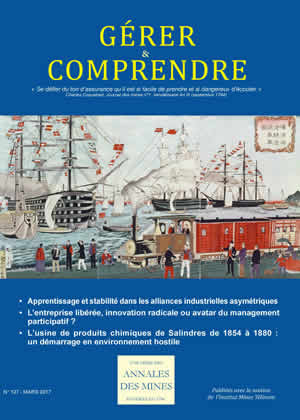
Issue 127
OVERLOOKED…
What strategies for subcontractors faced with a reconfigured value chain? The jewelry business in France
By Colette DEPEYRE
Maître de conférences à l’Université Paris-Dauphine, PSL Research University, CNRS, UMR [7088], DRM
Emmanuelle RIGAUD
Professeur à NEOMA Business School et chercheur associé i3-CRG École polytechnique-CNRS-Université Paris Saclay
and Fabien SERAIDARIAN
Mazars, chercheur associé i3-CRG École polytechnique-CNRS-Université Paris Saclay
Actions from players who are trying to dominate the process of value creation often punctuate the revamping of the value chain in an industry. But what about businesses in a much more subordinate position in the chain? What strategies guide how they reposition themselves in the market? The patterns whereby French subcontractors in the jewelry business have adapted are described. As changes in the luxury goods business are forcing them to raise questions about their position in this value chain, subcontractors must cope with a series of organizational and strategic tensions. As a function of their range of action, degree of autonomy, know-how and the nature of their relations with contractors, four patterns of adaptation have been identified: safeguarding, specializing, cooperating and “coopetiting”. They evince a diversity of strategic options in situations where ideas might have become fixated.
TRIAL BY FACT
From controlled to regulated risks: The case of nuclear medicine
By Bénédicte GEFFROY
Professeur en sciences de gestion, IMT-Atlantique, membre du LEMNA (Laboratoire d’économie et de management de Nantes Atlantique) - Université de Nantes
Sophie BRÉTESCHÉ
Enseignant-chercheur (HDR) en sociologie, IMT-Atlantique, membre du LEMNA (Laboratoire d’économie et de management de Nantes Atlantique) - Université de Nantes
and Romain LONCEINT
Doctorant en sciences de gestion, IMT-Atlantique, membre du LEMNA (Laboratoire d’économie et de management de Nantes Atlantique) - Université de Nantes
The development of nuclear medicine during the second half of the 20th century led to questions about how to manage risks, in particular, for the health professionals exposed daily to “low doses” of radioactivity with unknown effects. By precaution, measures were adopted to protect them from eventual risks. A qualitative survey conducted in two nuclear medicine services sheds light on risk-taking in this very special field. Work in nuclear medicine, which entails providing care to patients while protecting oneself from radioactivity, has given rise to a form of risk management based on strong group regulations.
IN QUEST OF A THEORY
A French conception of intercultural relations: What impact on French managers’ intercultural aptitudes?
quel impact sur les compétences interculturelles des managers français ?
By Catou Faust
adjunct professor, EM Lyon Business School.
Since intercultural aptitudes cannot be developed in firms without giving thought to their very nature, an approach, as yet unexplored, is proposed: how does the national culture influence conceptions of intercultural relations? The findings are presented from a qualitative study based on interviews with 62 French and international managers working in multinational manufacturing firms. A conception of intercultural relations specific to French managers thus comes to light that has an impact on their intercultural aptitudes. The cultural prism proposed by this research opens a new angle for analyzing successes and failures in intercultural relations.
The liberated firm, a radical innovation or simply an avatar of participatory management?
By Patrick GILBERT
Professeur des universités à l’IAE Paris I Panthéon-Sorbonne (Sorbonne Business School)
Ann-Charlotte TEGLBORG
Enseignant-chercheur à Novancia Business School Paris, chercheur affilié au Gregor, IAE Paris I Panthéon-Sorbonne (Sorbonne Business School) et chercheur invité à University College of London-IOE
and Nathalie RAULET-CROSET
Maître de conférences à l’IAE Paris I Panthéon-Sorbonne (Sorbonne Business School) et chercheure à I3-CRG École polytechnique
Is the “liberated firm” fad all that new in relation to previous managerial models? Is it a genuine innovation or a new avatar of participatory management? How is the liberated firm freed from the difficulties encountered while implementing this form of participatory management? To answer these questions, three emblematic cases are brought into focus: Favi, a metalworking firm; Poult, which makes cookies; and CHRONO Flex, a company that repairs hoses. Liberated firms turn out to be both in continuity and in rupture with the participatory model. Although they manage to overcome some problems, the difficulties of implementing “liberation” are not to be overlooked.
OTHER TIMES, OTHER PLACES
Unilateral and joint learning in the asymmetric alliances: What effects on the stability of partnerships?
By Fadia Bahri Korbi
PhD, Institut Supérieur de Management, Université de Versailles-Saint-Quentin-en-Yvelines (ISM-UVSQ).
The literature review highlights a large number of factors affecting the stability of strategic alliances. The purpose of this article is to analyze the impacts of learning on the stability of an asymmetric alliance. Drawing on a qualitative research based on 8 case studies of asymmetric alliances between MNCs and Tunisian firms operating in the agri-food and pharmaceutical sectors, we highlight a cross-sectoral comparison of “instability factors” of asymmetric alliances. These findings lend support to the inter-partner learning perspective of asymmetric alliances instability, and have important theoretical and managerial implications. The dominated partner reduces its level of dependency vis-à-vis the dominant partner by unilateral learning, allowing him to develop his research and new integrated knowledge and leading, thus, to the instability of the alliance. However, joint learning can consolidate the interdependence between the two partners and ensure the longevity of their relationshi.
The Salindres chemical factory (1854-1880): Off to a start in a hostile environment
By Marie-Claire Loison
assistant professor, EMLyon Business School, OCE Research Center;
and Oussama Ouriemmi
associate professor, ISG International Business School, GrIIsG.
In 1854 in Salindres, a small rural township in Gard department (France), a conflict broke out that would last 25 years. Neighbors complained about the nuisances caused by Pechiney’s first factory. The phases of this environmental dispute are presented: its beginning and the initial demands, its peak in litigation and then its waning. The transformation of this conflict sheds light on the strategies adopted by the parties involved and on the ideology, prevalent at the time, of industrialism. It also reveals the low level of awareness of issues characteristic of nascent industrial society.
Mosaics
The society of appearances
On Jean-François Amadieu’s La Société du paraître: les beaux, les jeunes… et les autres (Paris: Odile Jacob, 2016).
By Nicolas Berland
The national railway company we would like
On Pierre Messulam & François Regniault’s Que faire de la SNCF ? (Paris: Tallandier, 2016).
By Michel Berry
Proper tenure required!
On Michel Anteby’s L’École des patrons. Silence et morales d’entreprise à la Business School de Harvard (Paris: Éditions Rue d’Ulm/Presses de l’École Normale Supérieure, 2015).
By Stéphane Deschaintre and Emmanuel Coblence
Is managing people a form of exploitation?
On Thibault Le Texier’s Le Maniement des hommes. Essai sur la rationalité managériale (Paris: Éditions La Découverte, 2016).
By Antoine Masingue
The Gross National Happiness Index (GNH)
On Karma Ura, Sabian Alkire, Tshoki Zangmo & Karma Wangdi’s An extensive analysis of GNH Index (Thimphu, Bhutan: Centre For Bhutan Studies, 2012).
By Michel Villette