
September 2016
abstract
Gérer & Comprendre
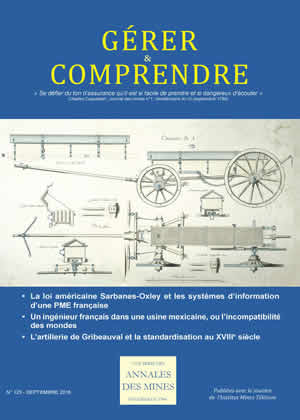
Issue 125
Editorial
By Pascal LEFEBVRE
Editorialiste
TRIAL BY FACT
Compliance with a foreign law: The application of the Sarbanes-Oxley Act by the information system management of a French firm
By Randa Ben Romdhane
research professor (ISC Paris Business School)
and Éric Fimbel
professor (NEOMA Business School)
The Sarbanes-Oxley Act (shortened to Sox) has sparked several controversies over the years since its enactment by the United States in 2002. Although the literature has pointed out many of its effects and consequences, attention has not yet been focused on its impact on the management of information systems in small and medium-sized businesses (SMBs). This article seeks to understand these effects and consequences through the study of the information system of a French SMB quoted on the New York Stock Exchange. Four types of difficulties are identified: organizational, technical, economic and cultural.
On the incompatibility of the worlds inside a multinational firm: A French expatriate’s experience in a Mexican factory
By Michel Villette
Centre Maurice Halbwachs (ENS/EHESS/CNRS)
and François Fourcade
ESCP Europe
The testimony of an expatriated engineer in a Mexican factory allows for the precise analysis of the gap between what needed to be done in the Mexican context to make the factory profitable and the good practices prescribed by the financial, technical and legal services of corporate headquarters. It shows the work of translation-betrayal and the dissimulation that an expat had to accomplish, including while presenting the accounts, in order to avoid any obstacles that the incompatibilities between the two worlds could cause to the smooth operations of the factory. This testimony can be interpreted in a number of ways, depending on the discipline: phenomenology, sociology, and management sciences. Our analysis favours the question of incompatible worlds ( Lebenswelt ) that a multinational corporation brings together. We insist on the arrangements that the engineer had to improvise in order to avoid, for example, the well intentioned paternalism of a powerful potentate or to avoid that the tithe received by local police constitute corruption in the name of an exogenous conception of law and ethics. Publishing this situation highlights the question of the legitimacy of the moral condemnation these local arrangements were subjected to in rich countries and the difficulty that management sciences have integrating these local arrangements in their analyses of the success or failure of a corporation. free download
IN QUEST OF A THEORY
Youth unemployment in France: A diversely experienced “plight”
By Didier Chabanet
researcher IDRAC Lyon and laboratory Triangle de l’Université de Lyon (UMR 5206 du CNRS), et researcher affiliated Sciences Po-CEVIPOF
The sociology of unemployment has long pointed to the destructive, desocializing effects of losing a job. However the current situation of jobless youth in France suggests that the variety of actual experiences does not reduce to this apocalyptic description. The approximately 20 semidirective, in-depth interviews conducted with young people from 18 to 35 years old on unemployment for a least one year reveal their diverse ways of coping with this plight and giving it a meaning. Although some interviewees lost confidence, felt a strong sense of personal failure and became isolated, others adjusted rather well to this situation and developed forms of sociability unrelated to the world of work. Their accounts bring to light a few factors that help us understand these variations. Among these factors, with age obviously the top-ranking one, are the sense of belonging socially or locally, cultural capital and gender.
Protecting innovations from imitation: A general analytical framework and an inventory
By Matthieu Mandard
associate professor in Managerial Sciences, University Rennes 1
How to protect innovations from being imitated? Although several means of protection have been identified during recent decades, they have not yet been placed in a coherent analytical framework. In pursuit of this objective, a framework is proposed with six general means of defending innovations; and an inventory, made of their concrete uses at the inter- and intraorganizational levels. A functional analogy between these means of protection thus comes to light through the various layers of analysis.
OTHER TIMES, OTHER PLACES
The Gribeauval system, or the issue of standardization in the 18th century
By Héloïse Berkowitz
and Hervé Dumez
i3-CRG, École Polytechnique, CNRS, Université Paris-Saclay
From the Revolution to the Napoleonic Empire, French armies were dominant militarily in Europe — mainly owing to the standardization of artillery by Jean-Baptiste Vaquette de Gribeauval (1715-1789), an officer and engineer, at the end of the 18th century. This standardization of the caliber of canons and the design of carriages (wheels and axles) presupposed the design of techniques of production and measurement, and implied training artillery officers in the basic and applied sciences. Everything had to change at the same time: military doctrine, industry and techniques. Like the Querelle des Bouffons in opera, this highly controversial shift sparked a major public debate in the last years of the monarchy: the so-called Quarrel of the Reds and Blues, with reference to the color of gunners’ uniforms before and after reorganization of the artillery. Initially backed by the king, Gribeauval was then eclipsed before coming back into command and achieving his reform. A presentation of this first big battle of industrial standardization in its historical context… free download
When innovation calls for reforming the firm: Walther Rathenau in a historical light
By Blanche Segrestin
professor (CGS, Mines ParisTech, PSL Research University)
The work of Walther Rathenau (1867-1922), the head of Allgemeine Elektricitäts-Gesellschaft (AEG) and a minister at the start of the Weimar Republic, sheds a historical light on the ideas that intellectuals and corporate executives in the 1910s had about the modern firm and its social responsibilities. For Rathenau, the modern firm stands out owing not to its size but to its capacity for collective innovation. Seeing this capacity as the grounds for the firm’s new responsibilities, he proposed institutionalizing a specific governance for articulating the firm’s private status with its finalities of collective interest. Now that corporate social responsibility is being debated from the angles of a voluntary ethics and utilitarian approach, reading Rathenau shows us that the history of corporate social responsibility could have struck out in a different direction. Original perspectives open for the future… free download
Mosaics
The making of the economy according to Jean Tirole (Nobel Prize in Economic Sciences, 2014)
On Jean Tirole’s Économie du bien commun (Paris: Presses Universitaires de France, 2016).
By Damien Collard
The Public Wealth of Nations – How Management of Public Assets Can Boost or Bust Economic Growth
On Dag Detter and Stafan Fölster’s The Public Wealth of Nations – How Management of Public Assets Can Boost or Bust Economic Growth (London: Palgrave Macmillan, 2015).
By Pierre Messulam