
June 2015
abstract
Gérer & Comprendre
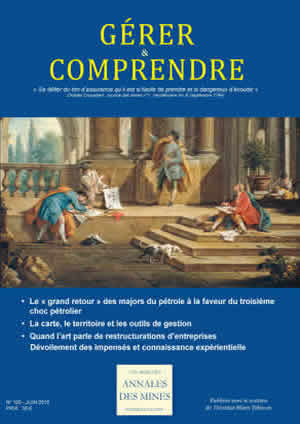
Issue 120
Editorial
By Pascal LEFEBVRE
Editorialiste
OVERLOOKED…
Ar(t)chitects and management: The introduction of managerial tools among architects
By Miguel DELATTRE
Maître de Conférences, ISEOR, Magellan, IAE Lyon, Université Jean Moulin
Renaud PETIT
Maître de Conférences, Université de Franche Comté, Centre de Recherches En Gestion des Organisations (CREGO), Chercheur associé à l’ISEOR
and Véronique ZARDET
Professeur, ISEOR, Magellan, IAE Lyon, Université Jean Moulin
How to reconcile the artistic essence of architecture agencies with their economic and social survival? These agencies are undergoing a crisis of identity and management owing to economic, social, environmental and legal factors with which they are not prepared to cope. To better understand this phenomenon, the socio-organizational, managerial and economic position of six agencies is analyzed at a six-month interval. As an analysis of the modes of articulation between the activities of management and of architects shows, reinforcing the agencies’ internal cohesion and quality of worklife is a factor of differentiation and, probably, a preliminary condition for coping with the external environment and rediscovering the full meaning of the art of architecture.
Big Oil’s comeback in the wake of the third oil shock Class of enterprise and strategic group in the oil industry
Classes d’entreprises et groupes stratégiques de l’industrie pétrolière
By Rodolphe Greggio
teacher of prep school classes for the Grandes Écoles (CPGE), Lycée Carnot, Paris;
and Benoît Mafféï
senior researcher, École des Hautes Études Commerciales (ÉDHÉC), Paris
The oil industry has been characterized for several decades by a deep-rooted paradox. The western multinational companies have been denied access to the most profitable oilfields as a result of their nationalization which occurred mainly during the seventies : they extract nowadays only a small part of the world’s oil. Yet, they have consolidated their financial, technological and strategic leadership, whereas oil companies from emerging countries do not have the same unrestricted freedom of action. As there has been no substantial change in the oil business hierarchy, oil companies should be presented as actually forming “classes of enterprises” rather than be construed as “strategic groups”. In other words, they constitute sets of relatively autonomous entities, which may sometimes conflict and also cooperate with each other, but whose strategies are excessively determined by geopolitical and industrial constraints which cannot be easily overcome.
Does the translation from French into English of communications from corporate chairmen alter their meaning?
By Michaël Vallée
research professor, EDC Paris Business School
The aim of this study is to show how the messages from the Board chairmen of companies listed on the CAC 40 (in the annual reports) are translated into English. Even though the translations should be very similar to the French messages, some noticeable variations can be found in English. It has been observed that companies are depicted in a factual and neutral way in French whereas the English translations reveal a more positive and encouraging way of describing it.
TRIAL BY FACT
“Co-opetition”, a stabilizing strategy in traditional sectors? A case study of a label of origin: “Free-range poultry from Landes”
Une histoire raisonnée de l’indication géographique protégée « Volailles fermières des Landes »
By Stéphanie Petzold
research professor, Kedge Business School;
and Marie Carpenter
senior lecturer, Télécom École de Management
While co-opetition has been researched significantly in the technology sector, it is also present in many other sectors of activity where firms require access to complementary resources to remain competitive. This is the case in the agri-food business which provides the setting for the case study used in this article to investigate how actors in a specific food chain engage in co-opetition. Analysis of the collective process involved in obtaining the European food label of Protected Geographic Indication generates insight into the balancing of cooperation and competition. On-going tensions suggest limits to co-opetition that regularly threaten to undermine the co-operative aspect when the outcome of co-opetition restrains the competitive freedom of certain actors to a degree that is considered greater than the benefits its confers. Comparing the results of the case study to those obtained in the technology sector allow us to examine the extent to which co-opetition strategies can have a stabilizing effect on the competitive dynamics in a more traditional sector.Geographical maps and managerial tools
Geographical maps and managerial tools
By Régis MARTINEAU
groupe ESC Troyes
Geographical maps serve as a metaphor to describe how managerial tools are used. Maps and managerial tools have in common that both of them are physical artefacts that present exterior objects (a territory — an activity or organization) by simplifying so as to help people (travelers — managers) take bearings. Maps, since much more is known about them than about these tools, help us think about how to design better adapted tools for management.
Managers in training at the Louvre: The art of painting in a training program
By Christophe Falcoz
associate professor, Institut d’Administration des Entreprises (IAE) in Lyon, director RCF Management;
and Yves Frédéric Livian
emeritus professor, Lyon IAE
Bringing 24 groups of managers to the Louvre Museum for a course in managerial studies has been an unusual experience. A training module on painting was conducted as a critical management education to foster thinking about power. It was part of an ongoing training program for managers from a multinational corporation with operations in France. This experiment’s successes and drawbacks are an invitation to continue reforming training practices in managerial studies. This is a major issue at a time when the drawn-out recession is spurring questions about the production of economic elites.
IN QUEST OF THEORIES
What art has to say about corporate restructuring: Revealing the unthinkable and knowing from experience
Dévoilement des impensés et connaissance expérientielle
By Géraldine SCHMIDT
GREGOR, Chaire MAI, IAE de Paris, Université Paris 1 Panthéon-Sorbonne
Rachel BEAUJOLIN
GREGOR (Groupe de Recherche en Gestion des Organisations de l’Institut d’Administration des Entreprises de Paris), Chaire MAI et Neoma Business School
Damien MOUREY
GREGOR, Chaire MAI, IAE de Paris, Université Paris 1 Panthéon-Sorbonne
Natalia BOBADILLA
GREGOR, Chaire MAI, IAE de Paris, Université Paris 1 Panthéon-Sorbonne
Stéphane DEBENEDETTI
Dauphine Recherches en Management, Université Paris Dauphine
Philippe MAIRESSE
ACTE, Art et Flux, Université Paris 1 Panthéon-Sorbonne
Véronique PERRET
Dauphine Recherches en Management, Université Paris Dauphine
François PICHAULT
LENTIC, HEC Liège
and Virginie XHAUFLAIR
Chaire Baillet Latour, HEC Liège
Can art offer us a new sort of knowledge about corporate restructuring? This question laid at the center of a European research project that brought together researchers, artists and persons involved in the restructuring of companies. The initial findings are presented herein. The goal was to identify and describe the sort of knowledge produced through the arts. In line with Becker’s (2007) suggestion to see works of art as possible and potentially fertile portrayals of society, what art reveals about the restructuring of firms can enhance the nature and modes of production of academic knowledge in this field. For this purpose, reference is made to works from different arts: cinema, photography, theater. Works of art are presented as a fertile, complex source that brings to light deliberately or involuntarily hidden aspects of corporate restructuring. By knowling from experience, works of art provide an unconventional view (sometimes complementary, sometimes contradictory) of the usual descriptions of economic restructuring contained in academic research. free download
Mosaics
How to make firms pay their debt to society?
On Michel Capron and Françoise Quairel-Lanoizelée’s, L’entreprise dans la société. Une question politique (Paris: Éditions La Découverte, Collection Grands Repères).
By Franck Aggeri
The cost of a breakdown in intelligence
On Bruno Jarrosson’s La panne de l’intelligence stratégique. Pourquoi les peuples creusent-ils leur tombe en sifflotant? (Paris: L’Harmattan, 2014).
By Arnaud Tonnelé
Disputed markets — Putting on the market, putting moral conceptions to the test
On Philippe Steiner and Marie Trespeuch’s (eds.), Marchés contestés. Quand le marché rencontre la morale (Toulouse: Presses Universitaires du Mirail, 2014).
La mise en marché : une mise à l’épreuve de nos conceptions morales ?
By Michel Villette