December 2014
abstract
Gérer & Comprendre
Identities, languages and corporate cultures: Cohesion in diversity?
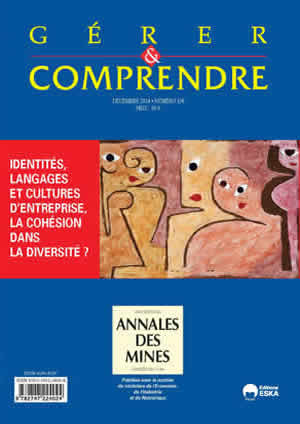
Issue 118
Editorial
By Pascal LEFEBVRE
Editorialiste
Introduction
By Philippe LECOMTE
Toulouse Business School, Président du Groupe d’Étude en Management & Langage (GEM&L)
A review of translation in corporations: A vector of strategic and operational efficiency in a multicultural environment
By Louis-Marie Clouet
head of research at the Institute of Intercultural Management and Communication (ISIT, Paris)
The phenomenon of “making sense" in the management of international firms is analyzed along with the key role therein of translation, understood as “any work of interlinguistic mediation facilitating communication between persons from different language communities”. In these ever more frequent situations with multicultural and multilingual interactions, the need for translation is growing. What strategic and operational role can translation play in multinational firms? The case study underlying this article refers to the drafting of documents for evaluating managers and their translation into several languages.
Can a corporate identity cross borders by borrowing the contemporary lingua franca, English?
By Geneviève Tréguer-Felten
PhD in language sciences, researcher associated with Cediscor-Syled (University of Paris 3 - Sorbonne Nouvelle) and with Gestion et Société (CNRS)
Everywhere around the world, organizations are trying to internationalize their corporate identities by introducing themselves to an “international” public through brochures or websites in English, the present-day lingua franca. The self-image (ethos) thus conveyed is intended to inspire confidence. Drafted in the organization’s language/culture of origin and transposed into a language characterized by the fact that it has been stripped of its own cultural roots, does this ideal image have any chances of convincing a public that shares but one known characteristic: it practices English? As an analysis of self-presentations in exchanges among organizations belonging to countries as physically and culturally distant as France and China shows, these “ideal” images of corporate identities hardly match, whence a seldom addressed question: how relevant is it to transpose a corporate identity with a potential of persuasion designed for a national audience into the lingua franca of English?
“Ethnomarketing” issues in an Austrian bank
By Cornelia Caseau
research professor, head of the Department of Languages and Cultures (CEREN/Chaire Banque Populaire en Microfinance, Groupe ESC Dijon Bourgogne),
and Mihaela Bonescu
research professor (LESSAC, Groupe ESC Dijon Bourgogne and CIMEOS EA 4177/Équipe 3S, University of Burgundy)
The Raiffeisen banking group of Lower Austria and Vienna is drafting — and even conducting and promoting — a policy for developing a loyal customer base among immigrants from Turkey and the lands of former Yugoslavia. Its communications and activities focus on the bank’s commitment in favor of integrating immigrants. Taking “ethnobanking” as a starting point, this article studies the discourse that the regional bank of Vienna has used to refer to senses of identity. The analysis of its written communications (activity reports, websites, miscellaneous publications) is completed with a qualitative survey of managers and white-collars. How can a bank foster a differentiating position through a coherent global discourse in phase with “ethomarketing”?
hybrid lexical use in french corporate discourse
By Dr Peter DALY
and Dennis DAVY
EDHEC Business School
The paper aims to explore the nature and extent of English-based lexis, especially loanwords and calques, and other neologisms in contemporary French corporate discourse (e.g. pitcher, forwarder, conf call, paperboard, N+1, être force de proposition ), which have been defined as managerial newspeak and wording, and to investigate the reactions this type of French provokes from members and non-members of this discourse community. The exploratory mixed-method approach used is empirically data-driven and exploits a lexicological/word-formational analysis. The first phase of the research was quantitative, involving a questionnaire sent to business school students working as ‘apprentices’ in French companies; this sought to identify and categorize the different types of novel lexis employed in French corporate discourse in order to create a taxonomy of the various categories of terms encountered. Lexical expressions selected from the 450 linguistic tokens in the questionnaire data, along with an email written in this style of ‘French’ and posted on the Internet, containing lexical items from various word-formational categories, were used as prompt documents in the qualitative phase of the research. A taxonomy of different kinds of borrowings and neologisms is proposed and reactions to a selection of the hybrid lexical terms are outlined, from members of the business community and from ‘outsiders’. The relevance of this research for teachers and students of French, English and Business Communication as well as for business professionals is also considered.
MISCELLANY
On accounting difficulties: Risks related to nuclear power
By Emmanuelle Plot
professor agrégé, researcher (Laboratoire Interdisciplinaire de Recherche en Sciences de l’Action, EA 4603)
and Olivier Vidal
associate professor and researcher (Laboratoire Interdisciplinaire de Recherche en Sciences de l’Action, EA 4603)
An extreme risk has a very slight probability but potentially heavy consequences. Despite the existence of three accountancy methods for dealing with them (provisions, contingent liabilities and insurance), the transposition of such risks into financial statements is based on a sequential analysis of both the probability of the risk happening and the ability to estimate the effects. This method keeps us from taking into account risks with a highly uncertain probability of occurrence, such as accidents at nuclear power plants - independently of the “amount” at stake. As management reports from firms concerned by nuclear risks show, the diffusion of qualitative information does not offset this gap in bookkeeping.
Buyers, suppliers: A process controlled by requirements
By Patrick GILBERT
Professeur, IAE de Paris, Université Paris 1
Nathalie RAULET-CROSET
Maître de conférences, IAE de Paris, Université Paris 1, Chercheur au CRG École Polytechnique
and Ann-Charlotte TEGLBORG
Enseignant-chercheur, Novancia Business School
How can a supplier adapt his organizational structure and undertake managerial changes so as to respond to buyers’ requirements and stimulate his business? From the perspective of studies on the controls developed in buyer/supplier relationships, this detailed analysis of Favi, a subcontractor in the automobile industry, examines the long-term process of building an organization that adapts to successive buyer profiles. This firm’s proactive approach in response to buyers’ bureaucratic and social requirements proceeds from its own managerial system.
What “managing wildlife” implies: An actor-network theory approach to the conservation of brown bears in the French Pyrenees
By Dorothée Denayer
research and teaching assistant at the University of Liège (Belgium),
and Damien Collard
associate professor (University of Franche-Comté) and researcher (Centre de Recherche en Gestion des Organisations, CREGO, EA 7317, University of Burgundy)
The conservation of wildlife lies at the center of projects that tap seldom studied qualifications. The human dimensions of managing nature are usually seen in terms of governance, of diverging conflicting interests and disputes. This review of the symbol of brown bears in the French Pyrenees does not seek to draw attention to conflicts around this issue but, instead, to focus on the work and qualifications of the persons involved in this conservation project. The actor-network theory is used to pragmatically explore “what stakeholders should be capable of” in order to accomplish this project. Four fields of key qualifications, each specific but also related to the others, are identified that put stakeholders to the test in the field. Managing nature is not just a matter of the guidelines, directives and arrangements to be implemented. It relies heavily on commitments from several participants and their ability to work together. These “ways of working together” are described.
Mosaics
Deciphering organized crime
On Diego Gambetta’s La pègre déchiffrée: Signes et stratégie de la communication criminelle (Geneva: Markus Haller, 2014).
By Hervé Dumez
The triumph of emptiness
On Mats Alvesson’s The triumph of emptiness: Consumption, higher education, and work organization (may 2013).
By Kevin Flamme
Stories about embassies, lessons on negotiations
On Emmanuel Vivet’s (ed.) Négociations d’hier, leçons pour aujourd’hui (Brussels: Éditions Larcier, 2014)
By Alain Henry
The will to exist at the workplace and through work
On Guy Jobert’s Exister au travail: Les hommes du nucléaire (Toulouse, Éditions Erès, 2014)
By Xavier Léon