
March 2014
abstract
Gérer & Comprendre
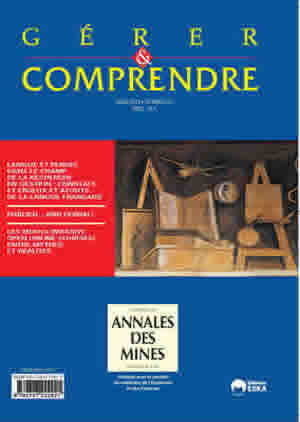
Issue 115
Editorial
By Pascal LEFEBVRE
Éditorialiste
DEBATED
Language and thought in the field of research in management: Observations, issues and advantages of the French language
By Jean-François Chanlat
professor at the University of Paris-Dauphine
For some years now in France, a lively topic of debate has been the language to prefer for publications in research in management, and even in other fields. The questions that arise are not specific to French-speakers, since they also concern other languages, including major ones. The language for publication is a key choice in the evolution of a scientific field, especially in a context where the plurality of languages has gradually yielded to the hegemony of American English. Taking this context into account, the issues related to choosing a language of publication are presented along with the advantages of French in research on management.
Publish… and perish!
By Sylvie Chevrier
professor at the University of Paris-Est Marne-la-Vallée and assistant director of the Institut de Recherche en Gestion (IRG)
Does academia’s obsession with publishing in journals with the widest renown help the science of management advance? On the contrary, evaluating research by the number of highly cited publications estranges those who publish from research itself! Forms of research are defended herein that are closer to the subject of study. Although they will not necessarily find a place as articles formatted for star journals, they allow for more innovation and creativity.
OVERLOOKED…
MOOCs (massive open online courses) between myth and reality
By Philippe Durance
professor at the Conservatoire National des Arts et Métiers (CNAM), researcher at the Laboratoire Interdisciplinaire de Recherche en Sciences de l’Action (LIRSA) and president of the Institut des Futurs Souhaitables (IFs)
The enthusiasm for “massive” open online courses (MOOCs) is not waning around the world. This trend exemplifies the acceleration of history. In a period of barely two years, the world of higher education seems to have been upended. The principal characteristics of this trend, following a brief look at its history, are described; and the major issues, presented that it bears for the future of education and, more broadly, for the diffusion of knowledge.
The obstacles to managing psychosocial risks: Four exploratory approaches
By Wim Van Wassenhove
associate researcher at CRC – Mines ParisTech
Managing psychosocial risks in firms encounters several obstacles. First of all, the polymorphous, multifactorial nature of these risks does not make it easy for them to be understood in the world of work. Secondly, the fact that the related costs are not very visible for firms is not an inducement to action. Furthermore, the widely available methods and tools used to assess these risks are not well adapted to usual practices in matters of occupational health and safety — for instance, the use of a single document (DUER) for evaluating occupational risks. Finally, a major lever of action — located at the level of the organization of work — is seldom taken into account. The obstacles to this type of risk management are analyzed; and paths for action, proposed.
Academic institutions coping with deviant behavior in the student body: The case of a French business school
By Safwan MCHAWRAB
Professeur associé à Grenoble École de Management
Aurélien ROUQUET
Professeur à NEOMA Business School – CMAC, membre du CRET-LOG (Aix-Marseille Université)
and Jean-Baptiste SUQUET
Professeur à NEOMA Business School – CMAC, membre de l’IRG (Université Paris-Est Marne-la-Vallée)
The point of view of academic institutions is adopted to focus on certain deviant behaviors among students with the aim of designing ways to cope with them. Three points are drawn from a study of the writing of theses in a French business school. First, the scope and diversity of students’ deviant behaviors with which academic institutions must cope are identified. Secondly, a typology is drawn up of institutional reactions to such behavior. Thirdly, attention is drawn to several major organizational issues that an academic institution must take into account if it wants to work out methods for coping. Light is shed on the dilemma that reactions to such deviancy generate for institutions of this type.
TRIAL BY FACT
Against the thesis of the commodification of the social sphere: The example of handicapped workers in establishments and services of aid through work (ESAT)
By Benoit Cret
senior lecturer in sociology at IFROSS (University of Jean-Moulin Lyon 3)
and Guillaume Jaubert
research engineer at IFROSS (University of Jean-Moulin Lyon 3)
A case study of nineteen “establishments and services of aid through work” (ESAT) in the Rhône-Alpes region of France serves to bring under question the thesis of the commodification of medical and social services. This analysis focuses on the capacity for action of the directors of these ESATs, which articulate a social with an economic purpose. The directors work out a strategy for diversifying the activities of their establishments, adapt the organization and modify their positions in relation to partners (public authorities and users).
IN QUEST OF THEORIES
For a useful sociology: The sociology of interventions
By Denis Bernardeau Moreau
(University of Paris-Est Marne-la-Vallée, ACP laboratory
Asking the question of the usefulness of sociology leads us to question the roles, missions and postures that will give social scientists to advance their knowledge about situations and social facts. Among these positions, we want to mention in particular the sociologist practitioner claiming the sociology of intervention. The sociology of intervention is a practical discipline leading sociologist to immerse themselves in a local situation to improve it. Acting as a third party, the sociologist intervention takes place between individuals to help them better manage their community life. By bringing as much as possible academic knowledge and popular knowledge, it contributes to the well-being of individuals in their community life. The sociologist raises the question of his usefulness.
Mosaics
De la violence ordinaire dans les organisations
À propos du livre de Gilles HERREROS, La violence ordinaire dans les organisations. Plaidoyer pour des organisations réflexives, Toulouse, Éditions Érès, 2012
By Pascal FUGIER
Laboratoire de changement social et politique (LCSP), Université Paris Diderot-Paris 7
Reimagining business history
À propos du livre de Philip SCRANTON et Patrick FRIDENSON, Reimagining Business History, Baltimore, John Hopkins University Press, 260 p., 2013
By Yannick LEMARCHAND
Professeur émérite en sciences de gestion – LEMNA, Université de Nantes
Survivre, c’est résister un appel à la résistance lancé aux cadres
À propos de l’ouvrage de Jean-Philippe BOUILLOUD, Entre l’enclume et le marteau : les cadres pris au piège, Seuil, 2012
By Christophe VIGNON
KEDGE Business School BP 921 – 13288 Marseille Cedex 09 – CERGAM