
June 2013
abstract
Gérer & Comprendre
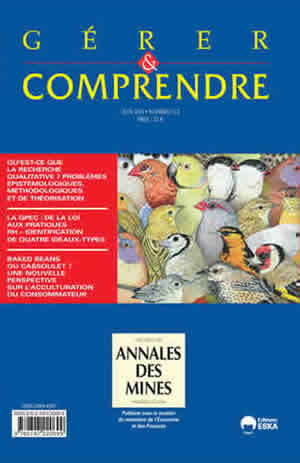
Issue 112
Editorial
By Pascal LEFEBVRE
OVERLOOKED
The prospective management of employment and qualifications (gpec), a follow-up to the adoption of the borloo act: an analysis of four typical practices articulating gpec, human resource policies, collective negotiations and the strategies of firms and local authorities
By Ewan OIRY, Stéphane BELLINI, Thierry COLOMER, Jacky FAYOLLE, Nicolas FLEURY, Agnès FREDY-PLANCHOT, Marcus KAHMANN, Amaury GRIMAND, Florence LAVAL, Thierry LE GUELLEC, Jean-François LEJEUNE, Mathieu MALAQUIN, Florine MARTIN, Antoine REMOND and Sabine VINCENT
IAE de Poitiers – Université de Poitiers – CEREGE ; Centre Études et Prospective du groupe ALPHA
Since its adoption on 18 January 2005, the Planning Act for Social Cohesion obligates firms with more than three hundred wage-earners to negotiate a three-year plan for the “prospective management of employment and qualifications” (GPEC). A study carried out by the authors sought to assess the impact of the agreements signed in compliance with this so-called Borloo Act on practices in managing human resources in the companies surveyed. Four quite different types of prospective management were brought to light: the “recuperated” GPEC, the “externalized” GPEC, the “agent-of-change” GPEC and the “territorialized and mutualized” GPEC. A description is made of the finality of each of these ideal types and of its interactions with human resource policies, collective bargaining and corporate strategies. Current practices are discussed; and lines of inquiry, suggested for future research.
The mixed work team: how does a composite labor force cooperate inside a firm?
By Marie-Rachel JACOB
Post-doctorante au Stockholm Centre for Organizational Research
Given the widespread use of contingent labor — whether subcontracted, temporary workers, consultants or interns — a firm’s “internal” employees often work on teams with these contingent “external” wage-earners. Work teams are increasingly composite. How to understand the specific problems of cooperation in this sort of situation? Conducted in a large French firm from 2009 to 2011, a study of two mixed work teams serves to illustrate the key role played by “mediators” and the firm’s relations with them.
IN QUEST OF THEORIES
What is qualitative research? Problems of epistemology, methodology and theorization
By Hervé DUMEZ
Directeur de recherche au CNRS, directeur du Centre de recherche en gestion de l’École Polytechnique
Given that research in the social sciences is increasingly turned toward modelization, quantitative methods or experimentation, it is important to lay new foundations for the “qualitative approach”. Drawing from his recently published book devoted to the methodology of qualitative research, the author has identified the epistemological risks associated with this type of research and the scientific results to be expected of it.
Baked beans or cassoulet? A new perspective on the acculturation of consumers
By Laurence BUNDY and Geneviève CAZES-VALETTE
Professeur de Marketing, Université de Toulouse, Toulouse Business School
This article studies the food acculturation of British corporate expatriates temporarily sent to Toulouse. It relies on field observations, seminal consumer acculturation papers, research on nostalgia and even studies outside of the marketing realm, to determine the motivations of this acculturation. More importantly, based on the study of a specific situation it fleshes out the previous models by the addition of individual migrant traits and new acculturation outcomes enabling to model all types of food acculturations thus enlarging the previous models realm of application.
OTHER TIMES, OTHER PLACES
Learning in a network: the unprecedented case of a moroccan automobile parts supplier
By MOSAICS and On Blanche Segrestin and Armand Hatchuel’s Refonder l’entreprise
This case-study of the learning processes undergone in a Moroccan firm selected as a parts subcontractor by Renault Tangier is based on in-depth interviews with employees and observations during meetings. The subcontractor had to adopt certain technical and organizational changes. This analysis of the shift from individual learning to an organizational form of learning in a network shows how a network, owing to its informal aspects, favors the circulation of knowledge while revealing management’s key role in creating the organizational conditions for boosting the investment of those involved. These interactions enter into a process that collectively produces meaning and makes knowledge advance.
Mosaics
(Re)penser l’entreprise en trois dimensions
À propos de l’ouvrage de Blanche Segrestin et d’Armand Hatchuel, Refonder l’entreprise, Seuil, coll. La République des Idées, 123 pages, 2012.
By Rachel BEAUJOLIN-BELLET
Reims Management School
Métropoles XXL en pays émergents
À propos du livre de Dominique Lorrain (dir.), Métropoles XXL en pays émergents, Les Presses de Sciences Po, 408 pages, Paris, 2011.
By Christophe DEFEUILLEY
EDF R&D - Département EFESE
Une aventure mathématique
À propos du livre de Cédric Villani, Théorème vivant, Grasset, 2012.
By Frédérique PALLEZ
Professeur à Mines ParisTech
La descendance de Frederick T.
À propos du livre de Béatrice Hibou, La bureaucratisation du monde à l’ère néolibérale, La Découverte, 2012.
By Arnaud TONNELÉ
Consultant, coach, Groupe Bernard Julhiet