January 2011
abstract
Responsabilité & Environnement
Une croissance verte ?
Issue editor:
Hélène SERVEILLER
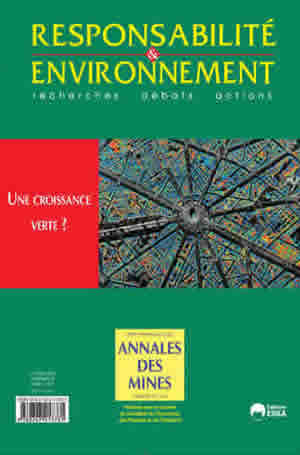
Issue 61
Editorial
By Bruno SAUVALLE
1. From economic fundamentals toward diversified public policies
Proposals from the Stiglitz report: How do they help steer the economy toward green growth?
By Didier BLANCHET
Chef du Département des Études Économiques d’Ensemble, INSEE
A convention for industry: How much room for “green” in French industrial policy?
By Luc ROUSSEAU
Directeur général de la Direction Générale de la Compétitivité, de l’Industrie et des Services (DGCIS) du Ministère de l’Economie, des Finances et de l’Industrie
Although public statistics do not yet provide a clear picture of the “green” production chain in France, the latter now represents, according to some studies, more than 300.000 jobs. Given its strong growth, it might create a quite large number of jobs by 2020. But the green economy is also and above all a common stake for all branches of industry. The “greening” of corporations is becoming essential to their competitive edge. The national convention, “États Généraux de l’Industrie”, has led to setting up low-interest “green loans” for financing industrial investments that are positive for both the competitiveness of firms and the environment.
The green economy: A response to the challenges of the 21st century
By Michèle PAPPALARDO
Commissaire générale au développement durable, au MEDDTL, et Déléguée interministérielle au développement durable
We have not yet begun measuring the scope of the problems that will loom up in the coming years and are already at the origin of many a present-day difficulty. Concern is being shown about population growth, the availability of natural resources and the tragic effects of global warming on both ecosystems and human organizations. The two major components of the green economy are the sustainable management of resources and the fight against climate change. These two are, given the consumption of fossil fuels, partly mixed up with each other.
Mobilization for green growth in Morocco
By Amina BENKHADRA
Ministre de l’Energie, des Mines, de l’Eau et de l’Environnement, Royaume du Maroc
Conscious of current environmental problems, Morocco has chosen to make the National Charter for the Preservation of the Environment and for Sustainable Development, which was presented on 14 January 2010, into a framework law with the objective of consolidating achievements and harmonizing actions. The country thus has a legal instrument for better dealing with environmental questions. Sustainable development and green growth are among the priorities in the new national strategy on energy, which was presented during the first energy conference on 6 March 2009. Electric power will triple by 2020; and power stations using renewable energy sources will account for 42% of total production capacity: sun-, wind- and water- power will amount to 14% each.
The OECD’s Green Growth Strategy
By Nathalie GIROUARD
OCDE, Direction de l’Environnement
In 2011, the OECD will present its strategy for green growth. Much is still to be done to adopt green taxes and systems of tradable permits, actions that a period of deepening deficits is ready to accept. Since firms are allergic to uncertainty, the rates set for taxes must be foreseeable and credible enough to encourage investments in innovations. Other initiatives, in particular reducing subsidies for fossil fuel consumption, can also stimulate green growth and efficiency while trimming public spending.
2. Information and communications technology as a resource for a greener economy
The development of new energy techniques and the energy transition toward a carbon-free economy that will be more secure and more competitive
By Pierre-Franck CHEVET
Directeur général à la Direction Générale de l’Energie et du Climat (Ministère de l’Ecologie, du Développement durable, des Transports et du Logement)
To position France as a major player in new energy technology — similar to what the country achieved forty years ago in nuclear energy — the choice has been made to omit no resources. Through a wide range of measures for subsidizing innovations and chains of production in new energy technology, France is supporting, within the European energy market’s framework, the emergence or consolidation of actors in technological domains as varied as solar thermodynamics, energy produced from the sea, smart energy networks or biofuels. Along with Sweden and Germany, France is now among the top European producers of energy from renewable sources.
How to characterize the efficiency of policies for reducing greenhouse gas emissions? A method of analysis in an uncertain universe
By Stéphane AMANT
Consultant senior chez Carbone 4, www.carbone4.com
For ADEME (the French Agence de l’Environnement et de la Maîtrise de l’Energie), Carbone 4, a consulting firm, has developed several tools that apply a methodology for assessing the efficiency of policies for reducing greenhouse gas emissions. This methodology is based on two criteria: the “full cost per ton of avoided CO2 equivalent” and the “potential of avoided emissions”. It is original in that it compares measurements in quite different socioeconomic contexts and thus yields elements that are useful for making choices in an uncertain universe, as shall be increasingly necessary. This methodology brings to light the key factors determining a measure’s efficiency and thus identifies the conditions for its success or failure. It is a precious tool for decision-making.
Renewable energy sources in 2020 and beyond
By Alain LIÉBARD
Président d’Observ’ER
Since the “Grenelle of the Environment”, which assembled officials and organizations for a wide-ranging discussion of environmental issues, everyone, or nearly everyone, in France now knows about renewable energy sources. However the impact of these sources on society might not be properly understood, nor the future they imply. A genuine metamorphosis is in the works. Will France manage to steer this transformation and profit from it?
The contribution of green information and communications technology to protecting the environment: Detic’s contribution and green growth
By Jean CUEUGNIET
Ingénieur général des Mines au Conseil Général de l’Industrie, de l’Energie et des Technologies (CGIET) Ministère de l’Economie, des Finances et de l’Industrie rapporteur du Groupe de réflexion sur les Eco-TIC
Information and communications technology (ICT), by linking people, enables them to perform, from home or office, tasks that would otherwise require transportation and produce pollution. Nonetheless, it represents a significant and growing share of the consumption of electricity and, too, produces greenhouse gases. The author, who has taken part in several studies on this topic (as the rapporteur of Detic, a group working on ecologically responsible development and ICT), draws conclusions about the administration’s studies of ICT’s impact. In a more personal note, he wonders about green growth’s side-effects.
Sustainable development and the growth of small businesses
By André-Jean GUERIN
Directeur Environnement et développement durable ACFCI
Since 2008, the recession has reminded us of economic imperatives. For firms, the need to optimize the management of all resources entails a requirement for total quality at a time when new prospects are opening for green businesses. More and more small businesses are becoming involved in sustainable development. The disinclination of French firms to implement management systems is probably related to: the imposition by certain big clients of an excess of specifications and controls, the quasi administrative interpretation by certifiers of the requirements set in standards, and the quite small size of most firms in our country.
Key elements for an economy-wide sustainable resource management
By Stefan BRINGEZU
Wuppertal Institute
It is getting tighter on our globe. A growing world population is getting richer and demands more and more products which require natural resources and create various environmental impacts from mining to final waste disposal. The competition on rarer metals let some countries prohibit exports containing such raw materials. The rising demand for food and non-food biomass such as feed-stocks for biofuels, and harvests fluctuating severely due to more frequent weather extremes triggered land grabbing in foreign countries, particularly in developing regions. Without mechanisms moderating resource consumption, abiotic and biotic resources will be depleted, mining and refining will devastate and pollute more and more places in remote areas, agriculture will expand into the remaining natural forests, and conflicts about land use and clean water will increase.
3. Springing locks through research and innovation
A strategic approach to a new organization of French and European research in energy
By Olivier APPERT
Président d’IFP Energies nouvelles, Président du Comité de Coordination de l’Ancre
To reinforce the synergy between the parties involved in French research, ANCRE (Alliance Nationale de Coordination de la Recherche pour l’Énergie) has just been set up. It brings together all public research organizations in France that are working on problems related to energy. Its three major assignments are to: favor and reinforce partnerships and the synergy between public research organizations, universities and corporations; identify the scientific, technological, economic and societal factors that impede industrial applications in this field; and propose joint long-term R&D projects and the procedures for a coordinated implementation of them.
The technological and industrial challenges of carbon- free energy
By Jean THERME
Directeur de la recherche technologique Directeur délégué aux énergies renouvelables du CEA
The world energy scene has undergone a thoroughgoing change in less than twenty years. It is ready for a new revolution based on the massive introduction of renewable energy sources along with the associated technology and, also, on ever smarter energy networks for managing supply and demand. As industrial and economic competition intensifies, innovation will be a key factor for winning this battle. Given its worldwide industries and topnotch research centers, France has a few aces up its sleeve. The country has to focus on industrial chains of production, research and innovation; and choose to back those of excellent quality that will help make it a world leader. The examples of photovoltaics and batteries are cited, two fields that France must continue supporting and developing.
Poles of competitiveness, the motors of green growth
By Alain SCHMITT
Chef du Service de la compétitivité et du développement des PME, Direction générale de la compétitivité, de l’industrie et des services, Ministère de l’Economie, des Finances et de l’Industrie
Since the “poles of competitiveness” policy was launched in 2004, it has boosted innovation and helped develop genuine chains of production. For the “Grenelle of the Environment” meeting, protecting the environment is an opportunity for investments that will stimulate growth and create jobs both nationally and internationally. The government has adopted a policy of green growth with the objective of turning the environmental challenge into an opportunity of growth for French firms. Planned investments should, by 2012, stimulate 450 billion euros in business and create 600.000 jobs. The competitive poles are a major factor in this dynamics.
Innovation, the key to green growth
By François DROUIN
Président-directeur général d’OSEO
All indicators point clearly in the same direction: French small and midsize businesses have adopted the objectives set by Europe and France in matters of sustainable development — and turned them into market opportunities. Companies are competing in ideas, and promising initiatives are increasingly being made in response to new requirements, especially in the fields of energy, transportation, waste management, construction and environmental risks. The starting signal has been given for green growth!
From a “demonstration fund” to investments with a future: Supporting a French supply of green technology
By François MOISAN
Directeur scientifique, Agence de l’Environnement et de la Maîtrise de l’Energie (Ademe)
ADEME (Agence de l’Environnement et de la Maîtrise de l’Énergie) has been assigned to implement four programs backing initiatives that, related to the development of a new “green” technology, had been started under the “demonstration research fund”. The four programs are: carbon-free energy, smart electric grids, vehicles for tomorrow and the recycling “circular economy”. Total public funds devoted to these four programs amount to 2,85 billion euros over a five-year period. Furthermore, the ANR (Agence Nationale de la Recherche) is managing a program for setting up a high-level institute, endowed with one billion euros, on carbon-free energy.
EU policy: Which technological strategies for smart, sustainable growth?
By Raffaele LIBERALI
Directeur Energie, Direction Générale pour la Recherche Commission Européenne
The EU’s Strategic Energy Technology Plan (SET Plan) was launched in November 2007 in response to issues haviung to do with energy and the climate. Its priority is to speed up the development and deployment of new energy technology thanks to a global approach providing coordination among member states. This plan is to position Europe as a world leader in the transition toward smart, sustainable growth.
4. New lifestyles for facilitating the transition toward a greener economy
The conditions for “green growth”
By Alain GRANDJEAN
Co-fondateur et associé de la société Carbone 4
For 150 years now, economic growth has come in hand with an exponential growth in the consumption of resources and in anthropogenic pressure on the environment, in particular the climate. Given the well-known properties of exponential curves, it is impossible to continue following this model. In the coming decades, we are going to, whether we want to or not, bump up against “production peaks” in strategic resources.
“Postcarbon cities”, the driving force in tomorrow’s green economy?
By Jacques THEYS
Responsable de la mission « prospective » du Ministère de l’Ecologie, du Développement durable, des Transports et du Logement
In early 2009, ADEME (Agence de l’Environnement et de la Maîtrise de l’Énergie) and the French Ministry of Ecology, Sustainable Development, Transportation and Housing launched a major program for exploring realistic — acceptable and efficient — approaches to the transition toward “postcarbon” cities. What happens in cities will determine to a large and durable degree the scope and structure of tomorrow’s green economy.
Energy and territories: Toward the concept “Energy 2.0” with local authorities
By Gérard MAGNIN
Délégué général d’Energy Cities
There has never really been a policy for heating, which represents 40% of needs, even though a policy has existed for a long time now for electricity, which represents only 20%. The latter has overdetermined the country’s total energy system, thus leading to a national, centralized approach focused on macro-level quantitative needs in energy and on a single product. In contrast, a local, decentralized, more qualitative approach should focus on needs in relation to heating as well as electricity and on tapping local energy potentials, including saving energy. The concept of “energy subsidiarity” is proposed. In its general acceptation, “subsidiarity” implies that the search for solutions be conducted as closely as possible to the problems to be solved. In relation to energy, it implies systematically mobilizing locally available energy potentials.
Sustainable urban growth
By Pierre-Noël GIRAUD
Professeur d’économie à Mines ParisTech et à Paris Dauphine
The principal messages from Energy and urban innovation are presented. This report by the World Energy Council has examined the challenges related to energy in big cities (in particular “megacities”), the policies that are being or could be implemented, and the role of firms in this implementation. Considerable progress can be made by using existing techniques. The main difficulty has to do with diffusing them. There is a need for organizational and institutional innovations that will stimulate players, coordinate their actions and speed up the tempo of change.
Miscellany IN MEMORIAM : Marcel LEMOINE (1924-2009)
By Jacques DEBELMAS
Professeur honoraire à l’Université de Grenoble 1