
July 2010
abstract
Responsabilité & Environnement
« Après copenhague »
Issue editor:
Pascal DUPUIS
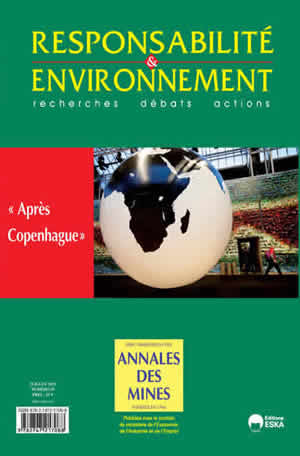
Issue 59
Editorial
By Bruno SAUVALLE
Ingénieur en Chef des Mines
The Copenhagen Accord
The debate and controversy about global warming
By Jean JOUZEL
Directeur de Recherches au CEA
A controversy has recently been stirred up about how solar radiation and water vapor in the atmosphere affect global warming. On the one hand, the sun’s activity has tended to decrease since the 1970s while the average temperature has increased. On the other hand, the concentration of water vapor in the atmosphere has risen; and it is a well-documented factor augmenting global warming.
Copenhagen: Another view
By Paul-Henri BOURRELIER
Ingénieur général des Mines honoraire,
Models of the climate might yield inexact findings insofar as they fail to take into account factors and phenomena of importance on other time scales and since most laws of science are not linear. At present, there are no grounds for asserting that the risk of extreme climate events increases dangerously if average warming amounts to more than two degrees.
Science
An action plan after Copenhagen
By Stéphane HALLEGATTE
Given the absence of any international procedure for fairly sharing the efforts for reducing greenhouse gas emissions, it is not possible to refuse to allow the more enterprising countries to apply compensatory fiscal arrangements at their borders. However the countries that have pledged to reduce emissions should accept tighter controls than those now foreseen. For example, an international organization should be set up to control emissions in each of these lands.
The bifurcation at the Copenhagen Summit
By Olivier GODARD
Directeur de Recherche au CNRS
The Copenhagen Summit broke with the tight, demanding international coordination, initiated in Rio de Janeiro and reinforced in Kyoto, that applied only to industrialized countries. This bifurcation leads toward a system with a low level of coordination, which is to be based on the unilateral but noncompulsory commitments made by sovereign states, in particular big countries or regional blocks, such as the European Union.
Carbon markets after Copenhagen
By Joffrey CÉLESTIN-URBAIN
Chef du Bureau des marchés du carbone à la Direction Générale de l'Energie et du Climat et Conseiller du Directeur général sur la gestion des actifs carbone de la France, MEEDDM
Although the unified disciplinary code imposed by the Kyoto Protocol is being phased out, carbon markets are not going to vanish. Instead, they will splinter, as their focus shifts to the regional or national levels.
The commitments made in Copenhagen and the question of comparable efforts
By Patrick CRIQUI & Constantin ILASCA
LEPII, UMR 5252 CNRS-UPMF, Grenoble
The question of taking a fair share in the fight against climate change is cogent to the drafting of a climate-control system. Establishing a universal criterion seems impossible, but a differentiated approach can be imagined. Compulsory targets for reducing greenhouse gases in relation to a base year could be set for wealthy countries, while emerging countries would be subject to targets set as a function of emissions per GDP unit, and developing countries would be exempted from compulsory objectives.
What international agreement will be worked out?
A hundred billion dollars
By Sandrine de GUIO
Ingénieur des Ponts, des eaux et des forêts à la Direction générale du Trésor - Ministère de l'Economie et de l'Emploi (MINEIE)
and Jean-Jacques BARBÉRIS
Administrateur civil à la Direction générale du Trésor (MINEIE)
The figure of a hundred billion dollars represents the funding foreseen by the Copenhagen Accord for developing countries starting in 2020. It was not randomly decided by a diplomat during the final minutes of negotiations. The Accord’s credibility is being put to the test: developed countries have set a target in the $30 billion range for the fight against climate change in developing lands for 2010-2012.
The Copenhagen Accord: The regrettable absence of international fuel consumption standards for airlines and shipping
By Marie-Claire LHENRY
Adjointe au chef du Département de lutte contre l'effet de serre Direction Générale de l'Energie et du Climat Ministère de l'Ecologie, de l'Energie, du Développement durable et de la Mer (MEEDDM)
At Copenhagen, the EU wanted to set a global objective for reducing greenhouse gas emissions in maritime activities and aviation. Such a clear political signal would have facilitated the work done by the International Civil Aviation Organization and International Maritime Organization, where measures for reducing emissions in these two sectors are to be worked out and implemented. Negotiations have made little progress; and bunker fuel for airplanes and ships was not included in the Copenhagen Accord.
Assessing forests and agriculture in relation to climate policies
By Nathalie GUESDON
Chargée de mission « Agriculture et changement climatique », Ministère chargé de l'Agriculture
and Pascal BLANQUET
Chargé de mission « Forêt et agriculture », Ministère chargé de l'Ecologie et de l'Energie
During negotiations in Copenhagen, thought was given to the technical procedures for assessing the role of forests in global warming, and attention was focused on the fight against deforestation in developing countries. But the advances made in evaluating CO2 sources and sinks in developed countries have been less significant. A political agreement must be worked out so that the efforts made in warding off climate change are balanced among countries. It should foresee a form of governance and system of funding for preventing deforestation.
The international diffusion of technology for fighting against global warming: An inventory and possible means of intervention
By Matthieu GLACHANT & Yann MÉNIÈRE
Économiste au CERNA, MINES ParisTech
The most important condition for successfully diffusing the technology for fighting against global warming is for countries to make significant, targeted commitments about their emissions. Intellectual property rights no longer seem to be a major obstacle to the diffusion of this technology. There is enough competition among patented techniques so that no firm can lock the market.
Copenhagen and the adaptation to global warming
By Bertrand REYSSET
Ingénieur du génie rural des eaux et forêts
Adapting to climate change means taking action to reduce our vulnerability to its effects or even drawing an advantage from them. The Copenhagen Accord clearly recognizes that developing countries, in particular the poorest among them, are the most vulnerable to the negative effects of climate change and the least capable of adjusting to global warming.
On the bargaining table
Let’s prepare right away for the period after Copenhagen
By Michel HAVARD
Député de la Première circonscription du Rhône Conseiller Municipal de Lyon
To draw lessons from Copenhagen, we must cast aside our eurocentrism and place ourselves for a while in the place of countries such as India, China or Brazil. Though not denying their current responsibility for global warming, they insistently point out that developed countries have, since the start of the industrial revolution, discharged into the atmosphere 80% of anthropogenic emissions of greenhouse gases.
After Copenhagen, a manufacturer’s point of view
By Alain CAPMAS
Directeur général de l'ATILH Président du Comité Changement Climatique du Medef
The announcement of a possible European pledge to reduce greenhouse gases not by 20% but by 30% creates a high degree of uncertainty that weighs on firms’ decisions about making investments.
The failure in Copenhagen, as seen by the World Wide Fund for Nature: A politically inevitable and useful shakeup?
By Elise BUCKLE
Responsable Energie Climat pour le WWF France
The Copenhagen Summit has brought to light major questions that transcend countries, regional blocks and interest groups, and dispel some of our illusions. The turbulence might give way to a social and political reconstruction on a healthier, more pragmatic basis for the future.
The 15th Conference of the Parties to the United Nations Framework Convention on Climate Change, Copenhagen (7-18 December 2009)
By Jean-Pierre BOMPARD
Délégué au développement durable de la Confédération Française
It is high time to change our way of making decisions about the climate. The procedure based on a consensus of nearly two hundred nation-states is no longer tenable. The Intergovernmental Panel on Climate Change must shift focus back on its scientific activities and accelerate its work on rising sea-levels, the local effects of global warming and the impact of the sun’s actions.