
October 2009
abstract
Responsabilité & Environnement
Adapting to climate change
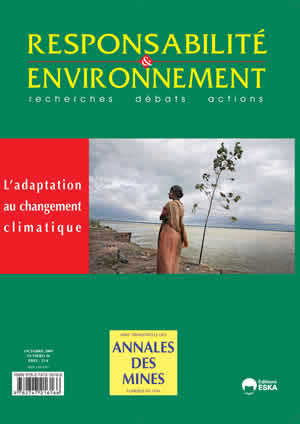
Issue 56
Editorial
By Pierre Couveinhes
Rédacteur en chef des Annales des Mines
I – Adaptation
Reflections on the climate
By Emmanuel Le Roy Ladurie
Historien, membre de l'Académie des Sciences morales et politiques de l'Institut de France
Emmanuel Le Roy Ladurie’s Histoire humaine et comparée du climat counts three major volumes on the history of the climate and, like Montesquieu, on the relations between history and climate: Canicules et glaciers XIIIe-XVIIIe, Disettes et révolutions (1740-1860) and Le réchauffement de 1860 à nos jours. In an article in the summer 2009 issue of Commentaire, he presented his “reflections on the climate”, which mainly focuses on the 20th century. This article can serve as an introduction to the trilogy, without being a summary of it. We thank the author and the journal Commentaire for allowing us to reprint this article in our current issue.
Ideas about the changing climate: From God’s creation to man’s responsibility
By René Favier
LARHRA (Laboratoire de Recherche Historique Rhône-Alpes) UMR CNRS 5190 Université Pierre Mendès - France – Grenoble 2
Is the climate changing? Do humanity’s actions affect this change? Raising such questions amounts to a sacrilege. A short while ago, Courrier International ran the headline “Climate: Global warming does not exist” on its cover. But this title was prudently followed by an asterisk referring to a politically correct subtitle at the bottom of the page: “At least, some thinks so”.
Lessons from geological history and the great extinction of species
By Patrick De Wever
Muséum National d'Histoire Naturelle
Talk about biodiversity often refers to endangered species, such as the Pyrenees bear (since Cannelle died on 1 November 2004), or the comeback of the wolf in the Alps or the elephant in Africa… animals that are symbolic, nearly mythical — the teddy bear of our younger years, held in our arms while listening to stories about the wolf and Little Red Riding Hood, or Babar. Now that we have grown up, we should not forget that other living beings — worms, insects, bacteria, etc. — are becoming extinct. Whether considered to be useful, pleasant or harmful, they are a part of biodiversity.
Climate, adaptation, evolution and biodiversity
By Gilles Escarguel
Laboratoire Paléoenvironnements et Paléobiosphère – UMR 5125 du CNRS, Université Claude Bernard Lyon 1
The biosphere — the thin layer surrounding our planet wherein living beings evolve — is a complex adaptative system, a network of multiple interactions where the existence of each being, regardless of its attributes, is linked to the existence of surrounding beings. The major physical, mathematical properties of this complexity are now known: nonlinearity, metastability, self-organization, emergent properties, invariance to scale, irreversibility, sensitivity to initial conditions, chaos… They have numerous biological, ecological and environmental implications.
Local areas faced with climate change
By Martine Tabeaud
Université Paris Panthéon Sorbonne, UMR CNRS ENEC
Various parties are involved in actions for attenuating global warming and adapting to a changing climate: international organizations, groups of nation-states, regions, local authorities, nongovernmental organizations, political parties, labor unions, banks, insurance companies, researchers, transnational firms, small businesses, mass marketing, transportation, the media and citizens.
From extreme events to figures of catastrophes
By Paul Henri Bourrelier
Ingénieur général des Mines et Jean Dunglas Président de l'Académie d'Agriculture de France
Major climate-related events have a place in myths about the origin and destruction of the world. The Flood in the Bible has an equivalent in all religions. It is not surprising that the announced climate change has revived literally apocalyptic predictions, in other words: revelations.
Adapting to what? What is humanity’s place in nature?
By Michel Juffé
Philosophe, conseiller du Vice-président du Conseil général de l’Environnement et du Développement durable (CGEDD) au Ministère de l’Ecologie, de l’Energie, du Développement durable et de la Mer, en charge des technologies vertes et des négociations sur le climat (MEEDDM)
Adapting to a changing climate or to any other disturbance in the biosphere does not just call for technical or economic considerations, nor for a “political economy”. Everyone around us is talking about “sustainable development” and the need to more “soberly” consume energy and to imagine a “different” growth (often without any specifics). We are under pressure from two sources: those who invoke a “natural” world whose equilibrium we must preserve and those who advocate a “cultural” (human) world whose originality we must maintain.
II - Public policies and citizen actions
The place of adaptation in climate policies
By Marc Gillet
Point focal pour la France du Groupe d’experts Intergouvernemental sur l’Evolution du Climat (GIEC), ancien directeur de l’Observatoire national sur les effets du réchauffement climatique (ONERC), actuellement directeur des affaires internationales à Météo France
Given inevitable changes, there are two forms of prevention. Released in 2007, the fourth report by the Intergovernmental Panel on Climate Change has dispelled any doubts that might yet exist about whether or not global warming has started and is caused by human activities and about its intensification during the coming decades.
France’s policy for adapting to climate change
By Pascal Dupuis
Chef du Service Climat et Efficacité énergétique au MEEDDM (ministère de l’Environnement, de l’Energie, du Développement durable et de la Mer, en charge des Technologies vertes et des Négociations sur le climat)
France’s policy for adapting to climate change has two pillars: reduce the emission of greenhouse gases (“attenuation”) and prepare for the inevitable changes to come (“adaptation”). Most sectors now feel concerned in the process of attenuation, given the compulsory objectives set at the international and European levels. However it is also important for them to become involved in the process of adaptation.
Tilling the planet: More biomass, less greenhouse gas
By François Papy
Académie d'Agriculture de France
The 21st century will have to take up two challenges. First of all, the production of crops on the planet has to increase in order to satisfy the growing needs of a population of about eight or nine billion by 2050: first of all, the need for food (which, under certain hypotheses, will double) but also needs related to energy (in various forms), textiles and products used by industry. The second challenge is to attenuate the climatic changes already under way and adapt to them: attenuate in order to remain within limits that allow for adaptation, since it is wise to take into account an always possible acceleration of the processes under way.
Imagining and planning urban agglomerations: A few examples from Europe
By Brigitte Mazière
Inspectrice Générale de l'Equipement honoraire
More than 70% of the European population — and 80% of the French — is concentrated in an urban environment. The growth of urban areas is a general trend. In the past few years, a few major events have illustrated how natural catastrophes can affect urban agglomerations: the December 1999 storms that swept over western Europe, the exceptional flooding in central Europe during the summer of 2002, and the heat wave in the summer of 2003. Outside Europe, other events have recently completed the picture: the December 2004 tsunami in Asia or hurricane Katrina’s devastation of New Orleans in August 2005.
For a dynamic management of coastal areas
By Nicole Lenôtre
Bureau des Recherches Géologiques et Minières (BRGM)
The coastline is increasingly attracting the attention of policy-makers, managers and citizens. The United Nations estimates that 80% of the world’s population will be living on a 100 km-wide strip along the coast by 2010. Eight out of ten of the biggest agglomerations are located on the coast: New York, Tokyo, Bombay…. France cannot dodge this trend: the coastal population is growing at an annual rate of 3,8% as compared with only 3,3% for the country as a whole.
Ethics, the guideline for adaptations
By Erwann Michel-Kerjan
The Wharton Business School, University of Pennsylvania, Etats-Unis & Département d’économie, École Polytechnique, France. Président du Haut Conseil sur le financement des catastrophes de grande échelle auprès du Secrétaire Général de l’OCDE
In the context of climate-related events that will be potentially ever more devastating, who will cover the costs of disasters? In industrialized lands, insurance traditionally plays a leading role, by covering individuals and firms in the case of major natural risks with an economic impact. Parties to an insurance contract pay moderate premiums compared with potential losses. Insurance is now a major revenue-generating industry worldwide. But traditional insurance systems are showing their limitations, as they deal with major catastrophes, which no longer happen on the average of once every twenty years (thus allowing the companies time to collect enough premiums), but more and more often…
Ethics, the guideline for adaptations
Entretien de Paul-Henri Bourrelier (Ingénieur général des Mines) avec Alain Grimfeld, (Président du Comité consultatif national d’éthique pour les sciences de la vie et de la santé), Yves le Bars (Président du GRET, association professionnelle de solidarité) et Claudine Schmidt-Lainé (Directrice de recherche au CNRS, directrice scientifique du CEMAGREF)
In the context of climate-related events that will be potentially ever more devastating, who will cover the costs of disasters? In industrialized lands, insurance traditionally plays a leading role, by covering individuals and firms in the case of major natural risks with an economic impact. Parties to an insurance contract pay moderate premiums compared with potential losses. Insurance is now a major revenue-generating industry worldwide. But traditional insurance systems are showing their limitations, as they deal with major catastrophes, which no longer happen on the average of once every twenty years (thus allowing the companies time to collect enough premiums), but more and more often…