
July 2009
abstract
Responsabilité & Environnement
Variations on risks
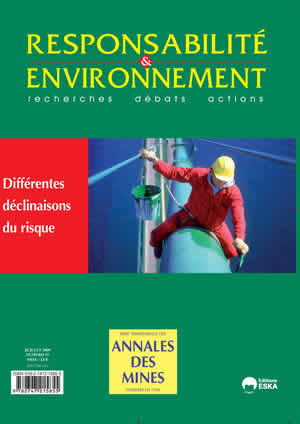
Issue 55
Editorial
By Pierre Couveinhes
Rédacteur en chef des Annales des Mines
How a firm copes with the risks to its reputation
By Patrice CAILLEBA
professeur, IRMAPE - Groupe ESC Pau
Putting one’s reputation at risk must be seen as a “metarisk”, since it arises in every risk that a firm takes. Natural risks, operational risks, legal risks, strategic risks and, of course, financial risks all have as a consequence, once the risk becomes reality, that the firm’s reputation is at stake.
Goodwill controlling: A challenge for legal auditors
By Christian PRAT dit HAURET
Professeur des universités, Université Montesquieu - Bordeaux IV
At the end of the 20th century, international firms adopted policies of external growth that led them to pay for ”goodwills”, which figure on their consolidated financial statements. These assets raise problems related to the control exercised by the legal auditors responsible for guaranteeing the quality of these statements to third parties.
Preventing work-related accidents: Hard-to-take steps
By Lionel CHAUTRU
Maître de conférences associé, IUT de Bayonne (UPPA)
Employees adopt attitudes toward risk-taking that very much depend on how they perceive risks. This perception often differs significantly from that of the experts on “security” who design preventive measures.
The implication of wage-earning shareholders in production cooperatives and the risks they run
By Yohan DUPORT
Doctorant en sciences de gestion, IAE de Limoges
In a cooperative, workers are both wage-earners and shareholders. Therefore, they both manage and own their means of production. This blurs the traditional bounds set in corporations, where these two “statuses” are filled by persons with usually contradictory objectives. As a consequence, specific risks loom up…
Technological tools and organizational changes: Risk factors for international firms?
By Corinne BAUJARD
Maître de Conférences, Université Européenne de Bretagne (UBO)
Learning how to use technological tools does not mechanically change organizations. As interviews conducted in eight international firms show, organizational strategies often carry more weight than the intrinsic characteristics of the technology in question…
Information and communications technology: From inherent risks to an abusive usage — “Technostress”?
By Sonia JEDDI
Doctorante à la Faculté des Sciences Economiques et de Gestion de Tunis
and Ridha OUNI
Assistante à l'Institut Supérieur de Comptabilité et d'Administration des Enstreprises, Université de la Manouba (Tunisie)
The current surge in information and communications technology has thoroughly transformed modes of management and methods of work. The advantages thus procured are, however, offset by new requirements. The increasing pressure on employees might now be the cause of a new work-related stress: “technostress”.
Corporate social responsibility in controlling risks: A new utopia? Bata’s management
By Patricia DAVID
Maître de Conférences, ESDES/Université catholique de Lyon
Might the “Bata system”, created in the 19th century, not be interpreted as an attempt to set up a pragmatic, utopian corporate social responsibility? The determination to exercise global control over the socioeconomic environment of production is close to the utopian concept of creating an ideal firm for coping with the shortcomings and inconveniences of society.
The bazaar, the missing link between fabric shops and department stores: Opportunities and risks at the start of the 19th century
By Luc MARCO
Professeur des universités, CEPN-CNRS/Université Paris 13
André-Martin Labbé is not well known despite his fundamental role in the history of management and business, and in urbanism and “shopping centers”, a field where he was a pioneer in France.
Miscellany
The risks and benefits of nanotechnology: The need for new forms of social debate: an initial assessment of CNAM’s Nanoforum
By W. DAB, N.FABRE, A. GEORGE-GUITON, E. GAFFET, S. DESMOULIN, J. CAMBOU, D. BENOIT-BROWAEYS, G. HERIARD-DUBREUIL, L. PITOUN, G. GUERIVE, L. TREPIED, A. POCHET, B. LAURENT, J. BOUDOT, M. FONTAINE, R. CHEVALLIER, J.L. PUJOL, D. HOUSSIN
The development of nanotechnology raises many questions regarding sanitary, social and environmental issues. To deal with this situation of uncertainty about the risks and benefits related to this technology, the French General Direction of Health has undertaken precautionary measures, in particular, the creation of CNAM’s Nanoforum in 2007. Nanoforum is a permanent, multidisciplinary meeting ground for discussing the advantages and risks to be expected in this field.