
June 2008
abstract
Gérer & Comprendre
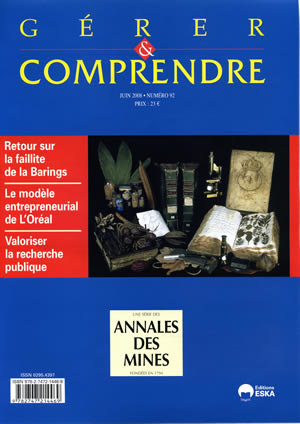
Issue 92
Editorial
By Francis LEFEBVRE
IN QUEST OF THEORIES
For another theory of decision-making: Looking back on the bankruptcy of Barings (and of its hierarchy…)
By Yves-Marie ABRAHAM
and Cyrille SARDAIS
HEC Montréal
Prevailing theories take information and the perception of it to be the decisive factor in decision-making. But they have a problem explaining the Barings bankruptcy. Despite several warning signals received during the months prior to the catastrophe, this revered institution’s leaders took no preventive measures. This textbook case is reinterpreted from a constructivist viewpoint. These leaders built for themselves a reality that was The Reality, where the misconduct of a young trader named Nick Leeson was simply unthinkable. Andreu Solé’s theory of “possibles and impossibles” is used to penetrate this reality.
OVERLOOKED…
Managing older employees in firms: The issues and a blueprint
By Olivier MEIER
Institut de Recherche en Gestion - Université Paris 12
To cope with the ageing of their populations, all European countries must make careers last longer in order to finance pension funds. What place do senior employees have as new generations are entering the labor market? Does keeping them on the payroll increase unemployment among youth? How to make the relations between generations into a source of wealth instead of a cause of discrimination? This strategic topic, long overlooked in France, takes issue with deeply rooted habits. Top management’s mentality must change. Till now, corporate leaders have been satisfied with programs for retiring older employees earlier so as to make room for young people. The situation has changed, and all parties now have an interest in treating senior employees “normally”. With its labor force participation rate of 36,8% for 55-64 year-olds, France has not yet realized the magnitude of this issue.
TRIAL BY FACT
Bata, the impossible change: A failed high-end strategy
By Antony Kuhn
Maître de Conférences à Nancy Université, CERFIGE
and Yves Moulin
Maître de Conférences à l'Université Robert Schuman de Strasbourg, CESAG
To what extent do a company’s initial choices about organizing production weigh on its strategic trajectory? This analysis of the Bata group’s high-end strategy sheds light on the crucial importance of preestablished conventions on the line. Although the latter help coordinate activities and are conducive to a convergence of ideas in workshops, they also close access to new solutions in production. If the preliminary work of legitimating organizational changes is not done, then such conventions turn out to be a powerful hindrance to changing the model of production.
OVERLOOKED…
Oréal’s entrepreneurial model: Its source and origins
By Olivier BASSO
Singleton Institute, Bruxelles
Alain FAYOLLE
Professeur EM Lyon, Chercheur au CERAG (Université Pierre Mendès France de Grenoble), Professeur invité Solvay Business School
and Thomas LEGRAIN
Président, TL Conseil
Oréal is one of the very few French firms created in the early 20th century that has managed to hoist itself to a planetary level and stay there. What managerial formula accounts for this success? It all has to do with the permanence of the firm’s founding values, as formulated by François Dalle in particular. On the basis of his deep understanding of human behavior and group dynamics, this outstanding president from 1957 to 1984 worked out a philosophy of regulated conflict, which has proven solid enough to still serve as the grounds for a strong entrepreneurial culture. What are the limits of this model of a “management of discontinuity” and a “constrained entrepreneuriate”? Would a systematic practice of confrontation not logically lead to doubting the founders’ creed?
Paying for talent: The wages of professional athletes — an exception or a precursor?
By Pierre MIRALLES
Professeur Associé à l'IAE de Montpellier
Pay practices in professional sports provide interesting examples for managers in the “mundane” world of work. How can pay practices for professional athletes give us new insight into questions as difficult as those having to do with the evaluation and remuneration of an individual’s contribution to a collective project, with the conditions of fairness as perceived by wage-earners, with the part of inhouse regulations and of the external market in the “fair” distribution of wages? Although this analogy with the corporate world has its limits, it stimulates our thoughts about how to measure talent and share in the profits.
TRIAL BY FACT
Developing public research: The human factor in the sale or transfer of patents by universities
By Dominique Philippe MARTIN
Professeur à l'Université de Rennes 1 membre du CREM-UMR CNRS 6211
and Lionel PUJOL
Ingénieur Valorisation pour Bretagne Valorisation
Why are universities able to sell some patents to private firms but not others? On the basis of a study of fifteen patent transfers undertaken by a joint service for several universities in western France, the complex process is analyzed that runs from an invention in the laboratory to its sale to a company. Among the factors coming into play are the characteristics of the project and of the interested firm as well as the profiles of the teams involved. One key to success is undoubtedly the qualifications and practices of the persons who convey a project. The empirical model proposed herein draws attention to the importance of the human factor in the transfer of the technology developed through public research.
Mosaics
The significance of a work
On Lucien Karpik’s L’économie des singularités (Paris: Gallimard, 2007).
By Franck Aggeri