
April 2008
abstract
Responsabilité & Environnement
The economic and financial levers of sustainable development
Issue editor:
Alain GRANDJEAN
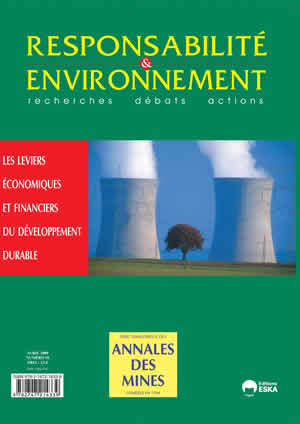
Issue 50
Editorial
By François Valérian
Introduction: The financial crisis and sustainable development
By Alain Grandjean
associé de Carbone 4
Overhauling the analytical tools used by economists, rethinking the part central banks play in financing the economy, orienting the creation of money and, in general, financial activities toward sustainable investments... the recent crisis prompts us to implement measures for obviating new shocks.
Corporate finance and sustainable development
From preventing risks to anticipating opportunities in the marketplace: The new frontier of big business’s environmental policy
By Elisabeth Laville
fondatrice du cabinet Utopies
Big firms are switching from perceiving the environment as a limiting factor to viewing it as an opportunity. Serious thought is being devoted to the impact of products on the environment. Providing environmental information to consumers has come to be seen as a decisive axis in marketing strategies.
Sustainable development: The necessity of changing behavior or an opportunity for clean technology?
By César de Brito
Gérant de portefeuilles chez Lombard Odier Darier Hentsch & Cie
Players in the economy prefer the present, whereas issues related to sustainable development often pertain to the long run. For this reason, we should not fully rely on markets for the selection of tomorrow’s “clean” technology. Governments and transnational authorities have a role in setting regulatory objectives and providing incentives. In this field as in others, we must not overuse coercive measures.
Financing the environment
By Arnaud Berger
The market related to the environment is often said to be very promising. Like all markets of recent origin however, it still lacks visibility for bankers and financiers. Government interventions can earmark funds and provide guarantees for players in this marketplace.
Environmental bookkeeping
By Jean-Paul Séguret
Président du cabinet Constantin
Sustainable development calls for information, especially when it needs financing. Information for investors entails adequate bookkeeping procedures for reporting expenditures and liabilities related to the environment and for following up on greenhouse gas emissions.
Socially responsible investments at the crossroads: A manifesto for a responsible performance
By Jean-Philippe Desmartin, Valéry Lucas-Leclin and Stéphane Voisin
et
A company’s nonfinancial performance, socially responsible investment… behind the talk, formulas and acronyms is the reality of an analysis that, as it develops, tries to improve accountability in terms of the sustainability and responsibility of a firm’s performance.
The need for governance
A European climate policy and adjustments at the border
By Olivier Godard
Directeur de recherche au CNRS et professeur chargé de cours à l'Ecole polytechnique
Europe cannot have an efficient climate policy if it remains indifferent to the importation of products with a high cost in terms of greenhouse gas emissions. This is a sensitive topic given the ever present risks of protectionism. Any new system should be compatible with GATT regulations. Solutions exist for making international trade compatible with the need to fight against harmful emissions.
The evolving CO2 market in Europe and electric issues
By Jean-Paul Bouttes
François Dassa
Anime le pôle relations internationales de la Direction prospective
and Jean-Michel Trochet
Economiste senior, EDF
Coming technological choices in electricity can contribute, in Europe and the rest of the world, to a sustainable development capable of countering climate change. Making and carrying out these decisions must be based on coherent, credible public policies at the European and worldwide levels.
Specifications and major international standards in relation to sustainable development
By François Fatoux
Délégué général de l'ORSE
Sustainable development is a quite normative concept, since it entails defining what is “good” behavior in several activities. However firms have difficulty winding their way through the maze of “norms’, most of which are, in fact, not binding. A typology is sketched…
The protection of intellectual property rights and sustainable development
By Claude Henry
Ecole polytechnique et Sciences-PO
Since patents foster innovation, they are useful for sustainable development. However they must not impede the latter by limiting the use of products and techniques, or by obstructing the circulation of knowledge.
Good corporate citizens, a vision of the future
By Marcel Grignard
Secrétaire national de la CFDT, en charge du développement durable et de la RSE
Along with the social responsibility of firms, sustainable development might generate the means for regulating capitalism. A challenge for Europe: how to make the growth of firms more profitable in the long run and to wage-earners?
“Scarcity looking for governance”… Desperately?
By Dominique Dron
Ecole des Mines de Paris, Centre énergétique et procédés
and Hervé Juvin
Président d'Eurogroup Institute
The aim is not to recreate a mythical nature where humanity never played a part but, instead, to enable our species to survive and develop in a world with scarce supplies of water, soil and energy. To this end, illusions about an efficient marketplace or a supranational governance must be dispelled. To make natural resources last, new forms of governance must be invented in the field at the grassroots level — forms rooted in a solidarity between people.
Miscellany
Methodological and practical aspects of the assessment of chemical risks in big firms
By Caroline Dechaume-Moncharmont, William Dab and Martine Courtois
Cnam, Chaire Hygiène et Sécurité
There is no standard tool for assessing risks in big firms that covers all dangerous chemicals and all activities in the firm. A method is proposed for designing one that operators who are not necessarily trained in using complicated tools will be able to put into operation.
For a scientific debate on climate change
By Vincent Courtillot
Membre de l'Académie des sciences
Debate is essential, and climatic change is quite debatable. We have decided to publish this article by Vincent Courtillot, whose minority view deserves to be respected and criticized like any other position grounded in science. The article is run with a table received from Paul-Henri Bourrelier, mining engineer and member of AFPCN (Association Française pour la Prévention des Catastrophes Naturelles) that lists the points raised in the ongoing debate about climate change.