
April 2007
abstract
Responsabilité & Environnement
1970, the invention of the environment?
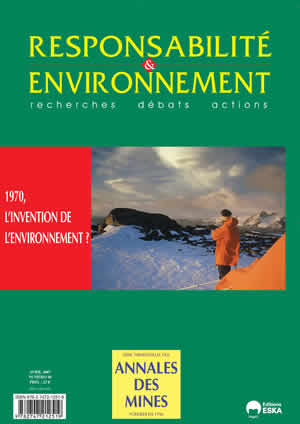
Issue 46
Editorial
By François Valérian
From an interministerial assignment to a Ministry of the Environment
By Serge Antoine
ministère de l'Environnement
The concept of “environment” germinated in several ministries at the same time. This might, it seems, have happened first in America. Whatever the case might have been, the concept in France did not come from America. It was a germination because a social phenomenon came into being.
A ministry’s birth
By Robert Poujade
ancien ministre de l'Environnement
Born out of political decisions at a time when a still rural France was trying to pursue economic growth without sacrificing its quality of life, the new Ministry of the Environment prepared the grounds that still underlie ecology here. A firm but pragmatic dialog with manufacturers, an undemagogic synergy with nongovernmental organizations, the requirements of science, operational actions, the economy and environment, international cooperation… all this has stood the test of time.
Ecology is the planet, and the planet is us
By Brice Lalonde
Ancien président de Génération écologie, ancien ministre de l'Environnement, président de la table ronde de l'OCDE sur le Développement durable
In 1969, the Apollo mission signaled an event as significant as Christopher Colombus discovering the New World: the first human being walked on the moon. Of even more importance were the pictures of the Earth taken from outer space. For the first time, mankind saw the Earth from a position beyond it. Ecology came into being. We are on a spaceship. The second launching of ecology occurred when President Pompidou explained that Paris had to be adapted to the automobile. This idea that public authorities were going to force us off the streets led the author to rebel and become an activist.
The early days of the Ministry of the Environment
By Jean-François Saglio
ancien Directeur de la Prévention des pollutions et des nuisances, ancien Délégué
There is a time when everything is to be done and when we try to intervene everywhere: water, air, noise, solid wastes, the oceans, industry, local governments. The time of budget-tightening is not yet at hand, EU restrictions are weak, and France is sometimes ahead of the United States. When laws or regulations are not upheld, news is leaked to a weekly, and compliance is obtained. The administration of the French Ministry of the Environment is not well developed, but successive presidents have lent their support. In a few years, a major legal arsenal has developed, and France has launched a major clean-up of pollution. The story of the early days at the Ministry: the “joy of administering”.
2 rue Royale, in the year of grace 1971
By Dominique Moyen
Ingénieur général des Mines
At its very beginning, the French Ministry of the Environment had few means but did have, above all, the freedom to invent new administrative positions, the willingness to act and, even more, the concern for making people see and think differently. Convince public administrations, undertake an untiring dialog with manufacturers, listen to citizens when their representatives do not relay their words, experiment with a new form of direct democracy, all this with, finally, the feeling of having taken part in an adventure with the future at stake, of having discovered a different way of imagining life in society and public issues. A testimony…
From the hobby of fishing to the condemnation of pollution: Formulating a demand (19581978)
By Christelle Gramaglia
Chargée de recherche au Cemagref
Since the early 20th century, anglers’ newsletters expressed concern about the quality of watercourses in France. The Association Nationale de Protection des Eaux and Rivieres underwent a noteworthy change as of the 1960s. A network of upstanding local citizens who were fond of fishing for salmon and trout slowly turned into an association of an environmentalist sort that regularly addressed public authorities and had recourse to the courts. These fishermen were pioneers of environmentalism, but their actions changed as more global demands were formulated.
From the Feyzin catastrophe to the creation of the CFDE
By Brigitte Wolpin
Responsable de la programmation des formations du CFDE, Assemblée des Chambres françaises de commerce et d'industrie de Paris
Thirty years ago in France, the large-scale accident at the Feyzin petroleum refinery south of Lyon spurred a reorganization of the services for inspecting classified installations and, later, once the CFDN (now the CFDE) was set up, to training all parties, public and private, who are involved in managing industrial risks and nuisances. As regulations have been repeatedly modified, the inspectors and operators of classified installations have managed to develop a new sort of relationship with an emphasis on cooperation with each other and on accountancy to the public. The next challenge will be to bring citizens into environmental decision-making — we predict that it will not take thirty years to do so.
The part of French economics in inventing the environment and sustainable development
By Franck-Dominique Vivien
Laboratoire "Organisations marchandes et institutions" Université de Reims Champagne-Ardenne
From 1957 to 1977, environmental questions destabilized economic theory. The bounds of economics have been redrawn; and new areas of (still active) investigation, opened. These twenty years were a key period for environmental issues and questions about the grounds for a science of the environment. The question of sustainable development, soon raised by French economists, spurred discussions about the need to reformulate the relations between economy, society and biosphere.
Subsidiarity: upwards or downwards? The origin of French water agencies and their place during a period of regionalization
By Bernard Barraqué
Directeur de recherche, CNRS, Latts
Water agencies were created at the time of DATAR for the development of regional planning and the management of big projects during de Gaulle’s presidency — at a time when the Gaullist movement was caught up in the thick of local politics. Given their position between modernization and regional identities, these agencies were clearly evidence of the increasing institutionalization of collective actions. Though often criticized for their lack of efficiency, they never had the assignment of replacing traditional government regulations with an economic sort of regulation. They were intended to facilitate compliance with new environmental standards. In a modern, global world, does the legitimacy of public interventions not depend on their effectiveness? Should regions and river valley authorities not play a larger part? Is it a good idea to “recentralize” water policy, as a recent law tends to do. Or on the contrary, should more place be made for participatory democracy?
What lessons can Americans draw from the history of the French environmentalist movement?
By Michael Bess
Chancellor's Professor en Histoire, Université Vanderbilt, Nashville, Tennessee, Etats-Unis
Since the 1960s, strong concern for the environment has been expressed in most industrialized lands. Beyond the transnational characteristics of these preoccupations, the movements that bore them and the institutional responses to them, each country seems to have followed its own pathway toward giving more consideration to the environment in public decision-making. France stands out from the United States owing to its relation with nature. In France, “nature” hardly ever refers to a nearly primeval wilderness untouched by mankind. Instead, it refers to the wedding of nature to humanity; and the French environmentalist movement has sought to preserve, or re-establish, this harmony. As a consequence, defending environmental issues can be compatible with technological, economic or social progress. Radical North American environmentalists have a few lessons to learn…
Miscellany
The inspectors of classified installations, a history (18102006)
By Laure Bonnaud
Chargée de recherches à l'Inra, Unité TSV
Police chiefs, surveyors, doctors, work inspectors, mining engineers… the forebears of the inspectors of classified installations are many in number. All of them shared a common point: the duties of inspection were performed along with other assignments. In a complicated balancing act between legal qualifications and technical expertise, the French Ministry of the Environment wanted to form a specialized occupational group of inspectors.